
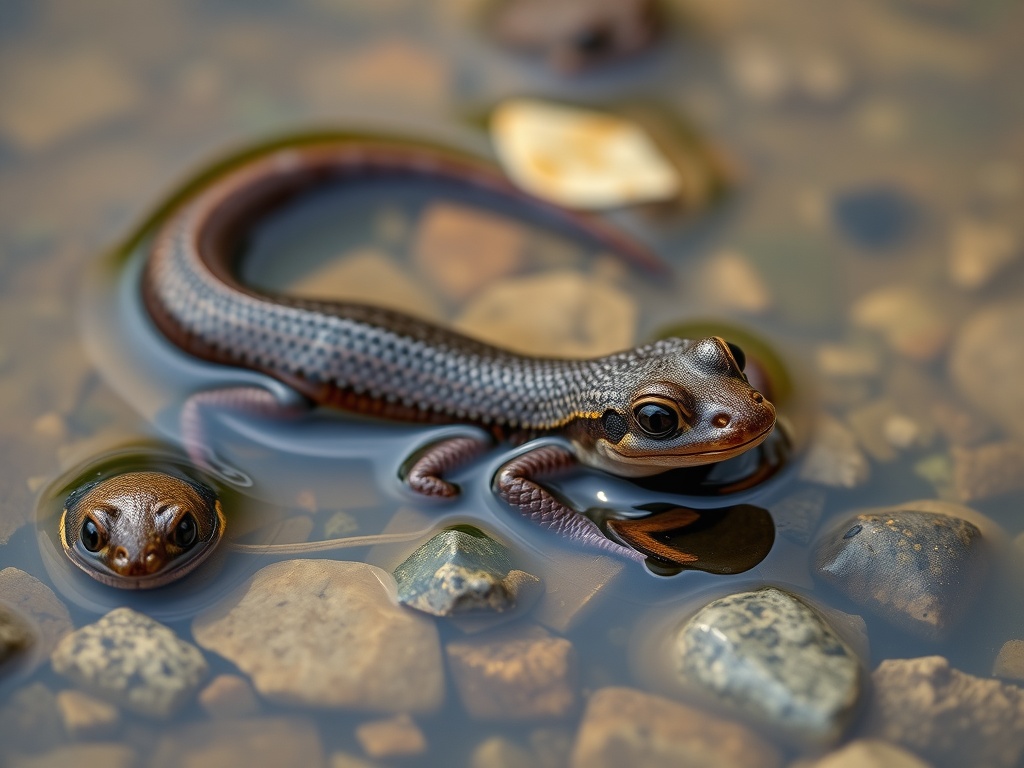
About the Anderson's Salamander
Anderson's Salamander is a critically endangered amphibian native to a single high-altitude lake, Lake Zacapu, in Michoacán, Mexico. It is a large, fully aquatic salamander characterized by its external feathery gills and robust, dark-colored body. Unlike many amphibians, Anderson's Salamander exhibits neoteny, meaning it retains larval features such as gills throughout its life and does not metamorphose into a terrestrial form. The species is adapted to cold, clear freshwater environments and is highly sensitive to habitat degradation. Due to its restricted range and specialized habitat requirements, Anderson's Salamander is extremely vulnerable to environmental changes.
Fascinating facts
Always Aquatic
Anderson's Salamander never leaves the water, spending its entire life in the aquatic environment of Lake Zacapu.
Permanent Gills
Unlike most salamanders that lose their gills as adults, Anderson's Salamander retains its external, feathery gills for life.
Regeneration Experts
They can regenerate entire limbs and even parts of their organs, making them important for scientific research in regenerative medicine.
Detailed description
Anderson's salamander (Ambystoma andersoni) is a large, fully aquatic neotenic salamander endemic to the Zacapu Lagoon in Michoacán, Mexico, at an elevation of approximately 2,000 meters above sea level. Adults typically reach lengths of 18–27 cm, with robust, laterally compressed bodies and broad, flattened heads. Their skin is smooth and darkly pigmented, often ranging from brown to grayish-black, with lighter ventral surfaces. The most distinctive anatomical feature is the presence of three pairs of prominent, feathery external gills, which are bright red to pink due to rich vascularization and are used for aquatic respiration. Unlike most amphibians, Anderson's salamander retains these larval characteristics throughout life, a phenomenon known as neoteny, and never undergoes full metamorphosis to a terrestrial form. The limbs are well-developed, with four digits on the forelimbs and five on the hindlimbs, adapted for swimming and maneuvering among submerged vegetation. The tail is laterally compressed and finned, aiding in propulsion. Vision is well-developed for detecting prey and predators in the dim, vegetated waters of the lagoon. The species is primarily nocturnal, spending daylight hours concealed among aquatic plants or under debris. Anderson's salamander is solitary outside of the breeding season, displaying limited social interaction except during courtship or competition for resources.
Did you know?
Anderson's Salamander is found only in a single lake in the world, making it one of the most geographically restricted amphibians.
Research & sources
Wikipedia summary
Anderson's salamander is a neotenic salamander from Zacapu Lagoon in the Mexican state of Michoacán.
Behaviour & social structure
Anderson's salamander is a predominantly nocturnal predator, emerging at dusk to forage for a variety of aquatic invertebrates, including insect larvae, worms, crustaceans, and small mollusks. Larger individuals may also consume small fish, tadpoles, or even conspecific larvae. They employ a sit-and-wait hunting strategy, remaining motionless among submerged vegetation before lunging at passing prey with rapid suction feeding. Social interactions are minimal, with individuals maintaining territories or preferred hiding spots. During the breeding season, males may become more active and occasionally aggressive in pursuit of mates. Daily routines involve alternating periods of rest and foraging, with activity levels influenced by water temperature and oxygen availability. The species is sensitive to disturbances and will retreat quickly if threatened.
Reproduction & life cycle
Breeding occurs primarily from late winter to early spring, coinciding with optimal water conditions in the lagoon. Courtship involves complex tactile and chemical signaling, with males depositing spermatophores (packets of sperm) on submerged substrates. Females pick up these spermatophores with their cloaca to fertilize their eggs internally. Females lay clutches of 100–300 eggs, attaching them individually or in small groups to aquatic plants or debris. Embryonic development is entirely aquatic, with eggs hatching after 2–3 weeks depending on water temperature. There is no parental care post-oviposition; larvae are independent from hatching. The neotenic nature of the species means that individuals reach sexual maturity while retaining larval features, typically at 1–2 years of age.
Adaptations & survival
Anderson's salamander exhibits several key adaptations for its fully aquatic, high-altitude environment. Neoteny allows it to remain in water throughout life, avoiding the need for terrestrial migration. The large, feathery external gills maximize oxygen uptake in the often cool, oxygen-rich waters of Zacapu Lagoon. Its cryptic coloration provides camouflage among submerged vegetation and detritus. The lateral line system, a sensory adaptation, helps detect water movements and prey in low-visibility conditions. Behavioral adaptations include nocturnal activity patterns to avoid diurnal predators and temperature extremes. The species can tolerate a range of water temperatures but is highly sensitive to pollution and changes in water chemistry.
Cultural significance
While Anderson's salamander does not have the deep-rooted cultural significance of the more famous axolotl (Ambystoma mexicanum), it is occasionally referenced in local environmental education campaigns as a symbol of the unique biodiversity of Michoacán's highland lakes. There are no known traditional uses or significant roles in indigenous mythology. However, the species has become a focal point for regional conservation efforts and is increasingly recognized as an indicator of freshwater ecosystem health.
Recent research
Recent research on Anderson's salamander has focused on its genetic diversity, population structure, and the effects of habitat fragmentation. Studies have highlighted the species' low genetic variability, likely due to its isolated and small population, raising concerns about inbreeding and reduced adaptive potential. Ongoing research includes captive breeding and reintroduction trials, as well as ecological monitoring of the Zacapu Lagoon. Comparative studies with other neotenic Ambystoma species, such as the axolotl, are providing insights into the genetic and environmental factors underlying neoteny and regeneration. Conservation biologists are also investigating the impacts of invasive species and water quality changes on larval survival and recruitment.
Videos
Habitat
High-altitude freshwater lakes

Conservation
The Anderson's Salamander is currently classified as Critically Endangered on the IUCN Red List.
Threats & challenges
Anderson's salamander faces severe threats due to its extremely restricted range and specialized habitat requirements. Major challenges include habitat degradation from agricultural runoff, pollution, water extraction, and the introduction of invasive species such as predatory fish and crayfish. Urbanization and land-use changes around Zacapu Lagoon have further reduced water quality and available habitat. Over-collection for the pet trade and scientific research has also contributed to population declines. The species is listed as Critically Endangered by the IUCN, with an estimated population of fewer than 1,000 mature individuals and a continuing downward trend. Conservation efforts are hampered by limited resources, lack of public awareness, and the complexity of restoring and protecting the lagoon ecosystem.
Taxonomy
Scientific name
Ambystoma andersoni
- Kingdom
- Animalia
- Phylum
- Chordata
- Class
- Amphibia
- Order
- Urodela
- Family
- Ambystomatidae
- Genus
- Ambystoma
- Species
- andersoni
Community notes
Share your observations about the Anderson's Salamander.
No community notes yet. Be the first!
Discover more wildlife
More fascinating animals from the encyclopedia.