
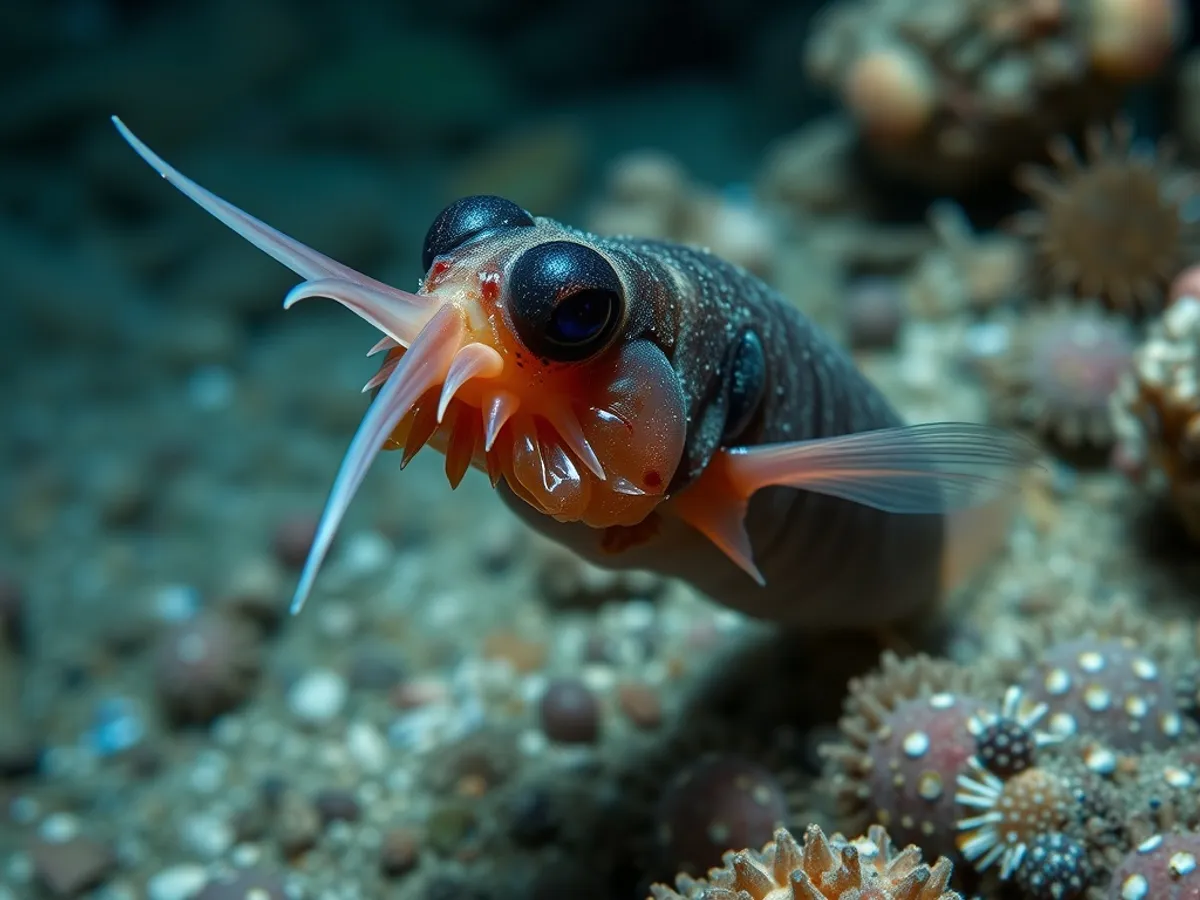
About the Deep-sea Anglerfish Larva
The deep-sea anglerfish is famous for the glowing lure suspended above its jaws, and the light is not its own. The bulb at the tip of that modified fin spine houses a colony of bioluminescent bacteria, which the fish farms — supplying nutrients in exchange for light it can twitch and wave in absolute blackness to draw prey within reach of an enormous hinged mouth and a stomach capable of stretching around something larger than itself. In a place where a meal may not arrive for months, that gape is the entire strategy. Stranger still is what becomes of the males. In many species the male is a fraction of the female's size, has no lure, and exists only to find her by scent — after which he bites onto her body and fuses with it, tissues and bloodstreams merging until he is little more than a permanent sperm sac drawing nourishment from her. For that graft to be possible at all, the anglerfish lineage has dismantled parts of its adaptive immune system, which would otherwise reject him — a trade-off that immunologists are still trying to understand.
Fascinating facts
Surface Dwellers
Unlike adult deep-sea anglerfish, the larvae live in upper ocean layers and only descend to the deep sea after metamorphosis.
Tiny and Transparent
Larval anglerfish are nearly transparent and extremely small, making them very difficult to observe in the wild.
Metamorphosis Masters
They undergo one of the most dramatic transformations in the animal kingdom, developing complex features like bioluminescent lures and massive jaws.
Detailed description
Deep-sea anglerfish larvae, especially those of Melanocetus johnsonii and related species, are remarkable for their stark differences from adult forms. Measuring typically between 4 to 10 mm at hatching, these larvae are nearly transparent, with delicate, gelatinous bodies that enhance buoyancy and reduce visibility to predators in the upper pelagic zone. Their heads are disproportionately large, housing well-developed eyes suited for detecting faint light in the open ocean. Unlike adults, larval anglerfish lack the bioluminescent esca (lure) and the pronounced jaws; instead, they possess relatively small, underdeveloped mouths and simple, conical teeth. Many species exhibit elongated fin rays or filaments, which are hypothesized to aid in flotation and possibly in detecting water movement. The larvae are solitary and exhibit minimal social interaction, drifting with ocean currents and feeding opportunistically on copepods, small crustaceans, and zooplankton. As they grow, they undergo a dramatic metamorphosis: their bodies become more robust, pigmentation develops, and the characteristic lure and large jaws of the adult form begin to emerge. This transformation is accompanied by a descent into the mesopelagic and bathypelagic zones, where adults reside at depths of 1,000 to 2,000 meters. The larval stage is critical for dispersal, allowing wide distribution before settling into the deep-sea environment. Their early life history remains poorly documented due to the challenges of sampling in the open ocean, but recent advances in deep-sea trawling and molecular identification have shed new light on their ecology.
Did you know?
Male anglerfish larvae never develop the bioluminescent lure and, as adults, become tiny parasites permanently attached to females.
Research & sources
Behaviour & social structure
Larval deep-sea anglerfish are primarily passive drifters, relying on oceanic currents for dispersal. They exhibit diel vertical migration, ascending to shallower waters at night to feed and descending during the day to avoid visual predators. Feeding is opportunistic; they capture small zooplankton using rapid mouth opening and suction feeding, facilitated by their flexible jaws. Unlike adults, larvae do not exhibit predatory ambush behavior or use bioluminescence for prey attraction. Social interactions are minimal; larvae are solitary and do not form schools or aggregations. Their activity levels are generally low, conserving energy in the nutrient-sparse pelagic environment. As they approach metamorphosis, behavioral changes may include increased vertical movement and a shift in diet as their morphology changes.
Reproduction & life cycle
Reproduction in deep-sea anglerfish is highly specialized, but the larval stage follows external fertilization. Spawning is believed to occur in the deep sea, with females releasing buoyant, gelatinous egg masses that float toward the surface. These egg masses, sometimes exceeding several meters in length, provide protection and dispersal for the developing embryos. Incubation periods are not precisely known but are estimated to last several days to weeks, depending on temperature and species. Upon hatching, larvae immediately ascend to the upper pelagic zone. There is no parental care; survival depends on rapid growth and dispersal. Sexual dimorphism and the extreme parasitic mating seen in adults (where tiny males fuse with females) are not present in larvae; these characteristics develop later during metamorphosis.
Adaptations & survival
Larval anglerfish have evolved several adaptations for survival in the open ocean. Their transparency and gelatinous tissues provide camouflage from both predators and prey. Elongated fin rays and body filaments increase surface area, enhancing buoyancy and possibly serving as sensory structures. The large eyes maximize light capture in dimly lit waters, while their flexible jaws allow them to exploit a variety of small prey. The ability to undergo dramatic metamorphosis enables larvae to exploit different ecological niches during their life cycle, reducing competition with adults. The production of buoyant egg masses ensures wide dispersal and reduces predation risk during early development.
Cultural significance
Deep-sea anglerfish, including their larvae, have limited direct cultural significance due to their inaccessibility and cryptic nature. However, adult anglerfish have inspired fascination and fear in popular culture, often depicted as monstrous denizens of the deep in literature, film, and art. The unusual life cycle and extreme sexual dimorphism of anglerfish have been subjects of scientific curiosity and public intrigue. In some cultures, anglerfish are referenced in folklore as symbols of mystery or the unknown depths of the ocean.
Recent research
Recent research has focused on larval identification using DNA barcoding, revealing previously unrecognized diversity among deep-sea anglerfish species. Advances in pelagic trawling and in situ imaging have improved understanding of larval distribution, morphology, and development. Notably, a 2020 study using environmental DNA (eDNA) sampling demonstrated the presence of anglerfish larvae in unexpected oceanic regions, suggesting broader dispersal than previously thought. Ongoing research aims to elucidate the genetic mechanisms underlying their dramatic metamorphosis and the evolution of their unique reproductive strategies. The challenges of sampling and observing these larvae in situ remain significant, but technological innovations continue to expand knowledge of their early life history.
Sources
Larval Development and Distribution of Deep-Sea Anglerfishes (Lophiiformes: Ceratioidei)
Pietsch, T.W. & Sutton, T.T. (2015)
scientificLarval Development and Metamorphosis in Deep-sea Anglerfishes (Lophiiformes: Ceratioidei)
Pietsch, T.W. & Sutton, T.T. (2015)
scientificIdentification and Distribution of Deep-sea Anglerfish Larvae (Lophiiformes: Ceratioidei) in the Atlantic Ocean
Moser, H.G. et al. (2016)
scientificVideos
Habitat
Open ocean (pelagic zone, upper layers)

Conservation
The Deep-sea Anglerfish Larva is currently classified as Least Concern on the IUCN Red List.
Threats & challenges
Larval deep-sea anglerfish face natural threats from predation by larger pelagic fish, jellyfish, and other zooplanktivores. Environmental changes such as ocean warming, acidification, and altered current patterns may impact larval survival and dispersal. Human impacts are currently minimal due to the remoteness of their habitat, but deep-sea fishing, pollution, and climate change pose potential future risks. Population trends are not well documented, but the species is currently listed as Least Concern, largely due to its wide distribution and deep-sea habitat, which offers some protection from direct human exploitation.
Taxonomy
Scientific name
Melanocetus johnsonii
- Kingdom
- Animalia
- Phylum
- Chordata
- Class
- Actinopterygii
- Order
- Lophiiformes
- Family
- Melanocetidae
- Genus
- Melanocetus
- Species
- johnsonii
Community notes
Share your observations about the Deep-sea Anglerfish Larva.
No community notes yet. Be the first!
Discover more wildlife
More fascinating animals from the encyclopedia.