
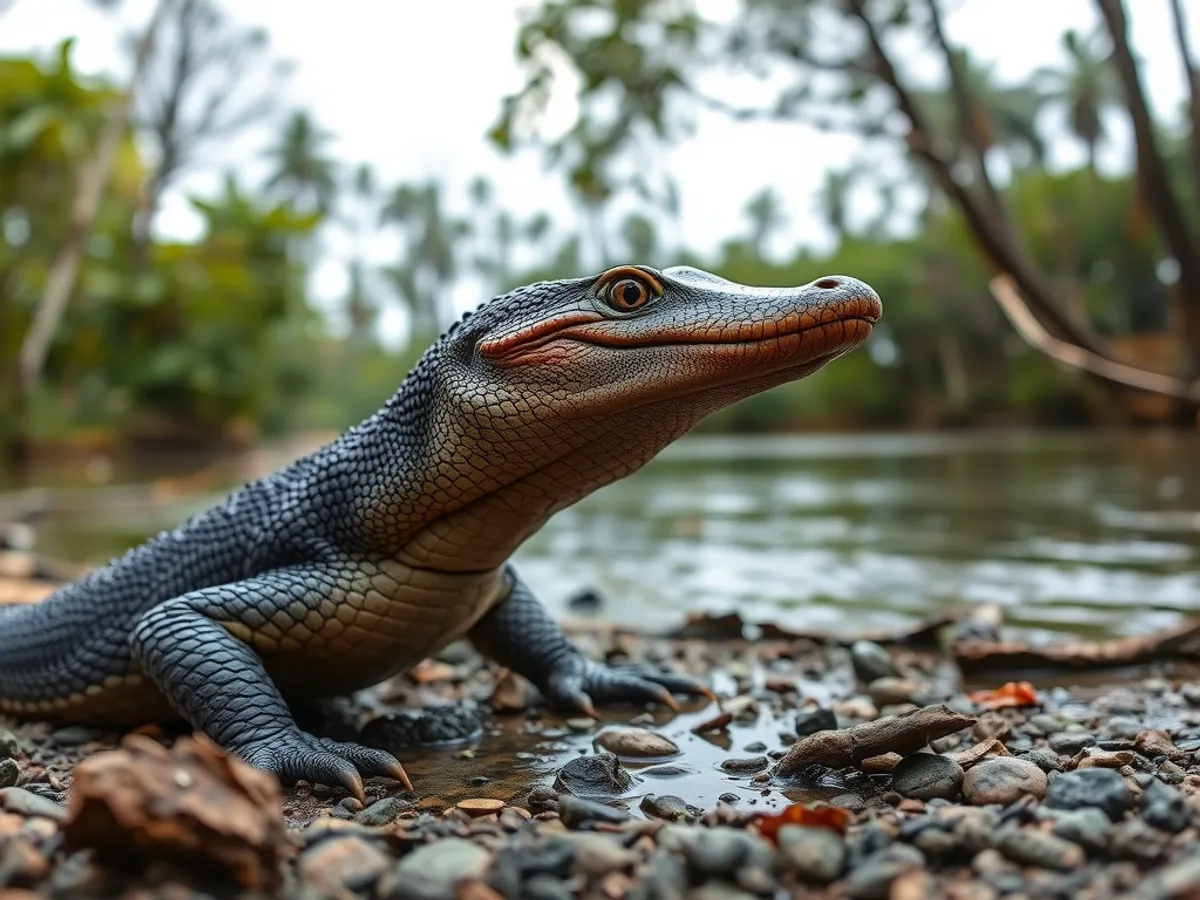
About the Asian Water Monitor
The Asian water monitor is the second-heaviest lizard alive, behind only the Komodo dragon, and it is one of the very few big reptiles that has done well out of human cities. It swims powerfully with a laterally flattened tail, can stay submerged for half an hour, climbs, runs, and is entirely comfortable scavenging — which is why the canals and parks of Bangkok, including Lumphini Park in the centre of the city, hold a substantial urban population living on rubbish, fish and carrion. It hunts with a deeply forked tongue feeding a Jacobson's organ, following scent trails, and it will dig up crocodile and turtle nests for eggs. Monitors turn out to have a lung anatomy nobody expected: airflow through the lung is largely unidirectional, looping in a one-way circuit like a bird's rather than tidally in and out like a mammal's, which suggests this efficient design long predates birds. Monitors also possess venom glands, though for a water monitor the real danger of a bite is mechanical damage and infection, not toxin.
Fascinating facts
Aquatic Expert
Asian Water Monitors are superb swimmers and can cross large rivers and even coastal waters to reach new habitats.
Egg Eater
Their diet includes eggs, fish, birds, small mammals, carrion, and even other reptiles, making them opportunistic carnivores.
Impressive Size
They are the second-largest lizard species in the world, capable of reaching over 3 meters (10 feet) in length.
Detailed description
The Asian Water Monitor (Varanus salvator) is a robust, semi-aquatic lizard that can reach lengths of up to 3 meters (9.8 feet), though most adults average between 1.5 and 2 meters. Weighing up to 50 kg (110 lbs) in rare cases, it is the second-largest lizard species after the Komodo dragon. Its body is streamlined with powerful limbs, sharp claws, and a long, muscular tail that is laterally compressed, aiding in swimming and defense. The skin is covered with small, keeled scales, typically dark brown or black with yellowish spots or bands, providing camouflage in dappled light environments. The head is elongated with a forked tongue, similar to snakes, which it uses for chemoreception. Nostrils are positioned close to the snout tip, allowing it to breathe while mostly submerged. The species is highly adaptable, occupying a range of habitats from pristine mangroves and rainforests to urban canals and agricultural areas. Asian Water Monitors are primarily solitary, exhibiting territorial behavior, especially among males. They are opportunistic carnivores, feeding on a wide variety of prey, and are known for their intelligence and problem-solving abilities. Reproduction is oviparous, with females laying clutches of up to 40 eggs in decaying vegetation or termite mounds, which provide heat for incubation.
Did you know?
Despite their intimidating size, Asian Water Monitors are occasionally kept as exotic pets in some countries.
Research & sources
Behaviour & social structure
Asian Water Monitors are diurnal, being most active during the day, especially in the early morning and late afternoon. They are skilled swimmers, often seen basking on riverbanks or logs before slipping into water to escape threats or hunt. Their diet is highly varied and includes fish, amphibians, birds, eggs, small mammals, carrion, and even invertebrates such as crabs and snails. They are known to scavenge in urban environments, feeding on refuse and roadkill. Hunting strategies include both active pursuit and ambush, using their acute sense of smell and vision. Social interactions are generally limited to mating or territorial disputes, which can involve ritualized combat where individuals stand on hind legs and grapple. Juveniles are more arboreal and secretive, while adults are predominantly terrestrial and aquatic. They exhibit seasonal movements in response to water levels and food availability.
Reproduction & life cycle
Breeding occurs seasonally, often triggered by the onset of the rainy season, which varies by region but typically falls between May and August. Males engage in combat for access to receptive females. After mating, females lay between 10 and 40 eggs in concealed locations such as rotting logs, termite mounds, or leaf litter, where heat from decomposition aids incubation. The incubation period ranges from 6 to 9 months, depending on temperature and humidity. There is no parental care after egg-laying; hatchlings are independent from birth and must avoid predation by remaining hidden. Sexual maturity is reached at around 3 to 4 years of age, with growth rates influenced by food availability and environmental conditions.
Adaptations & survival
Asian Water Monitors possess several adaptations for their semi-aquatic lifestyle, including a laterally compressed tail for powerful swimming, nostrils positioned for surface breathing, and valvular nostrils that close underwater. Their forked tongue and highly developed Jacobson’s organ allow for precise chemical detection of prey and carrion. Strong limbs and sharp claws facilitate climbing, digging, and capturing prey. Their tough, water-resistant skin reduces desiccation and provides protection from predators and rough terrain. Behavioral flexibility, such as scavenging and exploiting human-altered environments, has enabled the species to thrive despite habitat changes. Their ability to regulate body temperature through basking and seeking shade allows them to remain active across a range of microhabitats.
Cultural significance
Asian Water Monitors hold varied significance across their range. In some Southeast Asian cultures, they are associated with omens or considered taboo, while in others, their meat and body parts are used in traditional medicine and cuisine. In Malaysia and Indonesia, the lizard is sometimes called 'biawak' and features in folklore as a cunning or dangerous creature. Their presence in urban environments has led to both fascination and fear, with local authorities sometimes called to remove large individuals from populated areas. They are occasionally kept as exotic pets, though their size and strength make them challenging to manage.
Recent research
Recent studies have focused on the species’ ecological role as both predator and scavenger, highlighting their importance in controlling pest populations and recycling carrion. Genetic research has revealed significant variation among regional populations, leading to the recognition of several subspecies and ongoing debate about species boundaries. Radio telemetry and camera trap studies have provided insights into their movement patterns, home range sizes, and habitat use in both natural and urban landscapes. Research into their cognitive abilities has demonstrated problem-solving skills and learning capacity, contributing to our understanding of reptilian intelligence. Conservation research is increasingly focused on the impacts of urbanization and climate change on their distribution and reproductive success.
Sources
Varanus salvator (Asian Water Monitor): Taxonomy, Ecology, and Conservation
Böhme, W. & Koch, A. (2021)
scientificVaranus salvator: The IUCN Red List of Threatened Species 2022
IUCN SSC Monitor Lizard Specialist Group
conservationVaranus salvator (Asian Water Monitor): Taxonomy, Natural History, and Conservation
Böhme, W. & Koch, A. (2010)
scientificVaranus salvator: The IUCN Red List of Threatened Species 2021
IUCN SSC Monitor Lizard Specialist Group
conservationVideos
Habitat
Tropical forests, wetlands, and riverbanks
 Tropical Regions
Rainforest
Dense, wet forests with the highest biodiversity on Earth, containing more than half of the world's plant and animal species.
 Global
Forest
Wooded areas with significant tree cover and diverse plant and animal communities.
 Global
Freshwater
Lakes, rivers, and wetlands with diverse aquatic ecosystems.
Conservation
The Asian Water Monitor is currently classified as Least Concern on the IUCN Red List.
Threats & challenges
Despite being classified as Least Concern by the IUCN, Asian Water Monitors face localized threats including habitat destruction, wetland drainage, pollution, and hunting for their skin, meat, and traditional medicine. The international pet trade also poses a risk, particularly to some subspecies. In some regions, populations are declining due to overexploitation and loss of suitable nesting sites. However, their adaptability to disturbed environments and urban areas has allowed them to persist where other large reptiles have disappeared. Conservation challenges include enforcing hunting regulations, protecting wetland habitats, and mitigating human-wildlife conflict, especially in rapidly urbanizing regions.
Taxonomy
Scientific name
Varanus salvator
- Kingdom
- Animalia
- Phylum
- Chordata
- Class
- Reptilia
- Order
- Squamata
- Family
- Varanidae
- Genus
- Varanus
- Species
- salvator
Where to see an asian water monitor
1 zoo and aquarium in 1 country are recorded as keeping this species.
Community notes
Share your observations about the Asian Water Monitor.
No community notes yet. Be the first!
Discover more wildlife
More fascinating animals from the encyclopedia.