
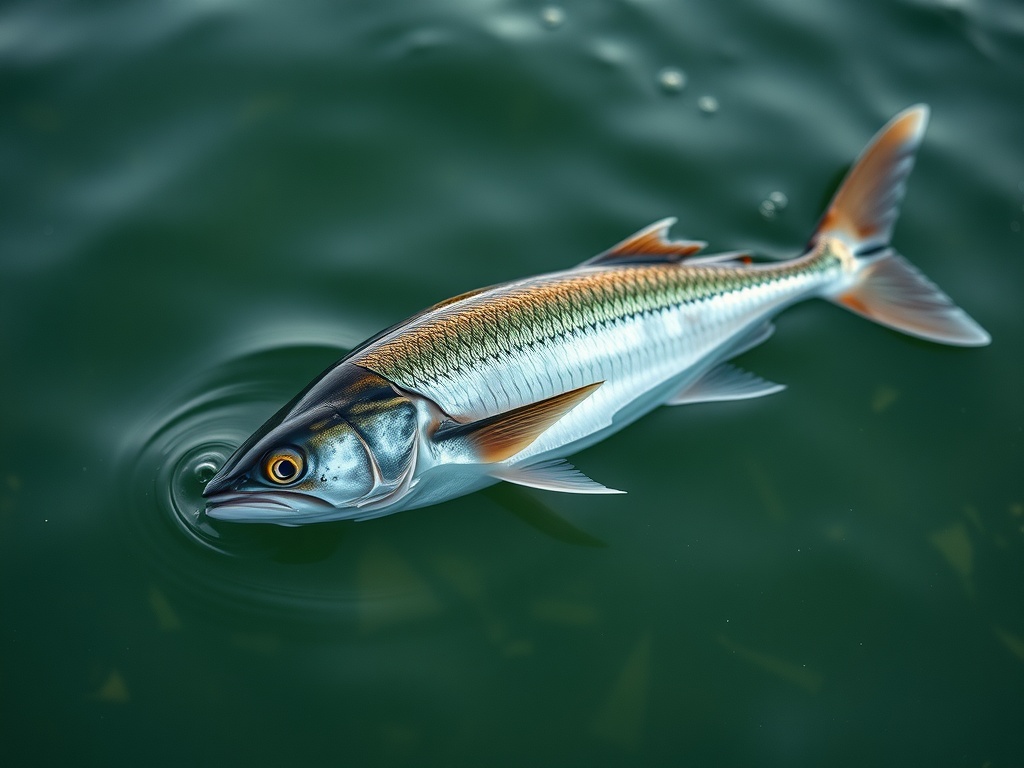
About the Atlantic herring
The Atlantic herring is a small, silvery fish found in the temperate waters of the North Atlantic Ocean. Known for forming enormous schools, these fish can number in the billions and play a crucial role in marine food webs. Atlantic herring are swift swimmers and feed primarily on plankton, using their finely spaced gill rakers to filter tiny prey from the water. They are an economically vital species, supporting large commercial fisheries for centuries. Their lifecycle includes spawning in coastal areas and migrating vast distances in search of food and suitable breeding grounds.
Fascinating facts
Schooling Behavior
Atlantic herring gather in immense schools, sometimes containing billions of individuals, which helps them evade predators and improve foraging efficiency.
Vital Food Source
These fish are a key prey species for a wide variety of marine animals, including whales, seabirds, and larger fish.
Mass Spawning
During spawning, Atlantic herring migrate to shallow coastal waters, where females deposit eggs on seaweed, gravel, or sand.
Detailed description
The Atlantic herring (Clupea harengus) is a streamlined, laterally compressed fish with a silvery body and a bluish-green dorsal surface, reaching lengths of up to 45 cm and weights of up to 1.1 kg, though most adults are typically 20–30 cm. Its body is covered in smooth, cycloid scales and lacks a lateral line, a trait common in clupeids. The mouth is terminal and equipped with fine gill rakers, which are highly specialized for filtering planktonic prey from the water column. Atlantic herring are renowned for their schooling behavior, forming some of the largest aggregations of any vertebrate, sometimes numbering in the billions. These schools provide both protection from predators and increased foraging efficiency. Herring are pelagic, inhabiting both coastal and offshore waters, and display diel vertical migrations, ascending to surface waters at night to feed. Their life cycle includes distinct spawning migrations, with adults moving to shallow, gravelly coastal areas to spawn. Eggs are adhesive and demersal, sticking to substrate until hatching. Juveniles undergo a pelagic larval stage before settling into adult habitats. Atlantic herring are a keystone species, serving as a crucial link between lower trophic levels (plankton) and higher predators such as cod, seabirds, and marine mammals. Their silvery coloration provides camouflage in open water, and their rapid, coordinated movements make them difficult targets for predators.
Did you know?
A single Atlantic herring female can lay up to 200,000 eggs in a single spawning season.
Research & sources
Wikipedia summary
Atlantic herring is a herring in the family Clupeidae. It is one of the most abundant fish species in the world. Atlantic herrings can be found on both sides of the northern Atlantic Ocean, congregating in large schools. They can grow up to 45 centimetres (18 in) in length and weigh up to 1.1 kilograms (2.4 lb). They feed on copepods, krill and small fish, while their natural predators are seals, whales, cod and other larger fish.
Behaviour & social structure
Atlantic herring are highly social, exhibiting complex schooling behavior that is both a defense mechanism and a foraging strategy. Schools can be tightly packed, with individuals maintaining precise spacing and synchronized swimming to reduce predation risk. Herring feed primarily at night, rising to the upper water column to exploit dense patches of zooplankton, especially copepods and euphausiids (krill). They use their fine gill rakers to efficiently filter small prey from the water. During the day, schools descend to deeper waters, likely as an anti-predator strategy. Herring display rapid escape responses when threatened, with the entire school capable of sudden, coordinated directional changes. Acoustic communication, including the production of 'fast repetitive ticks' (FRTs), has been documented and may play a role in maintaining school cohesion. Seasonal migrations are pronounced, with populations traveling hundreds of kilometers between feeding and spawning grounds.
Reproduction & life cycle
Atlantic herring are batch spawners, with reproduction typically occurring in spring or autumn, depending on the population. Spawning takes place in shallow, coastal waters over gravel or coarse sand substrates at depths of 10–40 meters. Females release between 20,000 and 40,000 eggs per spawning event, which are externally fertilized by males. The adhesive eggs stick to the substrate and hatch after 7–15 days, depending on water temperature (optimal range: 5–14°C). There is no parental care; larvae are planktonic and drift with currents, feeding on microplankton until they develop into juveniles. Sexual maturity is reached at 3–5 years of age, and individuals can live up to 20 years, though most are harvested earlier due to fishing pressure.
Adaptations & survival
Atlantic herring possess several notable adaptations: their laterally compressed, streamlined bodies minimize drag for efficient swimming in large schools. The silvery, reflective scales provide countershading camouflage, reducing visibility to both aerial and aquatic predators. Their highly developed lateral line system enables them to detect minute water movements, facilitating precise schooling and predator avoidance. The fine gill rakers are specialized for filter-feeding on small planktonic organisms. Herring also exhibit diel vertical migration, allowing them to exploit food resources while minimizing predation risk. Biochemically, they are capable of producing antifreeze proteins, which enable survival in cold northern waters.
Cultural significance
Atlantic herring has played a pivotal role in the cultural and economic history of northern Europe and North America. It has been a staple food source since prehistoric times, with evidence of herring fisheries dating back thousands of years. Herring was central to the Hanseatic League's trade in the Middle Ages and remains important in traditional cuisines, such as pickled herring in Scandinavia and the Netherlands. The fish features in folklore, art, and festivals, symbolizing abundance and prosperity. Herring fisheries have shaped coastal communities and continue to support livelihoods through commercial and artisanal fishing.
Recent research
Recent research on Atlantic herring has focused on population genetics, revealing distinct subpopulations with unique spawning times and locations, which has important implications for management. Studies using acoustic telemetry and satellite tagging have improved understanding of migration patterns and school structure. Investigations into herring communication have identified the use of sound for social cohesion. Climate change research is examining the impact of shifting oceanographic conditions on herring distribution and recruitment. Genomic studies have provided insights into adaptation to different thermal environments and resistance to disease.
Videos
Habitat
Coastal and open ocean waters of the North Atlantic

Conservation
The Atlantic herring is currently classified as Least Concern on the IUCN Red List.
Threats & challenges
While the Atlantic herring remains abundant and is listed as Least Concern by the IUCN, it faces several threats. Overfishing has historically led to population collapses in some regions, prompting the implementation of strict quotas and management measures. Bycatch, habitat degradation (especially of spawning grounds), and climate change-induced shifts in ocean temperature and plankton availability pose ongoing challenges. Ocean acidification may also impact egg and larval development. Population trends are closely monitored, with some stocks showing signs of recovery while others remain depleted. Effective management is critical to prevent overexploitation and ensure long-term sustainability.
Taxonomy
Scientific name
Clupea harengus
- Kingdom
- Animalia
- Phylum
- Chordata
- Class
- Actinopterygii
- Order
- Clupeiformes
- Family
- Clupeidae
- Genus
- Clupea
- Species
- harengus
Community notes
Share your observations about the Atlantic herring.
No community notes yet. Be the first!
Discover more wildlife
More fascinating animals from the encyclopedia.