
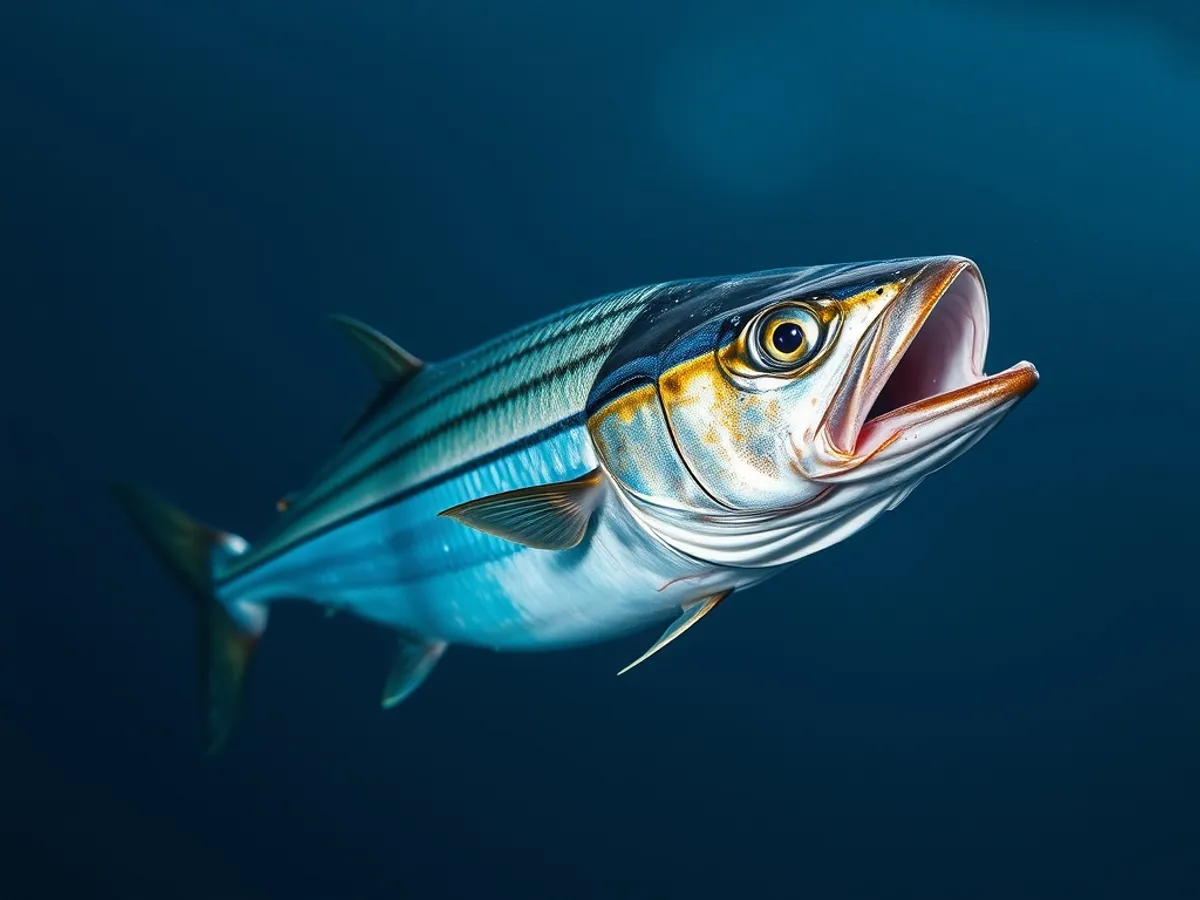
About the Atlantic mackerel
The Atlantic mackerel is a sleek, fast-swimming fish known for its iridescent blue-green back marked with wavy black lines and silvery flanks. Found in large schools, this species inhabits the temperate waters of the North Atlantic Ocean, migrating seasonally in search of food and spawning grounds. Atlantic mackerel are important both ecologically, as a prey species for larger predators, and economically, as a popular target for commercial and recreational fisheries. Their streamlined bodies and forked tails make them powerful swimmers, capable of quick bursts of speed.
Fascinating facts
Schooling Behavior
Atlantic mackerel form large, dense schools that can stretch for miles, providing safety in numbers from predators.
Migratory Fish
They undertake long migrations, moving north during warmer months and south during colder months to follow food sources and spawning conditions.
Agile Swimmers
Their streamlined bodies and absence of a swim bladder make them exceptionally agile and fast, capable of avoiding many ocean predators.
Detailed description
The Atlantic mackerel (Scomber scombrus) is a medium-sized pelagic fish, typically reaching lengths of 30–40 cm, with maximum reported lengths up to 60 cm and weights around 1.5 kg. Its body is fusiform and highly streamlined, adapted for sustained, rapid swimming, with a pointed snout and large eyes suited for detecting prey in open water. The dorsal surface is an iridescent blue-green, adorned with 20–30 wavy black stripes, while the ventral side is silvery white, providing countershading for camouflage. The species lacks a swim bladder, which reduces buoyancy and allows for rapid vertical movement. Atlantic mackerel possess two widely separated dorsal fins and a series of small finlets behind both the dorsal and anal fins, features typical of fast-swimming scombrids. Their gill rakers are well-developed, enabling efficient filtration of small prey from the water. Social by nature, they form large, dense schools that can number in the hundreds of thousands, which aids in predator avoidance and foraging efficiency. The species is highly migratory, undertaking extensive seasonal movements between spawning, feeding, and overwintering grounds. Atlantic mackerel play a key ecological role as both predator and prey, feeding on zooplankton and small fish, while serving as an important food source for marine mammals, seabirds, and larger fish.
Did you know?
Atlantic mackerel have specialized muscles that allow them to keep swimming continuously, even while sleeping.
Research & sources
Wikipedia summary
The Atlantic mackerel, also known as Boston mackerel, Norwegian mackerel, Scottish mackerel or just mackerel, is a species of mackerel found in the temperate waters of the Mediterranean Sea, the Black Sea, and the northern Atlantic Ocean, where it is extremely common and occurs in huge shoals in the epipelagic zone down to about 200 m (660 ft). It spends the warmer months close to shore and near the ocean surface, appearing along the coast in spring and departing with the arrival of colder weather in the fall and winter months. During the fall and winter, it migrates out into deeper and more southern water, seeking warmer temperatures.
Behaviour & social structure
Atlantic mackerel exhibit pronounced schooling behavior, maintaining tight, coordinated groups that enhance hydrodynamic efficiency and reduce individual predation risk. These schools are often size-structured, with individuals of similar age and size grouping together. Mackerel are diurnal, remaining near the surface during daylight hours to feed and descending to deeper waters at night. Their feeding strategy involves filter-feeding on copepods, euphausiids, and other zooplankton, as well as active pursuit of small fish and crustaceans. They use rapid, synchronized swimming to herd prey into dense aggregations, making capture more efficient. During migration, schools can travel hundreds of kilometers, guided by changes in water temperature, salinity, and food availability. Atlantic mackerel are known for their agility and speed, capable of short bursts exceeding 5.5 m/s (20 km/h) to evade predators or capture prey. Social interactions are generally peaceful within schools, but competition for food can become intense during periods of scarcity.
Reproduction & life cycle
Spawning occurs in large aggregations from late spring to early summer, varying with latitude (April–June in the southern range, May–July in the north). Females are highly fecund, releasing between 200,000 and 450,000 pelagic eggs per season in multiple batches. Fertilization is external, with both sexes releasing gametes into the water column. Eggs are buoyant and hatch within 4–7 days, depending on water temperature. Larvae are planktonic, feeding initially on microzooplankton before transitioning to larger prey as they grow. There is no parental care; survival of offspring is dependent on environmental conditions and food availability. Juveniles form schools soon after metamorphosis, remaining in nursery areas until they reach maturity at 2–3 years of age. Spawning grounds are typically located in offshore waters with temperatures between 9–13°C and salinities above 34 ppt.
Adaptations & survival
Atlantic mackerel exhibit several adaptations for pelagic life. Their streamlined bodies and deeply forked tails reduce drag and maximize swimming speed, essential for both migration and predator evasion. The absence of a swim bladder allows rapid vertical movement and prevents barotrauma during sudden depth changes. Well-developed gill rakers enable efficient filter-feeding on small planktonic organisms. Countershading provides camouflage from both aerial and aquatic predators. Their schooling behavior is a key evolutionary adaptation, reducing individual predation risk and increasing foraging success. Physiologically, they possess high concentrations of red muscle fibers, supporting sustained, aerobic swimming. Their lateral line system is highly sensitive, allowing detection of vibrations and movement in the water, which is crucial for maintaining school cohesion and detecting prey or predators.
Cultural significance
Atlantic mackerel have long been valued in human culture, particularly in Europe and North America, where they are a staple in traditional diets. They feature prominently in coastal cuisines, often smoked, salted, or canned, and are celebrated in local festivals (e.g., the Mackerel Festival in Norway). Historically, mackerel fisheries supported coastal economies and shaped settlement patterns. The fish appears in folklore and proverbs, symbolizing abundance and the bounty of the sea. In art and literature, mackerel have been depicted as icons of the changing seasons and the rhythms of nature. Recreational angling for mackerel is popular, especially during seasonal runs, and the species is sometimes used as bait for larger game fish.
Recent research
Recent research has focused on the effects of ocean warming and acidification on mackerel distribution, physiology, and spawning success. Genetic studies have revealed subtle population structuring across the Atlantic, challenging earlier assumptions of panmixia and informing management units. Advances in electronic tagging have provided new insights into migration routes, depth preferences, and habitat use. Studies on trophic ecology highlight the species' role in transferring energy from lower to higher trophic levels. Ongoing monitoring programs track stock health and recruitment, with particular attention to the impacts of fishing pressure and environmental variability. There is also growing interest in the potential impacts of microplastics and contaminants on mackerel health and food safety.
Sources
ICES Advice on Atlantic mackerel (Scomber scombrus) in the Northeast Atlantic
International Council for the Exploration of the Sea (ICES)
conservationPopulation structure and connectivity of Atlantic mackerel (Scomber scombrus) across the North Atlantic
Nielsen, E.E., et al. (2012)
scientificVideos
Habitat
Temperate coastal and open ocean waters

Conservation
The Atlantic mackerel is currently classified as Least Concern on the IUCN Red List.
Threats & challenges
While currently listed as Least Concern by the IUCN, Atlantic mackerel face several challenges. Overfishing, particularly in the Northeast Atlantic, has led to localized stock declines and concerns over long-term sustainability. Climate change is altering sea temperatures and plankton distributions, potentially impacting spawning success and larval survival. Bycatch in other fisheries and habitat degradation from coastal development also pose threats. Disease outbreaks, such as viral hemorrhagic septicemia, have been reported but are not currently a major concern. International management efforts, including quotas and seasonal closures, aim to prevent overexploitation, but enforcement and compliance remain variable. Population trends are closely monitored, with some regional stocks showing signs of recovery while others remain depleted.
Taxonomy
Scientific name
Scomber scombrus
- Kingdom
- Animalia
- Phylum
- Chordata
- Class
- Actinopterygii
- Order
- Scombriformes
- Family
- Scombridae
- Genus
- Scomber
- Species
- scombrus
Community notes
Share your observations about the Atlantic mackerel.
No community notes yet. Be the first!
Discover more wildlife
More fascinating animals from the encyclopedia.