
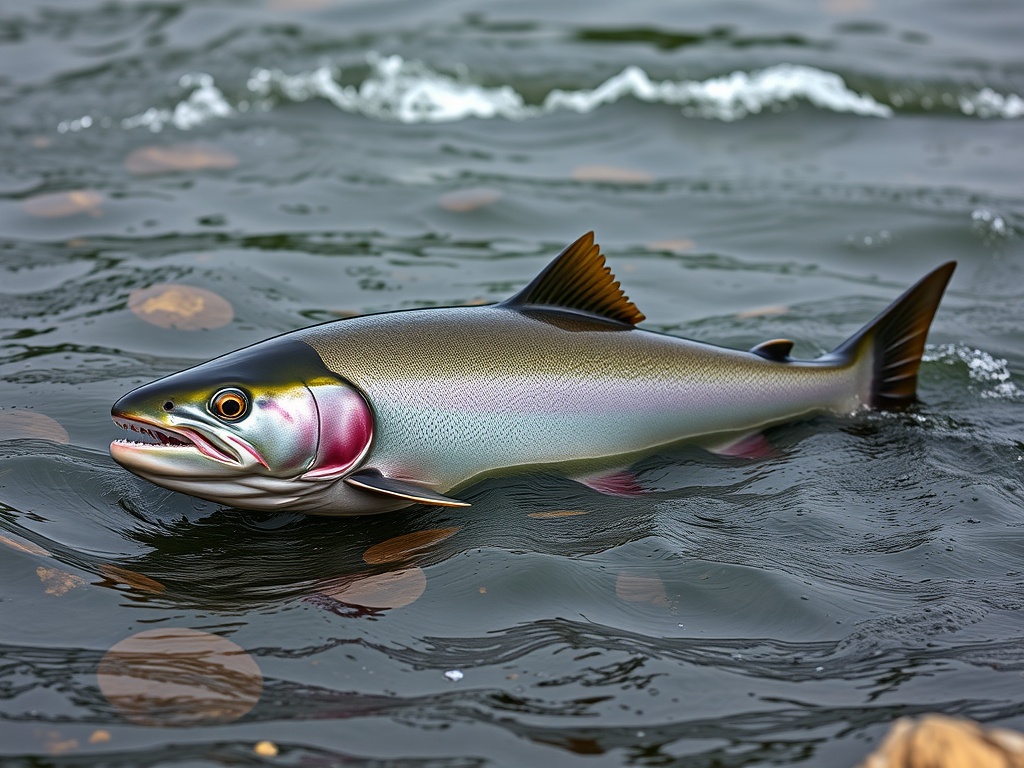
Atlantic salmon
Salmo salar
About the Atlantic salmon
Atlantic salmon breaks the rule everyone learns from Pacific salmon: it does not have to die after spawning. A spent fish, called a kelt, can drop back to sea, feed, recondition and return to spawn again, and repeat spawners — usually large females — are disproportionately valuable to a population. The migration involves a full physiological rebuild. A parr living in fresh water turns into a smolt: it silvers, its gill cells switch from retaining salt to excreting it, its kidneys change function, and its behaviour flips from territorial to schooling, all within weeks. It finds its way home with what appears to be a magnetic map for the ocean crossing, then switches to olfaction, homing on the specific chemical signature of the stream it was imprinted on as a juvenile. Small male parr that never went to sea at all can sneak into a redd and fertilise eggs while a large sea-run male is fighting off rivals — and in some rivers those tiny males fertilise a serious share of the eggs.
Fascinating facts
Incredible Migrators
Atlantic salmon are anadromous, meaning they hatch in freshwater, migrate to the ocean to grow, and return to their natal rivers to spawn.
Leaping Ability
They are powerful jumpers, often clearing obstacles over 3 meters high during their upstream migration to spawning grounds.
Repeat Spawners
Unlike Pacific salmon, some Atlantic salmon can survive spawning and return to the sea, sometimes repeating the migration and spawning process multiple times.
Detailed description
The Atlantic salmon (Salmo salar) is a robust, streamlined fish characterized by a silvery body with a slightly bluish or greenish back and scattered black spots above the lateral line, including on the gill covers. Adults typically measure 71–76 cm in length, with exceptional individuals reaching up to 150 cm and weighing over 30 kg, though most are smaller. Juveniles, called parr, display vertical dark bars and red spots, which fade as they mature into silvery smolts for their seaward migration. The species exhibits pronounced sexual dimorphism during spawning, with males developing a hooked lower jaw (kype) and brighter coloration. Atlantic salmon are renowned for their powerful swimming and leaping abilities, enabling them to ascend waterfalls and rapids during upstream migrations. Their life cycle is complex and anadromous: eggs are laid in gravel nests (redds) in freshwater streams, and after hatching, the young remain in freshwater for 1–3 years before migrating to the ocean. At sea, they undergo rapid growth, feeding on fish and invertebrates, and return to their natal rivers to spawn, often navigating thousands of kilometers. Unlike most Pacific salmon, Atlantic salmon may survive spawning and return to the sea, sometimes spawning multiple times (iteroparity). Their physiology is finely tuned for osmoregulation, allowing them to transition between freshwater and saltwater environments. Socially, they are generally solitary outside of spawning aggregations, but juveniles may form loose schools.
Did you know?
Atlantic salmon undergo dramatic physical changes, called smoltification, to adapt from freshwater to saltwater environments.
Research & sources
Wikipedia summary
The Atlantic salmon is a species of ray-finned fish in the family Salmonidae. It is the third largest of the Salmonidae, behind Siberian taimen and Pacific Chinook salmon, growing up to a meter in length. Atlantic salmon are found in the northern Atlantic Ocean and in rivers that flow into it. Most populations are anadromous, hatching in streams and rivers but moving out to sea as they grow where they mature, after which the adults seasonally move upstream again to spawn.
Behaviour & social structure
Atlantic salmon exhibit a range of behaviors adapted to their migratory lifestyle. Juveniles (parr) are territorial, defending feeding areas against conspecifics, while smolts form schools during their downstream migration to the sea. At sea, adults are largely solitary, dispersing widely across the North Atlantic to exploit rich feeding grounds. Their diet shifts from aquatic insects and crustaceans in freshwater to fish (such as capelin, sand lance, and herring), squid, and larger crustaceans in marine environments. Feeding is typically crepuscular, with peak activity at dawn and dusk. During upstream migration, feeding ceases, and energy is devoted to navigation and reproduction. Homing behavior is highly developed; salmon use olfactory cues to locate their natal streams, and geomagnetic navigation may guide their oceanic journeys. Aggressive interactions are common during spawning, with males competing for access to females and optimal nesting sites. Rest periods are interspersed with bursts of activity, especially during migration.
Reproduction & life cycle
Spawning occurs in autumn, typically from October to December, when water temperatures range from 4–10°C. Females excavate gravel nests (redds) using vigorous tail movements, depositing 3,000–20,000 eggs depending on size. Males fertilize the eggs externally, and multiple males may compete for a single female. Incubation lasts 2–6 months, influenced by temperature, after which alevins emerge and remain in the gravel, subsisting on yolk sacs. Fry then emerge to feed actively in the stream. Juveniles (parr) undergo a period of freshwater residency (1–3 years, sometimes longer in colder climates) before smoltification, a physiological transformation preparing them for saltwater. Unlike Pacific salmon, Atlantic salmon can survive spawning; some individuals (kelts) return to the sea and may spawn in subsequent years, though survival rates are low (typically 5–10%). Parental care is absent after egg deposition.
Adaptations & survival
Atlantic salmon possess a suite of adaptations for anadromous migration and survival in variable environments. Their streamlined body and powerful musculature facilitate long-distance swimming and leaping. Specialized gill structures and hormonal changes enable efficient osmoregulation during transitions between freshwater and marine habitats. Smoltification involves morphological, physiological, and behavioral changes, including increased silvering, altered body shape, and changes in ion transport proteins. Homing is facilitated by an acute sense of smell, allowing adults to detect unique chemical signatures of their natal streams. During upstream migration, metabolic reserves are mobilized to sustain prolonged fasting. The kype in males is used in intraspecific combat during spawning. Eggs are deposited in well-oxygenated gravel beds, reducing predation and increasing survival.
Cultural significance
Atlantic salmon have held profound cultural, economic, and symbolic importance for millennia. They are featured in Celtic and Norse mythology, often representing wisdom, transformation, and perseverance (e.g., the 'Salmon of Knowledge' in Irish legend). Indigenous peoples of the North Atlantic have relied on salmon as a staple food and spiritual symbol. In modern times, Atlantic salmon support valuable commercial, recreational, and subsistence fisheries, and are a flagship species for river conservation. The species is celebrated in art, literature, and cuisine, and is central to the identity of many communities in Scotland, Norway, Canada, and New England. Salmon festivals and conservation campaigns highlight their enduring legacy.
Recent research
Recent research has focused on the genetic structure of Atlantic salmon populations, revealing distinct evolutionary lineages and the importance of maintaining genetic diversity for resilience. Advances in telemetry and satellite tagging have elucidated oceanic migration routes, revealing trans-Atlantic movements and critical feeding areas. Studies on the impact of climate change indicate shifts in migration timing and reduced marine survival linked to ocean warming. Genomic tools are being used to monitor hybridization with farmed salmon and to inform conservation breeding programs. Ongoing research addresses the efficacy of habitat restoration, fish passage technologies, and the role of microbiomes in disease resistance. The Atlantic Salmon Genome Project has provided a reference genome, facilitating studies on adaptation, disease, and aquaculture improvement.
Videos
Habitat
Freshwater rivers and coastal North Atlantic Ocean


Conservation
The Atlantic salmon is currently classified as Least Concern (global), but many wild populations are Vulnerable or Endangered locally on the IUCN Red List.
Threats & challenges
Atlantic salmon face numerous threats throughout their range. Overfishing, habitat loss (due to damming, pollution, and river modification), and climate change have led to dramatic declines in many populations, especially in southern parts of their range. Introduced species, such as predatory fish and non-native salmonids, compete for resources and transmit diseases. Aquaculture poses additional risks, including genetic introgression from escaped farmed salmon, spread of parasites (notably sea lice, Lepeophtheirus salmonis), and disease outbreaks. Climate change affects oceanic feeding grounds and riverine spawning habitats, altering migration timing and survival rates. While the species is globally listed as Least Concern, many wild populations are classified as Vulnerable, Endangered, or Critically Endangered, particularly in Western Europe and the northeastern United States. Conservation efforts focus on habitat restoration, fish passage improvements, regulation of fisheries, and genetic management.
Taxonomy
Scientific name
Salmo salar
- Kingdom
- Animalia
- Phylum
- Chordata
- Class
- Actinopterygii
- Order
- Salmoniformes
- Family
- Salmonidae
- Genus
- Salmo
- Species
- salar
Community notes
Share your observations about the Atlantic salmon.
No community notes yet. Be the first!
Discover more wildlife
More fascinating animals from the encyclopedia.