
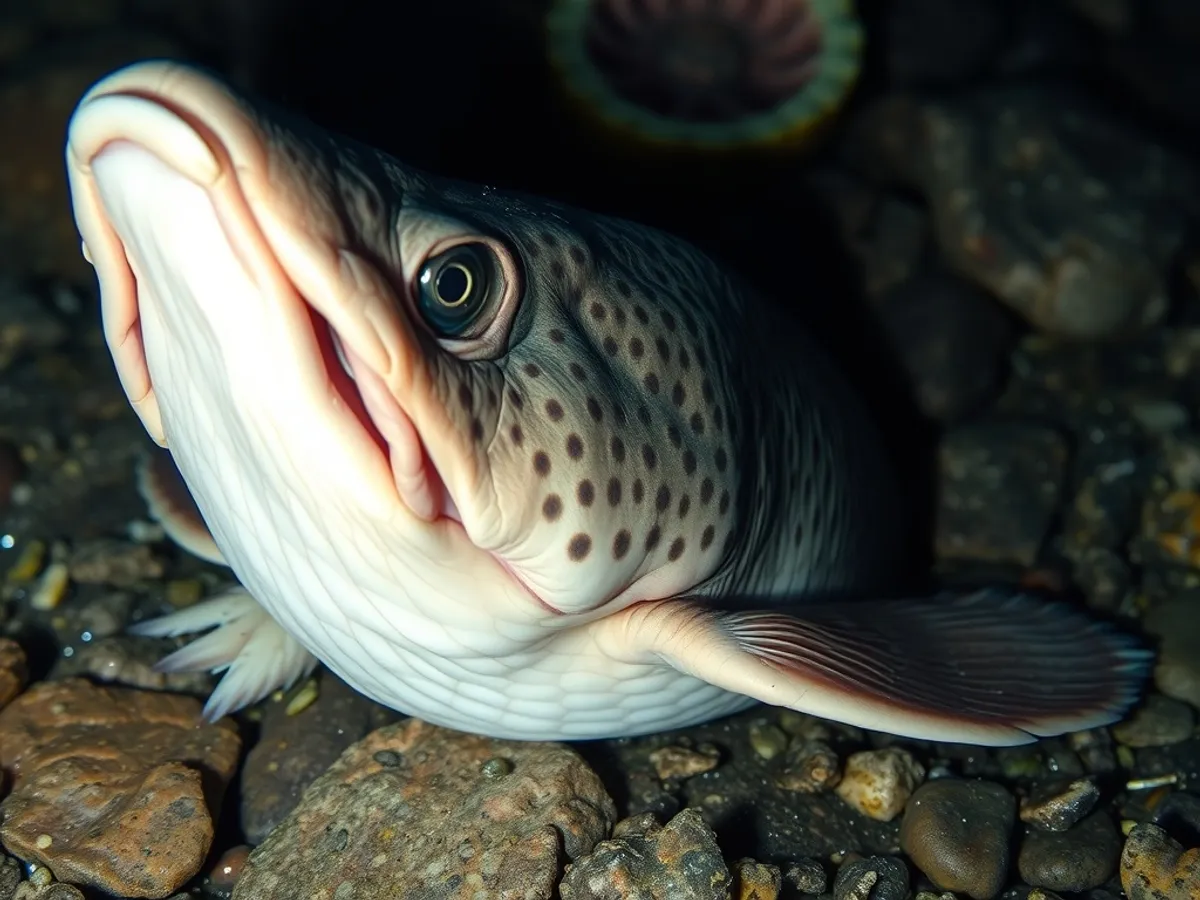
About the Atlantic wolffish
The Atlantic wolffish has a face like a nightmare for a good reason: it eats sea urchins, whelks, hermit crabs and scallops, and it needs to break them. Conical fangs at the front seize and wrench prey off the rock, and behind them, on the palate and in the throat, sit blunt crushing molars and bony plates that mill the shell to gravel. Those teeth wear out. Every year the wolffish sheds and regrows the entire set, and during the regrowth period it essentially stops feeding. It lives in cold, rocky North Atlantic dens, produces its own antifreeze glycoproteins, and does something almost no other bony fish of the region does: fertilisation is internal, and the male then guards the large clumped egg mass — sometimes for four months or more — fanning it and driving off intruders. That combination of a slow reproductive cycle, dependence on structured rocky bottom, and a habit of sitting still in a den made it catastrophically vulnerable to bottom trawling, which both kills the fish as bycatch and bulldozes its habitat.
Fascinating facts
Impressive Dentition
Atlantic wolffish have strong, protruding canine and molar teeth specifically evolved for crushing hard shells of mollusks, crustaceans, and sea urchins.
Parental Care
Unlike most fish, Atlantic wolffish exhibit parental care by guarding their eggs in nests until they hatch, which improves offspring survival rates.
Natural Antifreeze
Their blood contains unique antifreeze proteins that prevent ice crystal formation, allowing them to thrive in water temperatures close to freezing.
Detailed description
The Atlantic wolffish (Anarhichas lupus) is a robust, elongated marine fish distinguished by its powerful jaws and prominent, canine-like teeth, which are specialized for crushing the hard shells of mollusks and crustaceans. Adults typically reach lengths of 90–150 cm (35–59 in) and can weigh up to 18 kg (40 lbs), with females generally being larger than males. The body is laterally compressed and covered in small, embedded cycloid scales, giving the skin a smooth appearance. Its coloration ranges from slate blue to olive brown, often with irregular dark bands or spots along the flanks. Unlike true eels, the wolffish possesses a long dorsal fin running nearly the length of its back and a similarly extended anal fin, both supported by soft rays. The head is large and blunt, with a broad mouth lined by several rows of molariform teeth adapted for processing armored prey. Atlantic wolffish are benthic, residing at depths of 20 to 500 meters (66–1,640 ft), favoring cold (1–11°C), rocky substrates where they can shelter in crevices. They are solitary and territorial, rarely venturing far from their chosen lairs. Notably, this species exhibits unique reproductive behavior among marine fishes, including internal fertilization and extensive parental care, with males guarding demersal egg masses for several months. The wolffish's physiological adaptations, such as the production of antifreeze glycoproteins in its blood, enable survival in subzero temperatures. Its ecological role is significant, as it helps regulate populations of sea urchins, green crabs, and other invertebrates, thus maintaining the balance of benthic communities.
Did you know?
Despite their fierce looks, Atlantic wolffish are shy and spend most of their time hiding among rocks rather than actively hunting.
Research & sources
Wikipedia summary
The Atlantic wolffish, also known as the seawolf, Atlantic catfish, ocean catfish, devil fish, wolf eel, woof or sea cat, is a marine fish of the wolffish family Anarhichadidae, native to the North Atlantic Ocean. The numbers of the Atlantic wolffish in US waters are rapidly being depleted, most likely due to overfishing and bycatch, and it is currently a Species of Concern according to the U.S. National Oceanic and Atmospheric Administration's National Marine Fisheries Service.
Behaviour & social structure
Atlantic wolffish are primarily crepuscular to nocturnal, emerging from their rocky shelters at dusk and dawn to forage. They are ambush predators, relying on stealth and their powerful jaws to capture and crush hard-shelled prey such as sea urchins, large gastropods, crustaceans (notably crabs and lobsters), and bivalves. Their feeding strategy involves slow, deliberate movements and the use of their strong teeth to break through shells. Socially, wolffish are solitary and highly territorial, with individuals aggressively defending their chosen crevices or dens from conspecifics. They are generally sedentary, exhibiting limited home ranges and site fidelity. During the breeding season, males become more active in searching for mates but otherwise maintain their solitary habits. Daily routines are centered around sheltering during daylight hours and foraging during periods of low light.
Reproduction & life cycle
Atlantic wolffish exhibit oviparous reproduction with a unique twist: fertilization is internal, a rarity among marine teleosts. Spawning typically occurs in late summer to autumn (August–October), depending on latitude. Females lay large, demersal eggs (5–6 mm in diameter, among the largest of any marine fish), which are deposited in clusters within rocky crevices or under boulders. After fertilization, the male remains to guard the egg mass for up to 4–9 months, aerating and protecting it from predators and sedimentation. This extended parental care increases offspring survival. Embryonic development is slow due to cold water temperatures, and larvae hatch as well-developed juveniles, bypassing a planktonic stage. Sexual maturity is reached at 6–7 years, and the species is relatively long-lived, with lifespans exceeding 20 years in the wild.
Adaptations & survival
The Atlantic wolffish is highly adapted to life in cold, rocky marine environments. Its most notable adaptation is its dentition: robust, conical anterior teeth for gripping prey and flattened molariform teeth for crushing shells. The jaws and associated musculature are exceptionally strong, allowing the fish to feed on armored invertebrates that few other predators can exploit. Physiologically, wolffish produce antifreeze glycoproteins in their blood, preventing ice crystal formation and enabling survival in near-freezing waters. Their elongated bodies and continuous dorsal and anal fins facilitate maneuvering within tight crevices. The sedentary, territorial lifestyle reduces energy expenditure and predation risk. The species' reproductive strategy—large, yolk-rich eggs and prolonged parental care—maximizes juvenile survival in a challenging environment.
Cultural significance
While not a major commercial species, the Atlantic wolffish has been historically valued in some North Atlantic coastal communities for its firm, white flesh, which is marketed as 'ocean catfish' or 'woof.' Its striking appearance and formidable dentition have inspired local folklore and nicknames such as 'sea wolf' and 'devil fish.' In some cultures, wolffish teeth were used as amulets or tools. The species is increasingly recognized as an indicator of healthy benthic ecosystems, and its decline has prompted conservation advocacy and public awareness campaigns.
Recent research
Recent research has focused on the wolffish's physiological adaptations to cold, particularly the molecular structure and function of its antifreeze proteins. Genetic studies have clarified population structure and connectivity across the North Atlantic, revealing limited gene flow between American and European stocks. Ecological research has underscored the wolffish's role in controlling invasive invertebrate species, such as green crabs, and its importance in maintaining kelp forest health. Ongoing studies are investigating the impacts of bottom trawling on wolffish habitat use and reproductive success, as well as the potential for habitat restoration to support population recovery.
Videos
Habitat
Cold, rocky seafloors of the North Atlantic Ocean

Conservation
The Atlantic wolffish is currently classified as Near Threatened on the IUCN Red List.
Threats & challenges
Atlantic wolffish populations face significant threats from overfishing, both as targeted catch and as bycatch in bottom trawl and gillnet fisheries. Habitat degradation, particularly the destruction of rocky seafloor habitats by trawling, further reduces suitable shelter and breeding sites. Climate change poses additional risks by altering water temperatures and prey availability. In U.S. waters, populations have declined sharply, leading to their designation as a Species of Concern by NOAA. In Europe, data are insufficient for a full assessment, but localized declines have been reported. The species is slow-growing and late-maturing, making it particularly vulnerable to overexploitation and slow to recover from population declines.
Taxonomy
Scientific name
Anarhichas lupus
- Kingdom
- Animalia
- Phylum
- Chordata
- Class
- Actinopterygii
- Order
- Perciformes
- Family
- Anarhichadidae
- Genus
- Anarhichas
- Species
- lupus
Community notes
Share your observations about the Atlantic wolffish.
No community notes yet. Be the first!
Discover more wildlife
More fascinating animals from the encyclopedia.