
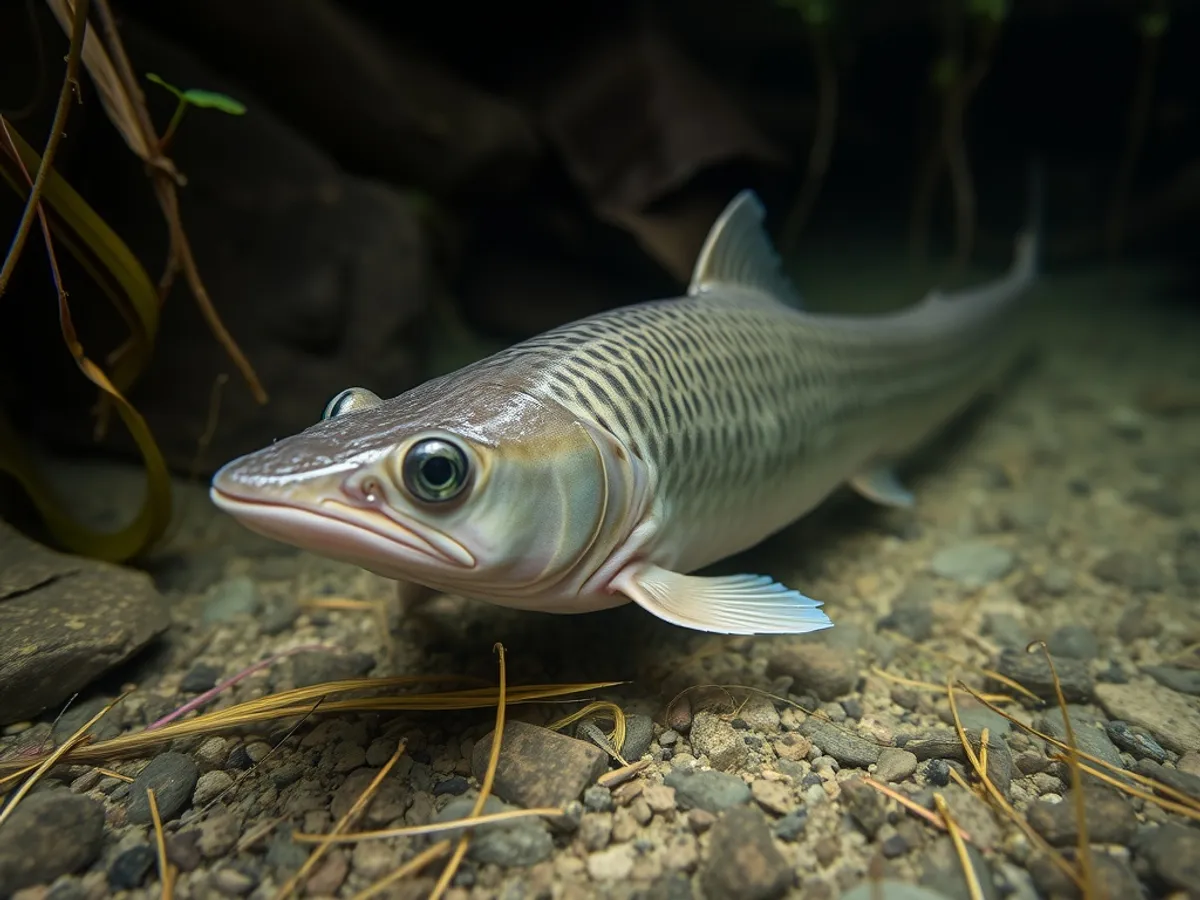
About the Australian Lungfish
The Australian Lungfish is a large, ancient freshwater fish native to the rivers of southeastern Queensland, Australia. Recognized for its single long dorsal fin and olive-green coloring, this species is remarkable for its ability to breathe both in water and air using a single lung. Fossil records reveal that the Australian Lungfish has remained virtually unchanged for over 100 million years, making it a living relic of prehistoric times. Its slow growth, late sexual maturity, and specialized habitat requirements have made it vulnerable to environmental changes and habitat disturbances.
Fascinating facts
Ancient Lineage
The Australian Lungfish is one of the oldest living vertebrates, with fossils dating back over 100 million years.
Breathes Air
It has both gills and a single lung, allowing it to breathe air directly when oxygen levels in water are low.
Unique Fins
Its pectoral and pelvic fins are fleshy and limb-like, resembling the early evolutionary stages of land vertebrates.
Detailed description
The Australian Lungfish (Neoceratodus forsteri) is a large, robust freshwater fish, typically reaching lengths of 1–1.5 meters and weights up to 40 kilograms, though most individuals are smaller. Its body is elongated and laterally compressed, covered in large, cycloid scales, and characterized by a single, continuous dorsal fin running along much of its back, merging seamlessly with the caudal and anal fins. The coloration ranges from olive-green to brown dorsally, fading to a pale yellow or cream ventrally. The head is broad with a blunt snout and a terminal mouth lacking teeth but equipped with crushing dental plates suited for its omnivorous diet. The species possesses a single functional lung, derived from a modified swim bladder, allowing facultative air breathing when dissolved oxygen is low, though it primarily relies on gill respiration. Australian Lungfish are generally solitary and sedentary, favoring deep, slow-moving pools with abundant aquatic vegetation. They are long-lived, with individuals documented to survive over 80 years in captivity and likely similar spans in the wild. Their slow growth rate and late sexual maturity (typically at 15–20 years) are notable, and they exhibit little sexual dimorphism. The species is considered a 'living fossil,' displaying many primitive features retained from their Devonian ancestors, such as lobed fins with internal skeletal elements homologous to tetrapod limbs.
Did you know?
Unlike African and South American lungfish, the Australian Lungfish cannot survive prolonged droughts by burrowing into mud.
Research & sources
Wikipedia summary
The Australian lungfish, also known as the Queensland lungfish, Burnett salmon and barramunda, is the only surviving member of the family Neoceratodontidae. It is one of only six extant lungfish species in the world. Endemic to Australia, the Neoceratodontidae are an ancient family belonging to the class Sarcopterygii, or lobe-finned fishes.
Behaviour & social structure
Australian Lungfish are mostly nocturnal or crepuscular, spending daylight hours resting among submerged logs or dense aquatic plants. They are opportunistic omnivores, feeding on a variety of prey including mollusks, crustaceans, insect larvae, worms, and plant material such as seeds and detritus. Food is detected using well-developed olfactory and lateral line senses. Feeding involves slow, deliberate movements and the use of strong jaw muscles to crush hard-shelled prey. Social interactions are minimal outside the breeding season, with individuals maintaining overlapping home ranges but rarely engaging in aggressive encounters. They exhibit site fidelity, often remaining within a limited stretch of river for years. During periods of low oxygen, especially in warm, stagnant water, they surface to gulp air, a behavior facilitated by their lung. Unlike African and South American lungfish, the Australian Lungfish does not aestivate and cannot survive complete desiccation.
Reproduction & life cycle
Breeding occurs annually between August and December, coinciding with rising water temperatures and increased daylight. Courtship is subtle, involving parallel swimming and gentle nudging between partners. Females lay adhesive eggs singly or in small clusters among aquatic vegetation, particularly in shallow, slow-flowing backwaters. Fecundity is low, with a typical female producing 200–600 eggs per season. There is no nest-building or parental care; eggs are left to develop unattended. Incubation lasts 3–4 weeks, after which larvae hatch with external gills and a yolk sac. Larvae are highly cryptic, remaining hidden among vegetation until they absorb the yolk and begin independent feeding. Juvenile growth is slow, and sexual maturity is not reached until at least 15 years of age, contributing to the species' vulnerability to population declines.
Adaptations & survival
The most distinctive adaptation of the Australian Lungfish is its single functional lung, enabling it to survive in hypoxic waters by supplementing gill respiration with aerial breathing. Unlike other lungfish, it cannot survive prolonged drought or aestivate, reflecting its evolution in relatively stable aquatic environments. Its lobed pectoral and pelvic fins, supported by a central bony axis, provide enhanced maneuverability and are homologous to the limbs of terrestrial vertebrates, offering insights into the fish-tetrapod transition. The robust dental plates allow efficient processing of hard-shelled prey. Its large size, cryptic coloration, and sedentary habits reduce predation risk. The species' longevity and slow life history are evolutionary strategies for survival in stable but resource-limited habitats.
Cultural significance
The Australian Lungfish holds significant scientific and cultural value. It is a key species in evolutionary biology, providing a living link to the early vertebrate transition from water to land. Aboriginal Australians have recognized the species for millennia, with some groups incorporating it into traditional stories and as a minor food source. In the late 19th and early 20th centuries, the lungfish was widely distributed to other Australian rivers for fisheries enhancement, though these translocated populations have not always thrived. The species is occasionally displayed in public aquaria, where its longevity and unique appearance attract considerable interest.
Recent research
Recent research has focused on the lungfish's genome, which is among the largest of any vertebrate, providing insights into vertebrate evolution and the origins of terrestrial adaptations. Studies of its developmental biology have illuminated the evolution of lungs and limb-like fins. Ongoing conservation research includes habitat restoration, population genetics, and the impacts of river regulation on breeding success. Notably, a 2021 study sequenced the full genome, revealing ancient gene families involved in lung and limb development. Long-term monitoring programs are assessing population trends and the effectiveness of conservation interventions.
Videos
Habitat
Slow-moving freshwater rivers and lakes


Conservation
The Australian Lungfish is currently classified as Endangered on the IUCN Red List.
Threats & challenges
Major threats to the Australian Lungfish include habitat degradation from dam construction, water extraction, and altered flow regimes, which disrupt spawning habitats and fragment populations. Invasive species, such as tilapia and carp, compete for resources and disturb breeding sites. Pollution, sedimentation, and loss of aquatic vegetation further reduce habitat quality. The species' slow reproduction and late maturity hinder recovery from population declines. Illegal collection and translocation have also impacted some populations. Although some reintroduction efforts have occurred, the overall population trend is decreasing, and the species is listed as Endangered by the IUCN and protected under CITES Appendix II.
Taxonomy
Scientific name
Neoceratodus forsteri
- Kingdom
- Animalia
- Phylum
- Chordata
- Class
- Sarcopterygii
- Order
- Ceratodontiformes
- Family
- Neoceratodontidae
- Genus
- Neoceratodus
- Species
- forsteri
Community notes
Share your observations about the Australian Lungfish.
No community notes yet. Be the first!
Discover more wildlife
More fascinating animals from the encyclopedia.