
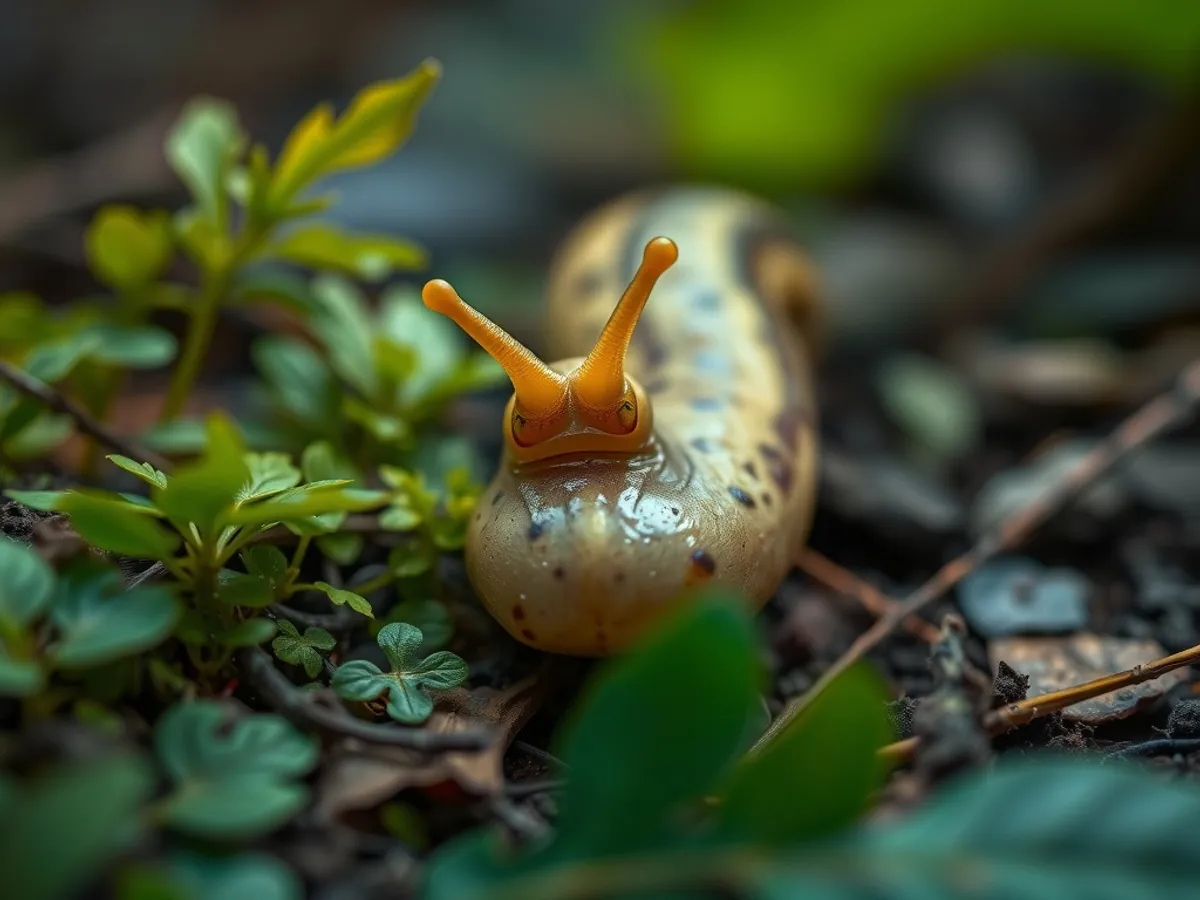
About the Banana Slug
The banana slug is the second-largest terrestrial slug on Earth, reaching about 25 cm, and it is essentially a walking chemistry experiment. Its slime is not merely lubricant: it contains a compound that anaesthetises tissue, so a predator that mouths a banana slug finds its tongue going numb, and this is the main reason most animals leave them alone. The mucus is also a remarkable material — a hydrogel that absorbs many times its weight in water and behaves as a shear-thinning liquid, turning runny under the pressure of the slug's foot and stiffening again at rest, which is how an animal with no legs sticks to a vertical trunk and still moves. Slugs are hermaphrodites, and banana slugs mate reciprocally, each fertilising the other. It works the redwood forest floor as a decomposer, eating fungi, dead leaves and animal droppings, and its droppings return a rich, nitrogen-loaded pellet to the soil. It also disperses fungal spores through the forest in its gut.
Fascinating facts
Bright Coloration
Banana slugs get their name from their yellow coloration, which can be as vivid as a ripe banana, though they sometimes appear greenish or brown.
Nature's Recycler
They are important decomposers in forest ecosystems, feeding on dead plant material, fungi, and detritus, helping to recycle nutrients.
Slippery Defense
The slime they secrete not only aids movement and moisture retention but also has anesthetic properties to deter predators.
Detailed description
The banana slug (Ariolimax dolichophallus) is a large terrestrial gastropod mollusk, reaching lengths of up to 25 centimeters (10 inches), making it one of the largest land slugs in North America. Its soft, elongated body is usually bright yellow, but coloration can vary from greenish, brown, white, or even mottled with black spots, providing camouflage among leaf litter and forest debris. The skin is moist and covered in a thick layer of mucus, which serves multiple functions: it prevents desiccation, aids in locomotion, and deters predators with its unpalatable taste and mild anesthetic properties. The head bears two pairs of retractable tentacles; the upper pair contains light-sensitive eyespots, while the lower pair is used for tactile and chemical sensing. Banana slugs are hermaphroditic, possessing both male and female reproductive organs, and are capable of self-fertilization, though cross-fertilization is more common. They are primarily nocturnal, emerging during damp conditions to feed and mate. Their slow, deliberate movement is facilitated by muscular contractions along the foot, and they leave a distinctive slime trail that can be used for communication and navigation. As detritivores, they play a vital role in forest ecosystems by consuming decaying plant matter, fungi, and occasionally animal droppings, thus accelerating nutrient cycling. Their lifespan in the wild can range from 1 to 7 years, depending on environmental conditions and predation pressures.
Did you know?
Banana slug slime contains chemicals that can numb the tongues of predators, making them think twice before taking another bite!
Research & sources
Wikipedia summary
Banana slugs (Ariolimax) are a genus of air-breathing, terrestrial gastropod slugs in the family Ariolimacidae. They are often yellow color and elongated shape can resemble a banana, thus giving rise to their common name.
Behaviour & social structure
Banana slugs are solitary and largely nocturnal, becoming most active during periods of high humidity or after rainfall. They spend much of their time foraging for decaying leaves, dead plant material, fungi, and occasionally animal feces, using their radula—a rasping, tongue-like organ—to scrape food from surfaces. Feeding is slow and methodical, and they are known to exhibit food preferences, sometimes favoring certain types of fungi or decomposing matter. Social interactions are limited, primarily occurring during mating periods when slugs follow each other's slime trails to locate potential partners. They exhibit homing behavior, often returning to favored moist refuges under logs or rocks. When threatened, banana slugs can contract their bodies and secrete copious amounts of thick, sticky mucus, which contains chemicals that deter many predators, including birds, mammals, and amphibians. They are also known to estivate during dry or hot periods, burrowing into soil or hiding in moist microhabitats to conserve moisture.
Reproduction & life cycle
Ariolimax dolichophallus is a simultaneous hermaphrodite, meaning each individual possesses both male and female reproductive organs. Mating typically occurs during the wet season, from late fall to early spring, when conditions are moist. Courtship involves a prolonged ritual in which two slugs follow each other's slime trails, circle, and nibble at each other's bodies before aligning side by side to exchange sperm. The species is notable for its exceptionally long penis relative to body size, which can sometimes become entangled, occasionally resulting in apophallation (biting off of the penis), a phenomenon documented in some banana slug species. After mating, each slug can lay up to 75 translucent eggs in moist soil or under decaying wood. There is no parental care; the eggs are left to develop and hatch independently after several weeks, depending on temperature and humidity. Juvenile slugs resemble miniature adults and reach sexual maturity in 1-2 years.
Adaptations & survival
Banana slugs exhibit several key adaptations for terrestrial life in moist forest environments. Their copious mucus secretion prevents desiccation, facilitates movement over rough terrain, and contains compounds that deter predators and inhibit microbial growth. The mucus also enables slugs to traverse sharp objects and even hang from surfaces. Their coloration provides camouflage among leaf litter, while their ability to alter skin pigmentation helps them blend into different microhabitats. The retractable tentacles allow them to sense their environment and withdraw sensitive organs when threatened. Behavioral adaptations include nocturnal activity patterns and estivation during dry periods. Their hermaphroditic reproductive system increases the likelihood of successful mating encounters in low-density populations.
Cultural significance
Banana slugs hold a unique place in the cultural landscape of the Pacific Northwest. They are the official mascot of the University of California, Santa Cruz, symbolizing individuality and resilience. The slug appears in local folklore and is often celebrated in art, literature, and festivals. Some indigenous peoples have traditional knowledge regarding slugs, though they are not commonly used for food or medicine due to their unpalatable mucus. Their striking appearance and ecological importance have made them a subject of environmental education and conservation awareness.
Recent research
Recent research on Ariolimax dolichophallus has focused on the biochemical properties of their mucus, which has potential applications in medicine and biomaterials due to its adhesive and antimicrobial qualities. Genetic studies are refining the taxonomy and evolutionary relationships within the Ariolimax genus. Ecological research highlights their role in nutrient cycling and soil health, as well as their interactions with forest fungi and microbial communities. Ongoing studies are monitoring the impacts of climate change and habitat fragmentation on their distribution and population dynamics.
Videos
Habitat
Temperate rainforest

Conservation
The Banana Slug is currently classified as Least Concern on the IUCN Red List.
Threats & challenges
Currently, banana slugs are classified as Least Concern, with stable populations throughout their range in the Pacific coastal forests. However, they face localized threats from habitat loss due to logging, urban development, and climate change, which can alter the moist microhabitats they require. Invasive species, such as non-native slugs and snails, may compete for resources or introduce diseases. Pesticide use and pollution can also negatively impact slug populations. Despite these challenges, banana slugs are resilient and can persist in fragmented habitats if sufficient moisture and organic matter are available.
Taxonomy
Scientific name
Ariolimax dolichophallus
- Kingdom
- Animalia
- Phylum
- Mollusca
- Class
- Gastropoda
- Order
- Stylommatophora
- Family
- Ariolimaxidae
- Genus
- Ariolimax
- Species
- dolichophallus
Community notes
Share your observations about the Banana Slug.
No community notes yet. Be the first!
Discover more wildlife
More fascinating animals from the encyclopedia.