
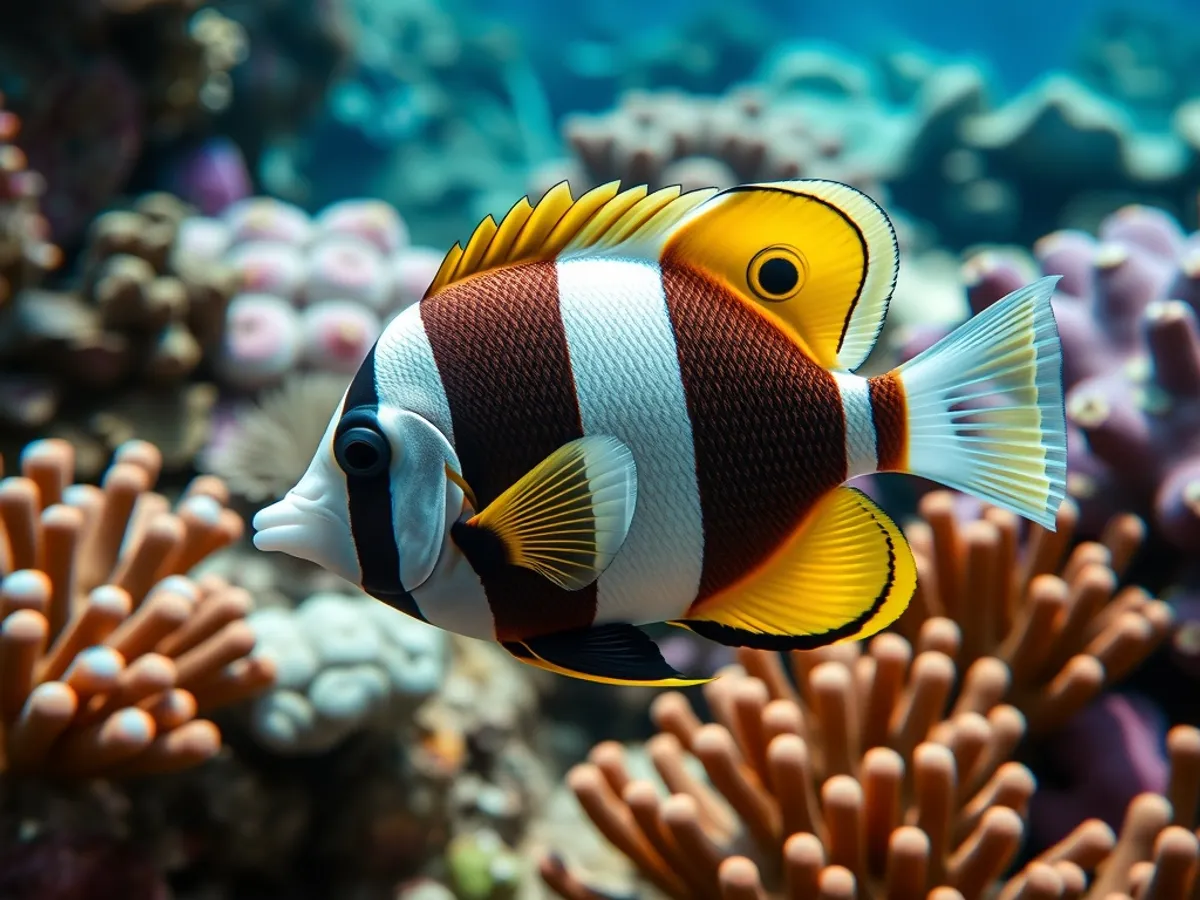
About the Banded butterflyfish
The banded butterflyfish is a striking marine fish recognized by its silvery-white body adorned with bold, vertical black bands. Native to the western Atlantic Ocean, it is commonly found around coral reefs from Florida and the Bahamas to Brazil. This species is notable for its laterally compressed, disc-shaped body and small, protruding mouth adapted for picking prey from crevices. Banded butterflyfish are often seen in pairs or small groups, gracefully swimming among coral heads in search of food. Their unique coloration provides effective camouflage among the reef's shadows and structures.
Fascinating facts
Pair Bonding
Banded butterflyfish usually swim in pairs and maintain close bonds, especially during the breeding season.
Specialized Feeder
Their narrow snouts allow them to feed on small invertebrates, coral polyps, and worms hiding in reef crevices.
Wide Range
This species inhabits reefs from the coasts of Florida and Bermuda, throughout the Caribbean, and down to Brazil.
Detailed description
The banded butterflyfish (Chaetodon striatus) is a medium-sized marine fish, typically reaching a maximum length of about 16 cm (6.3 inches), though most adults are between 12–15 cm. Its body is highly laterally compressed and disc-shaped, facilitating agile maneuvering among coral branches and rocky crevices. The species is instantly recognizable by its silvery-white background coloration, intersected by three prominent, vertical black bands: one passing through the eye (which helps obscure the eye from predators), a central band across the body, and a third near the caudal peduncle. The dorsal fin is continuous, with 12–13 spines and 21–23 soft rays, while the anal fin has 3 spines and 17–19 soft rays. The small, terminal mouth contains fine, brush-like teeth adapted for picking small invertebrates from hard substrates. Banded butterflyfish are diurnal, spending daylight hours actively foraging and retreating to reef crevices at night for shelter. They are often observed in monogamous pairs, a social structure that persists year-round, though juveniles may form small aggregations. Their coloration and body shape provide effective camouflage among the complex shadows and patterns of coral reefs, aiding in predator avoidance and ambush predation.
Did you know?
Despite their delicate appearance, banded butterflyfish sometimes engage in aggressive displays to defend their territory from other butterflyfish.
Research & sources
Wikipedia summary
The banded butterflyfish is a species of marine ray-finned fish, a butterflyfish found in the tropical western Atlantic Ocean from Brazil to Bermuda. Common names include the banded butterflyfish, the butterbun, the butterflyfish, the Portuguese butterfly, the school mistress and the banded mariposa.
Behaviour & social structure
Banded butterflyfish are primarily benthic feeders, foraging during the day on a diet that includes polychaete worms, small crustaceans, coral polyps, and various other invertebrates. They use their elongated snouts and small mouths to extract prey from narrow crevices and holes in the reef. The species is known for its strong pair-bonding behavior; adult pairs maintain small, overlapping territories and are rarely seen apart. These pairs engage in synchronized swimming and mutual grooming, which may reinforce social bonds and facilitate coordinated defense against intruders. At night, individuals seek shelter within the reef structure, becoming less active and reducing their conspicuousness to nocturnal predators. Juveniles are more solitary and secretive, often hiding among branching corals or rubble until they mature.
Reproduction & life cycle
Reproduction in Chaetodon striatus is characterized by monogamous pairing and external fertilization. Spawning typically occurs during the warmer months, with peaks varying regionally but often coinciding with lunar cycles. Courtship involves synchronized swimming and circling displays between paired individuals. During spawning, the pair ascends into the water column, releasing eggs and sperm simultaneously. The fertilized eggs are pelagic, drifting with ocean currents for approximately 24–48 hours before hatching into planktonic larvae. The larval stage lasts about 30–50 days, after which juveniles settle onto suitable reef habitats. There is no parental care post-spawning; survival of offspring is dependent on dispersal and successful settlement.
Adaptations & survival
The banded butterflyfish exhibits several notable adaptations for reef life. Its laterally compressed body allows it to navigate tight spaces within the reef, while its cryptic coloration and eye-stripe band help to confuse predators by obscuring the location of the eye. The small, protrusible mouth is specialized for precision feeding on small, sessile invertebrates, allowing the fish to exploit food resources inaccessible to many other reef fishes. Socially, the formation of stable pairs enhances territory defense and may improve reproductive success. Their diurnal activity pattern aligns with the availability of prey and reduces exposure to nocturnal predators.
Cultural significance
The banded butterflyfish is a popular species in the marine aquarium trade due to its striking appearance and peaceful demeanor. In some Caribbean cultures, it is known by various local names and features in traditional folklore as a symbol of grace and beauty. Its presence on healthy reefs also makes it a favorite subject for underwater photographers and ecotourism, contributing to the economic value of reef ecosystems. There are no known traditional medicinal or culinary uses for this species.
Recent research
Recent research on Chaetodon striatus has focused on its role as an indicator species for coral reef health, given its reliance on complex reef structures and sensitivity to habitat changes. Studies have examined its feeding ecology, revealing a flexible diet that may buffer it against some impacts of coral loss. Genetic analyses have provided insights into population connectivity across the Caribbean and western Atlantic, highlighting the importance of larval dispersal in maintaining genetic diversity. Ongoing research is investigating the effects of ocean warming and acidification on its reproductive success and larval development.
Videos
Habitat
Coral reefs

Conservation
The Banded butterflyfish is currently classified as Least Concern on the IUCN Red List.
Threats & challenges
Currently, Chaetodon striatus is classified as Least Concern by the IUCN, with stable populations across its range. However, the species faces localized threats from habitat degradation, particularly coral reef loss due to climate change, ocean acidification, and destructive fishing practices. Over-collection for the aquarium trade is not considered a major threat at present, but could become significant if not managed sustainably. Pollution, sedimentation, and coastal development also pose risks to reef habitats. Despite these challenges, the banded butterflyfish demonstrates some resilience due to its broad distribution and dietary flexibility, but ongoing reef decline could impact long-term population stability.
Taxonomy
Scientific name
Chaetodon striatus
- Kingdom
- Animalia
- Phylum
- Chordata
- Class
- Actinopterygii
- Order
- Perciformes
- Family
- Chaetodontidae
- Genus
- Chaetodon
- Species
- striatus
Community notes
Share your observations about the Banded butterflyfish.
No community notes yet. Be the first!
Discover more wildlife
More fascinating animals from the encyclopedia.