
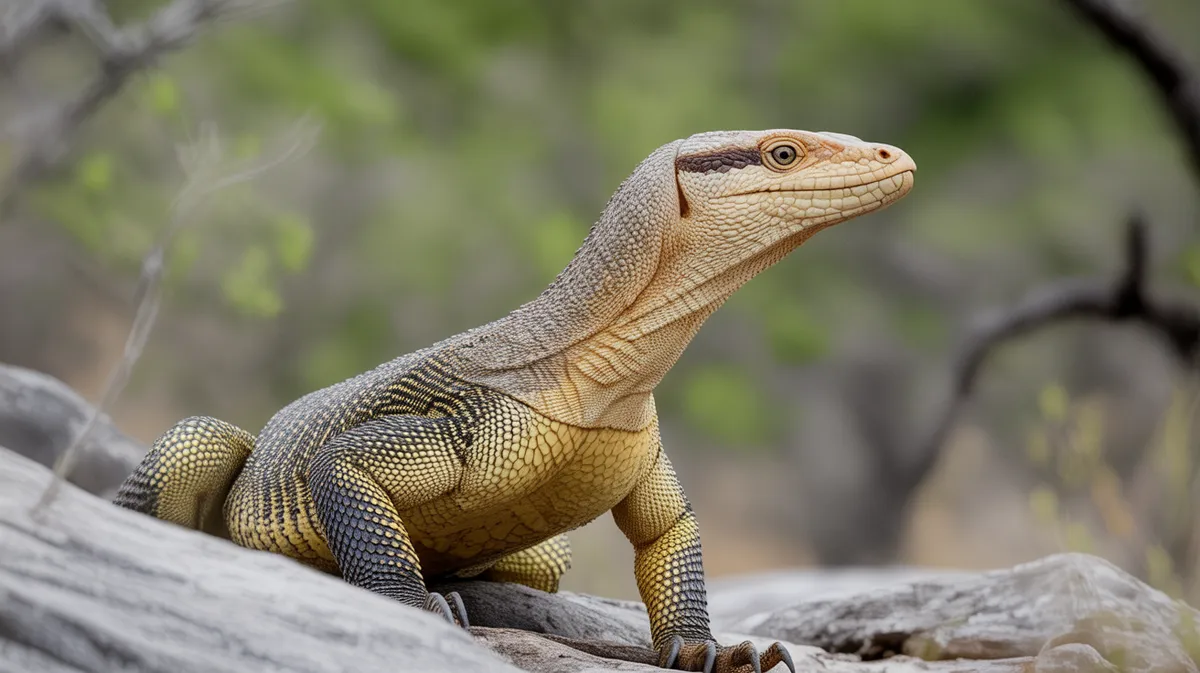
About the Bar-necked Rock Monitor
The Bar-necked Rock Monitor is a robust, medium-to-large lizard native to southern Africa, recognized by the distinctive pale bands or bars on its neck. This subspecies is part of the white-throated monitor complex and is known for its stocky build, strong limbs, and powerful tail, which it uses both for balance and defense. Bar-necked Rock Monitors are primarily terrestrial, often found in rocky outcrops and savannas, where they use their keen senses to hunt prey and evade predators. Their adaptability and intelligence make them one of the most successful monitor lizards in their range.
Fascinating facts
Distinctive Markings
The pale bars across the neck and throat help distinguish the Bar-necked Rock Monitor from other similar species.
Rocky Dwellers
These monitors favor rocky outcrops and crevices for shelter, using them as both lookout points and protection from predators.
Forked Tongue
Like all monitors, they use a long, forked tongue to sample scents from the air, helping them track prey over long distances.
Detailed description
The Bar-necked Rock Monitor (Varanus albigularis angolensis) is a robust, terrestrial lizard reaching total lengths of 100–150 cm, with some individuals exceeding 160 cm. Its body is heavily built, with a broad, flattened head, muscular limbs, and a thick, tapering tail that can comprise over half its total length. The skin is covered in rough, granular scales, with coloration ranging from grayish-brown to olive, often patterned with pale crossbars or 'bars' on the neck and shoulders, a distinguishing feature of this subspecies. The throat is typically white or cream, contrasting with the darker body. The species possesses strong, curved claws adapted for digging and climbing among rocky outcrops. Its keen eyesight and well-developed Jacobson’s organ allow for acute detection of prey and environmental cues. Bar-necked Rock Monitors are primarily diurnal, emerging in the morning to bask and forage, and retreating to burrows or crevices at night or during extreme heat. They are solitary, with defined home ranges, but may tolerate conspecifics in areas of abundant resources. Their diet is highly opportunistic, including insects, small mammals, birds, eggs, reptiles, and carrion. Reproduction is oviparous, with females laying clutches of 10–30 eggs in deep burrows or termite mounds. Hatchlings are precocial, receiving no parental care. The species is notable for its intelligence, problem-solving abilities, and adaptability to varied environments within southern Africa.
Did you know?
Bar-necked Rock Monitors can inflate their bodies and hiss loudly to deter predators, making themselves appear much larger and more intimidating.
Research & sources
Behaviour & social structure
Bar-necked Rock Monitors are primarily solitary and territorial, with individuals maintaining overlapping but distinct home ranges. They are active during the day, especially in the cooler morning and late afternoon hours, spending much of their time basking on rocks to regulate body temperature. Foraging involves slow, deliberate movement interspersed with bursts of speed when pursuing prey. They rely heavily on their forked tongue and Jacobson’s organ to sample chemical cues, allowing them to locate hidden prey such as rodents in burrows or eggs buried in sand. Their diet is varied and opportunistic, including arthropods, snails, small vertebrates, eggs, and carrion. When threatened, they may inflate their bodies, hiss, lash with their powerful tails, or bite. Social interactions are generally limited to the breeding season or territorial disputes, which may involve ritualized displays such as head-bobbing, tail-whipping, and posturing. Juveniles are more arboreal and secretive, while adults are predominantly terrestrial.
Reproduction & life cycle
Breeding in Varanus albigularis angolensis typically occurs during the warmer, wetter months (October to March) in southern Africa. Males may engage in combat for access to receptive females, using their size and strength to wrestle rivals. Courtship involves head-bobbing, circling, and tactile stimulation. Females lay a single clutch per season, depositing 10–30 eggs in deep burrows, decaying logs, or abandoned termite mounds, which provide stable temperature and humidity for incubation. Incubation lasts 120–180 days, depending on environmental conditions. Hatchlings emerge fully independent, measuring 25–30 cm in length, and receive no parental care. Sexual maturity is typically reached at 3–4 years of age, depending on growth rates and resource availability.
Adaptations & survival
The Bar-necked Rock Monitor exhibits several adaptations for survival in arid and semi-arid habitats. Its thick, keratinized skin reduces water loss and provides protection against rough terrain and predators. The muscular tail serves as both a defensive weapon and a counterbalance during rapid movement or climbing. Strong, curved claws enable efficient digging for burrows and excavation of prey. The species’ acute vision and chemosensory abilities facilitate detection of prey and predators. Behavioral thermoregulation, such as basking and seeking shade or burrows, allows it to maintain optimal body temperature. Its opportunistic diet and ability to exploit a wide range of food sources contribute to its ecological success. Juveniles’ arboreal tendencies reduce predation risk, while adults’ cryptic coloration aids in camouflage among rocks and vegetation.
Cultural significance
In southern African cultures, monitors (locally known as 'leguaans') are often regarded with a mixture of respect and superstition. They are sometimes believed to possess medicinal or magical properties, and their fat, skin, or organs may be used in traditional remedies or rituals. In some regions, they are erroneously feared as venomous or dangerous, leading to persecution. Conversely, they are also recognized for their role in controlling pests such as rodents and insects. The Bar-necked Rock Monitor features in local folklore, sometimes as a symbol of stealth or resilience.
Recent research
Recent research on Varanus albigularis angolensis has focused on its ecological role as a mesopredator, dietary flexibility, and spatial ecology using radio telemetry. Studies have highlighted its importance in regulating populations of small mammals and invertebrates. Genetic analyses have clarified its taxonomic status within the Varanus albigularis complex, supporting the recognition of distinct subspecies. Ongoing research investigates the impacts of habitat fragmentation and human-wildlife conflict on population dynamics. Cognitive studies have demonstrated problem-solving abilities and learning capacity in captive individuals, underscoring the species’ intelligence.
Sources
Varanus albigularis (White-throated Monitor) Species Account
Bennett, D., Pianka, E.R., King, D.R. (2010)
scientificVaranus albigularis: The IUCN Red List of Threatened Species 2021
IUCN SSC Monitor Lizard Specialist Group
conservationThe Varanus albigularis Species Complex: Taxonomy, Distribution, and Natural History
Bennett, D. & Pianka, E.R. (2020)
scientificVaranus albigularis: The IUCN Red List of Threatened Species 2021
IUCN SSC Monitor Lizard Specialist Group
conservationA Taxonomic Revision of the Varanus albigularis Species Complex
Böhme, W. & Ziegler, T. (2007)
scientificVideos
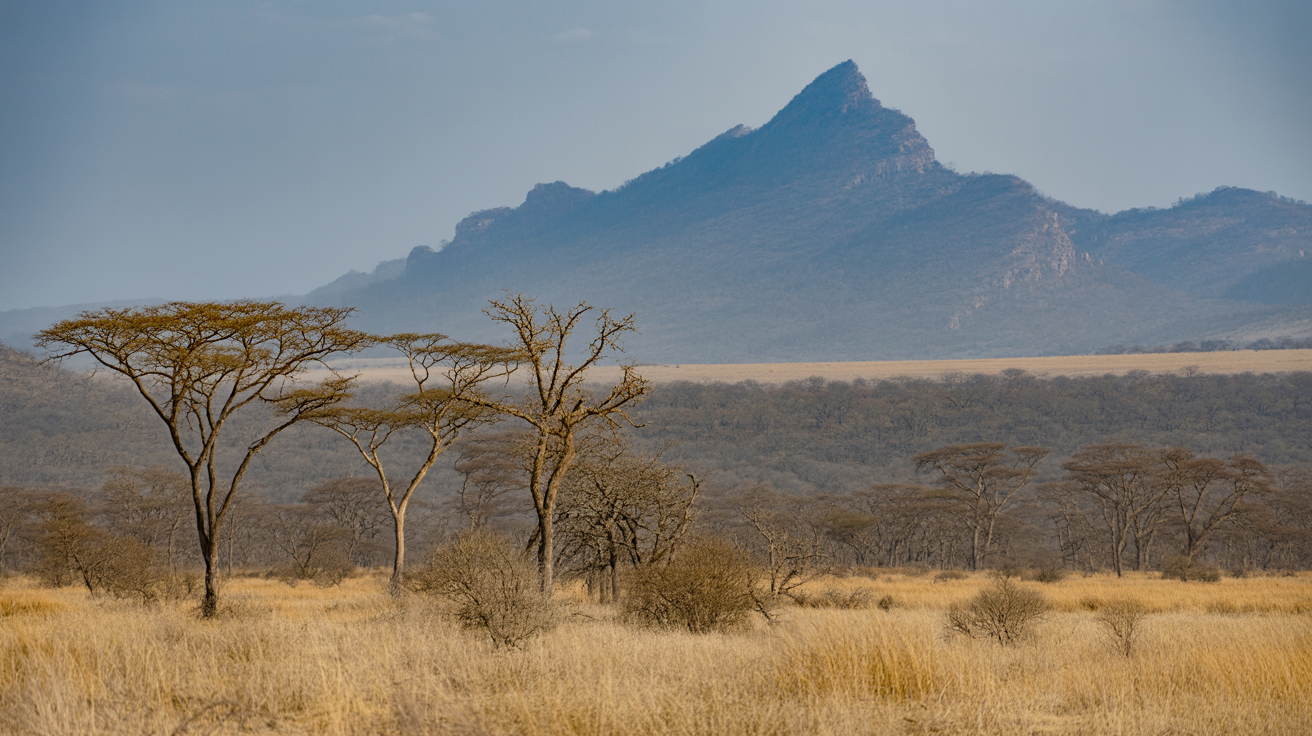
Habitat
Rocky savanna and woodland

Conservation
The Bar-necked Rock Monitor is currently classified as Least Concern on the IUCN Red List.
Threats & challenges
Currently assessed as Least Concern by the IUCN, the Bar-necked Rock Monitor faces localized threats from habitat destruction, agricultural expansion, and persecution due to perceived threats to livestock or poultry. Collection for the pet trade occurs but is not considered a major threat at present. Road mortality and accidental killing during bush clearing or burning are additional concerns. Climate change may pose future challenges by altering habitat suitability and prey availability. Despite these pressures, the species remains widespread and adaptable, with stable populations across much of its range. Continued monitoring is recommended to detect potential declines, especially in areas of intense human activity.
Taxonomy
Scientific name
Varanus albigularis angolensis
- Kingdom
- Animalia
- Phylum
- Chordata
- Class
- Reptilia
- Order
- Squamata
- Family
- Varanidae
- Genus
- Varanus
- Species
- angolensis
Community notes
Share your observations about the Bar-necked Rock Monitor.
No community notes yet. Be the first!
Discover more wildlife
More fascinating animals from the encyclopedia.