
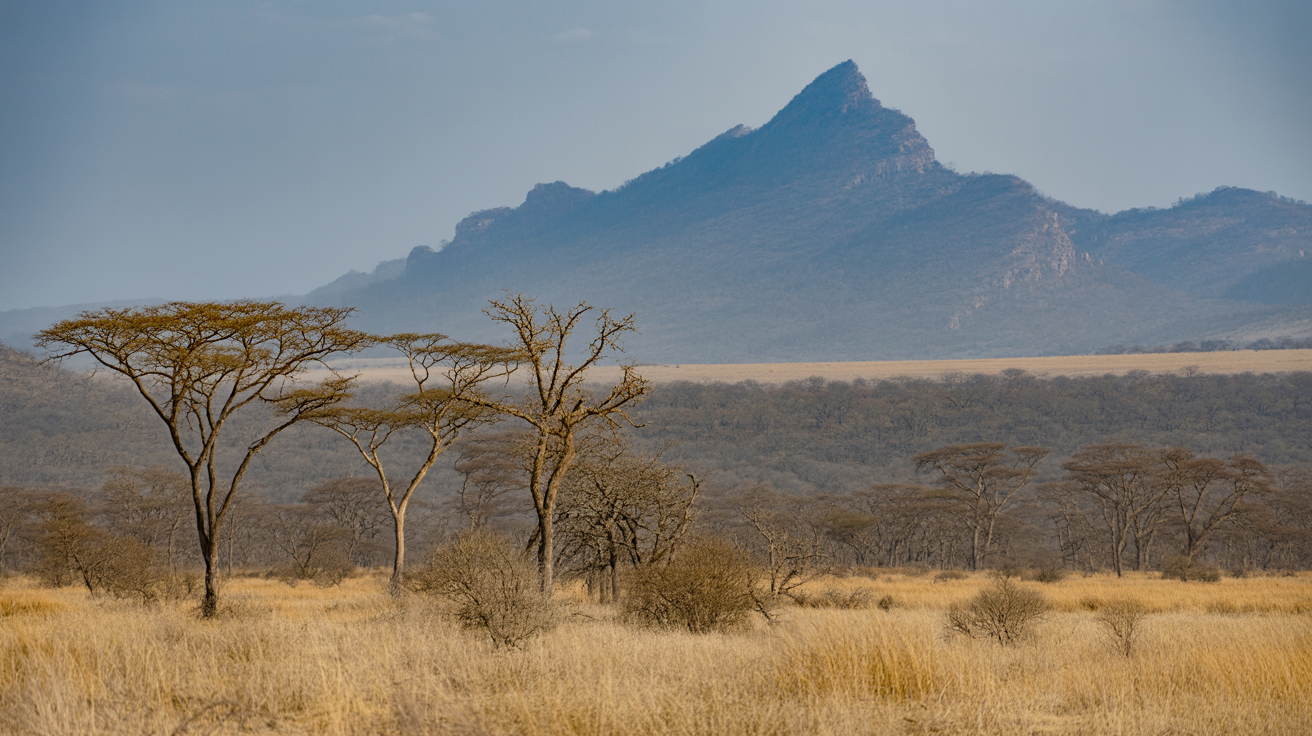
Savanna
Grasslands with scattered trees, characterized by seasonal rainfall and home to diverse grazing animals and predators.
Animals of the Savanna
Species recorded in this habitat.
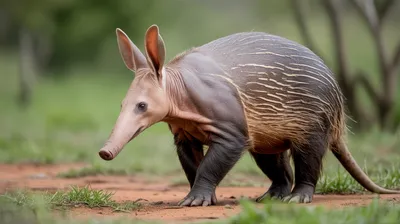
Aardvark
Orycteropus afer
The aardvark looks like an animal assembled from spare parts — rabbit ears, a pig's snout, a kangaroo's tail — and it is related to none of them, nor to the anteaters and pangolins it so closely resembles. It is the only living member of an entire order, Tubulidentata, named for its strange teeth: they have no enamel, are built from bundles of upright dentine tubes, grow continuously to replace what wears away, and sit only at the back of the jaw. It is a phenomenal digger, able to excavate faster than several people with shovels, and its burrows matter far beyond itself — warthogs, hyenas, porcupines, owls and hares all shelter in abandoned aardvark holes, making it a keystone species whose loss would evict an entire community. It hunts ants and termites by night, sweeping a long sticky tongue through nests it has torn open, and can seal its nostrils to keep the insects out. One plant depends on it entirely: the aardvark cucumber fruits underground, and the aardvark digs it up for its water and buries the seeds in its dung. Its likeness to other ant-eating mammals is convergent evolution — the same diet, solved the same way, by animals that are not related at all.
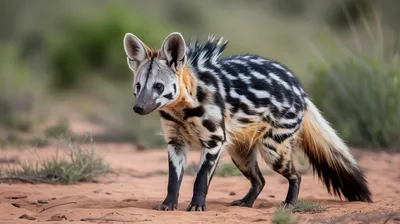
Aardwolf
Proteles cristata
The aardwolf is a hyena that gave up being a hyena. It looks like a small striped hyena and it is one, but where its relatives evolved bone-crushing jaws, the aardwolf abandoned the entire carnivore project and went after termites. It eats almost nothing else — as many as a quarter of a million in a single night, lapped up with a broad, sticky tongue — and it does not dig into their mounds but takes them from the surface as they forage. It specialises on one genus, Trinervitermes, which defends itself with a noxious terpene secretion that deters almost every other predator, and the aardwolf simply tolerates it. Its jaws have collapsed accordingly: the cheek teeth are reduced to widely spaced, useless pegs, and only the canines remain, kept for fighting rather than eating. It is nocturnal, largely solitary but monogamous, and it defends a territory containing enough termite mounds to see it through the year, marking the boundary meticulously.
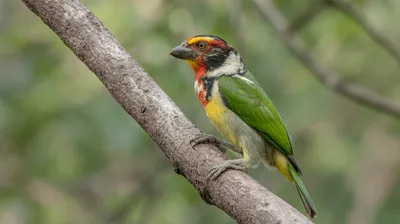
African Barbet
Lybiidae
Barbets are plump, colorful birds found throughout tropical regions of Africa and Asia, known for their stout bills and bristle-fringed faces. Members of the family Lybiidae, African barbets are particularly noted for their bright plumage, which often includes striking reds, yellows, and greens. They primarily inhabit forests and woodland environments, where they excavate nest holes in trees. Barbets are vocal birds, producing distinctive, repetitive calls that can be heard over long distances. Their diet consists mainly of fruit, but they will also eat insects and other small animals.
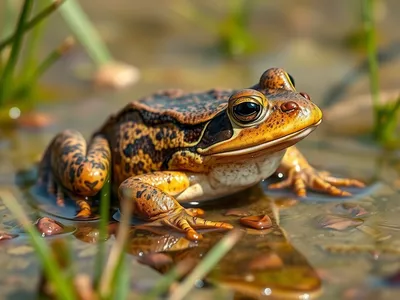
African Bullfrog
Pyxicephalus adspersus
The African bullfrog inverts the usual amphibian rule that females are the larger sex: males can exceed 2 kg and grow roughly twice the size of the females they mate with, because male-male combat over breeding pools rewards bulk. Along the lower jaw sit three odontoid projections — bony, tooth-like spikes that let it hold struggling prey, and give a bite that draws blood. It eats essentially anything it can cram down, including rodents, birds, other frogs, and famously young cobras. Its most remarkable behaviour is paternal: a male guards the tadpole mass, and when the puddle begins to evaporate he will excavate a channel with his hind legs to drain water from a shrinking pool into a larger one, saving the shoal. He is not sentimental about it — he also eats a share of the tadpoles he is guarding. Between rains the frog burrows down and encases itself in a cocoon built from layers of shed skin, sealing in moisture, and can wait out drought underground for a year or more.
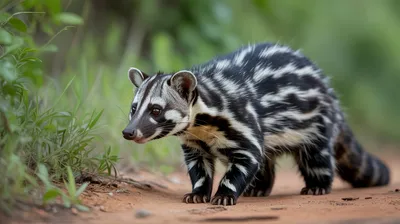
African Civet
Civettictis civetta
The African civet is a nocturnal, medium-sized mammal known for its distinctive black and white markings and a mane of long hair along its back. It is famous for the musky secretion called civetone, which is used in the perfume industry. The species is solitary and highly territorial, using scent marking to communicate with others. African civets are agile climbers and swimmers, inhabiting a wide range of environments across sub-Saharan Africa.
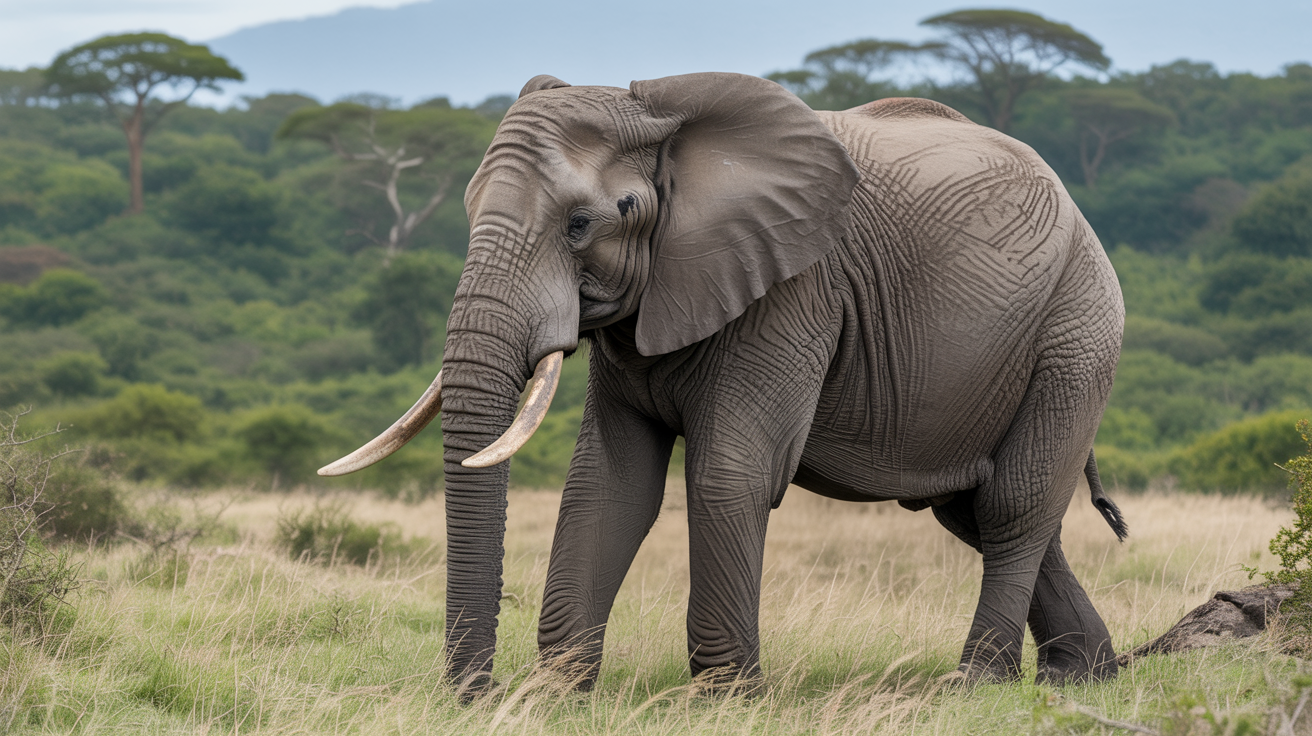
African Elephant
Loxodonta africana
The African elephant, scientifically known as Loxodonta africana, is the largest land mammal on Earth, with bulls reaching up to 4 meters at the shoulder and weighing as much as 6,000 kilograms. These majestic creatures are divided into two species: the African bush elephant and the African forest elephant. The bush elephant, found in a variety of habitats from savannas to deserts, is distinguished by its larger size, broader ears, and curved tusks, which are adaptive traits for dissipating heat and foraging. In contrast, the forest elephant, which inhabits the dense rainforests of Central and West Africa, has straighter tusks and more rounded ears, adaptations that facilitate maneuvering through thick underbrush. Both species exhibit complex social structures, typically led by a matriarch, where females and their calves form tight-knit family groups. Their grey skin is not just a protective layer but also serves as a cooling mechanism, with mud baths providing sunscreen and pest protection.
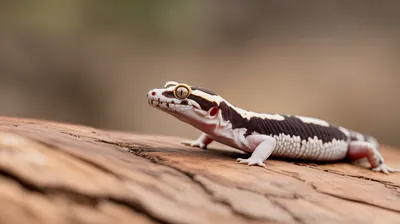
African Fat-tailed Gecko
Hemitheconyx caudicinctus
The African Fat-tailed Gecko is a medium-sized, nocturnal lizard native to West Africa. Recognized for its distinctive broad tail, which stores fat as an energy reserve, this gecko displays earthy color patterns with bold stripes or bands. It prefers arid to semi-arid environments, often sheltering under rocks or in burrows to avoid the harshest heat. Calm and docile, the African Fat-tailed Gecko is a popular choice for reptile enthusiasts due to its manageable size and hardy nature.
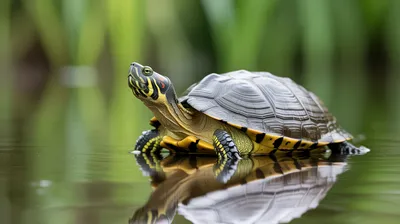
African Helmeted Turtle
Pelomedusa subrufa
The African Helmeted Turtle is a small to medium-sized freshwater turtle known for its distinctive domed shell and broad, flattened head. Found throughout much of sub-Saharan Africa and parts of the Middle East, it is highly adaptable and inhabits a variety of freshwater bodies, including ponds, lakes, and slow-moving rivers. This turtle is famous for its ability to survive in temporary water sources by burrowing into mud during dry periods, a behavior known as aestivation. It is an opportunistic feeder, consuming a wide range of animal and plant matter. African Helmeted Turtles are also known for their social basking behavior and occasional group hunting.
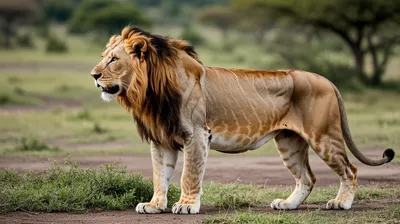
African Lion
Panthera leo
The lion is the only truly social cat, and its social life explains most of what it is. A male's mane is an honest advertisement: darker manes correlate with higher testosterone and better nutrition, and in Serengeti experiments using life-sized dummy lions, females approached dark-maned models while rival males avoided them. Manes are costly — dark manes trap heat, which is why males in hot, arid places such as Tsavo are often nearly maneless, and why mane colour lightens in cooler seasons. The roar carries up to about 8 km, produced by unusually square, fat-padded vocal folds that let the lion push huge volume without straining the larynx. Prides are matrilineal, and the females stay for life while coalitions of males hold tenure for only a couple of years before being ousted; incoming males kill the cubs, which brings the females back into oestrus. Lionesses do most of the hunting, but males are decisive on large, dangerous prey such as buffalo. Fewer than about 25,000 remain in the wild, in a fraction of a range that once stretched from Greece to India.
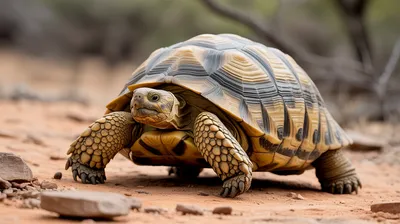
African Pancake Tortoise
Malacochersus tornieri
The pancake tortoise abandoned the one thing tortoises are famous for: armour. Its shell is flat, thin and riddled with large fenestrations — genuine holes in the underlying bone — so the whole carapace flexes like a stiff leather pad. Squeezed into a crack in a granite kopje, the tortoise inflates its lungs and braces outward with its legs, wedging itself so firmly that a predator cannot extract it; the flexible shell lets it exploit crevices far too narrow for a domed tortoise. It does not withdraw and sit tight, because it cannot — instead it is the fastest tortoise known, and will simply run for the nearest rock and disappear. The low mass that comes with a hollow shell also means that, unlike a heavy domed species, a flipped pancake tortoise can right itself with a flick of the neck and leg. It lives on rocky outcrops in Kenya and Tanzania, lays a single egg at a time several times a year, and was moved to CITES Appendix I in 2019 after collectors stripped whole kopjes for the pet trade.
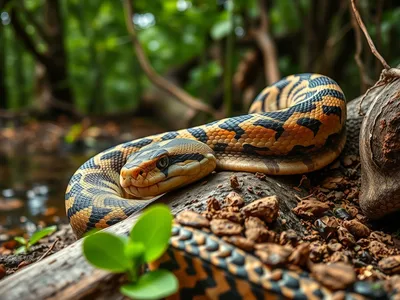
African Rock Python
Python sebae
The African Rock Python is Africa's largest snake and one of the largest python species in the world. Characterized by its thick, muscular body and distinctive dark blotched pattern, it can grow up to 6 meters (20 feet) in length. This non-venomous constrictor is highly adaptable and found across a wide range of habitats, including savannas, forests, and near water bodies. African Rock Pythons are solitary and ambush predators, relying on stealth and power to subdue large prey such as antelope, monitor lizards, and even crocodiles. Despite their formidable size, they face threats from habitat loss and hunting.
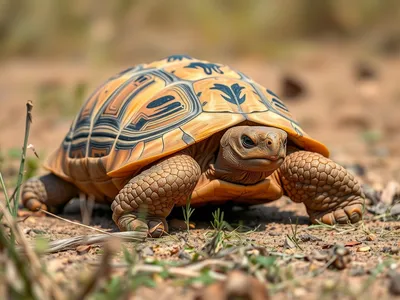
African Spurred Tortoise
Centrochelys sulcata
The sulcata is the largest mainland tortoise on Earth — outweighed only by the island giants of Aldabra and Galapagos — and it can pass 100 kg. It survives the Sahel by engineering its own climate: it excavates burrows that can run 3 m deep and over 10 m long, where humidity stays high and temperature stable, and it aestivates through the worst of the dry season inside. Those burrows are a keystone resource, sheltering rodents, snakes, lizards and invertebrates that would otherwise cook. The tortoise stores water in an enlarged bladder and reabsorbs it as needed, which is why it can go months without drinking, feeding on dry grasses that most herbivores cannot digest. The "spurs" of its name are the conical, horny scales on the back of each thigh. Its size is also its tragedy in captivity: sold as a hatchling the size of a golf ball, it grows into a burrowing, fence-flattening animal that outlives its owner, and reptile rescues across the United States are permanently overwhelmed with abandoned adults.
Other habitats
 Polar Regions
Arctic
Cold, frozen landscapes around the North Pole with specialized wildlife adapted to extreme cold.
 Arid Regions
Desert
Arid lands with minimal rainfall, extreme temperatures, and specialized wildlife adapted to harsh conditions.
 Polar and Subpolar Regions
Tundra
Cold, treeless regions with permafrost supporting specialized cold-adapted wildlife.
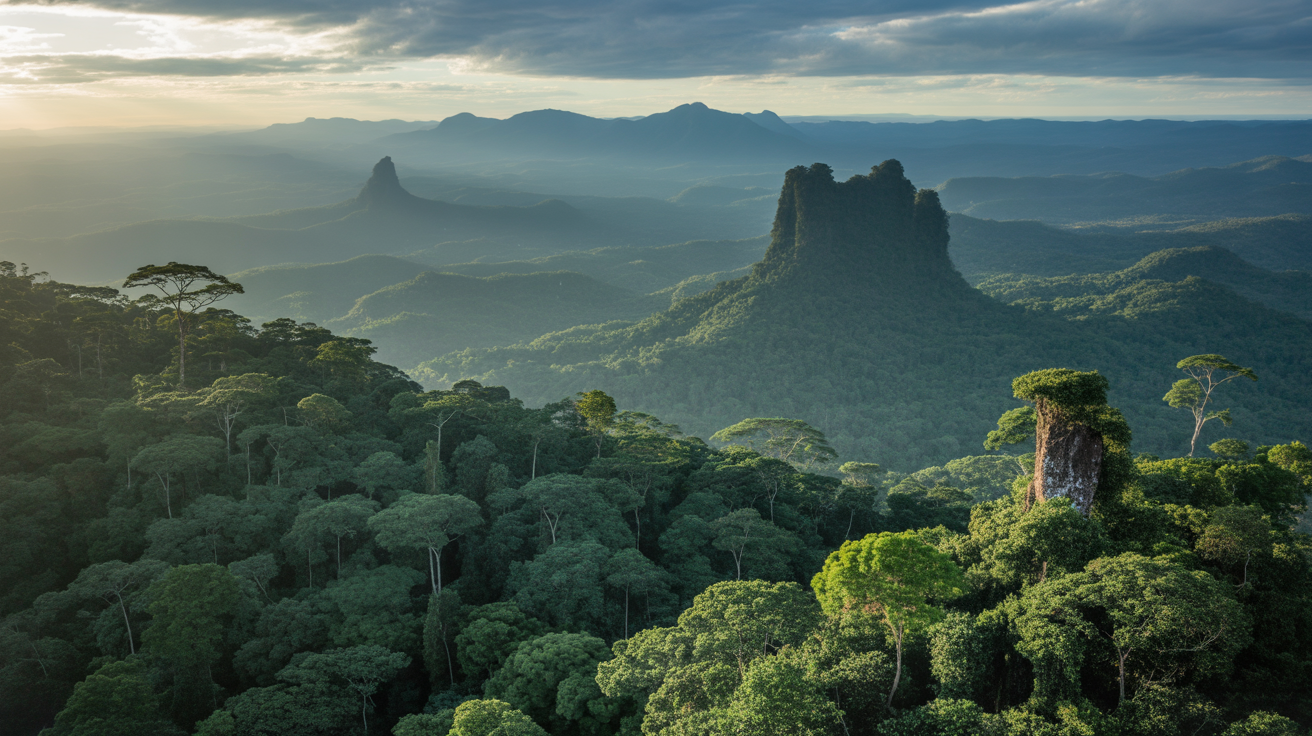 Tropical Regions
Rainforest
Dense, wet forests with the highest biodiversity on Earth, containing more than half of the world's plant and animal species.
 Elevated Terrain
Mountain
High-altitude environments with varying climates and specialized wildlife adapted to rugged terrain and thin air.
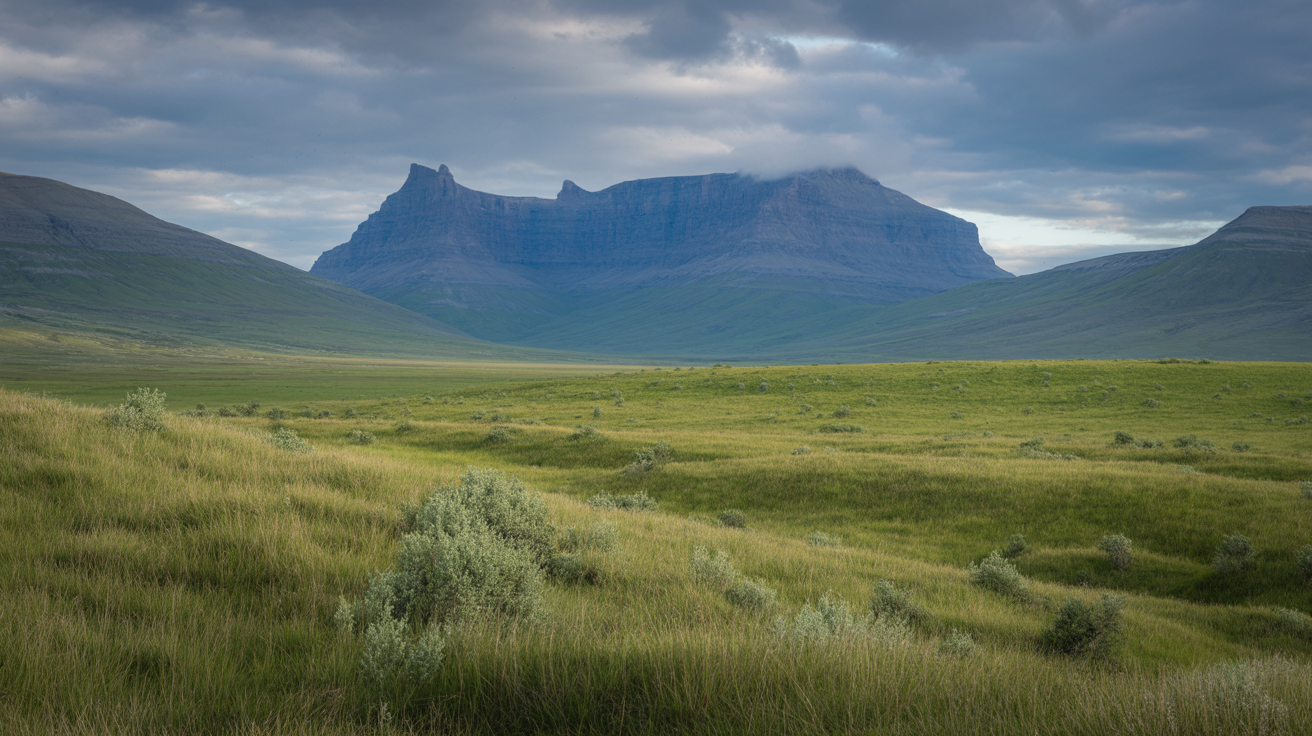 Various Continental Regions
Grassland
Open areas dominated by grasses rather than trees, supporting numerous herbivores and their predators.