
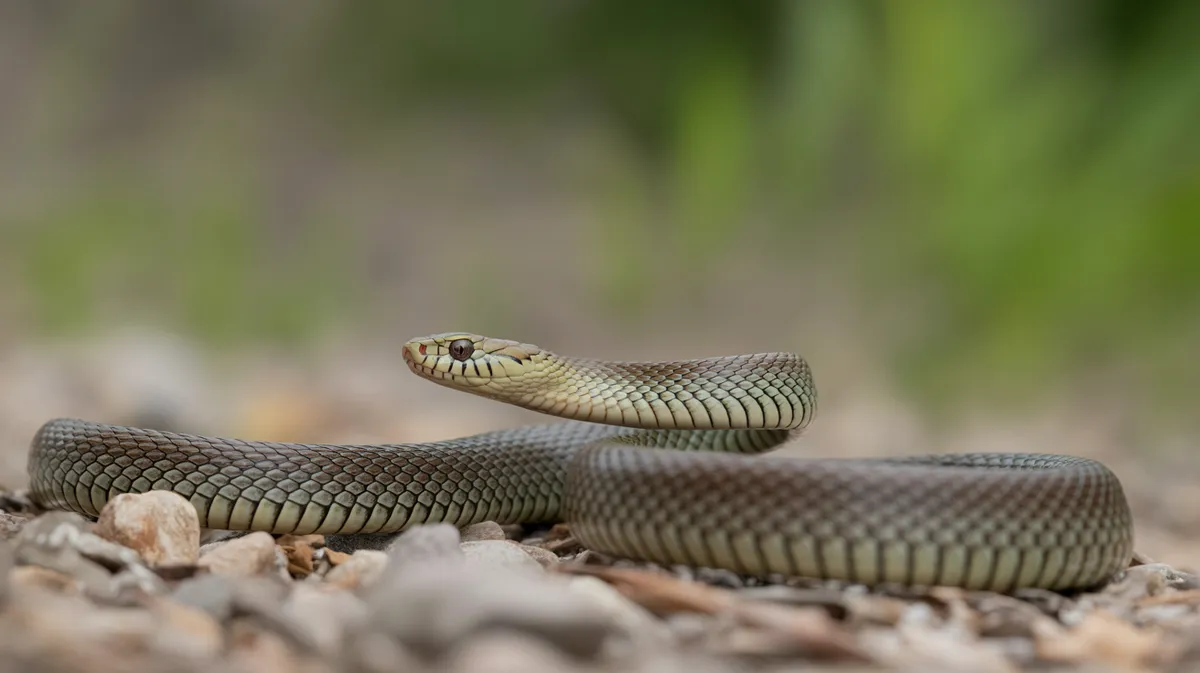
About the Barbados Threadsnake
The Barbados threadsnake is the smallest snake in the world: an adult is about 10 cm long and roughly as thick as a strand of spaghetti, and one can coil comfortably on a US quarter. It was described only in 2008, by Blair Hedges, from specimens including one that had been sitting misidentified in a museum for decades. Its size is close to an actual physical floor for snakes, and the reason is reproductive: it lays a single egg, and the hatchling emerges about half the length of its mother. That ratio is extreme, and it reflects a hard constraint — a snake much smaller than this could not produce an offspring large enough to survive and still fit inside itself. Big snakes lay many small eggs; the smallest species are forced into one relatively enormous one. It is a blind, burrowing snake, effectively eyeless, that eats termite and ant larvae underground. It is known only from a few fragments of forest on Barbados, an island whose native forest has been almost entirely cleared for sugar cane.
Fascinating facts
Smallest Snake
The Barbados Threadsnake holds the record as the smallest known snake species in the world.
Single Large Egg
Females usually lay only one egg at a time, but it is proportionally large compared to the size of the mother.
Endemic to Barbados
This species is found nowhere else on Earth except for the island of Barbados.
Detailed description
The Barbados Threadsnake (Tetracheilostoma carlae) is the smallest known snake species, with adults typically measuring between 97 and 104 mm in total length and rarely exceeding 2.5 mm in diameter. Its body is highly elongated, cylindrical, and uniformly slender, resembling a dark brown or black earthworm, with a blunt head and tail that are difficult to distinguish at first glance. The scales are smooth and glossy, aiding in movement through soil and leaf litter. The eyes are vestigial, appearing as small dark spots beneath the head scales, reflecting its largely subterranean lifestyle. The mouth is tiny and positioned ventrally, adapted for consuming minute prey. This species lacks any visible sexual dimorphism, making males and females externally indistinguishable. It is fossorial, spending nearly its entire life beneath the surface, emerging only rarely, typically after heavy rainfall. The snake's tongue is forked and highly sensitive, used to detect chemical cues from prey. Its overall morphology and physiology are specialized for a cryptic, burrowing existence in the dry forests and shrublands of Barbados.
Did you know?
Despite being a snake, its eyes are almost vestigial and it relies heavily on its sense of smell and touch to navigate underground.
Research & sources
Wikipedia summary
The Barbados threadsnake is a species of threadsnake. It is the smallest known snake species. This member of the Leptotyphlopidae family is found on the Caribbean islands of Barbados and Anguilla.
Behaviour & social structure
Barbados Threadsnakes are solitary and secretive, rarely observed above ground. They are primarily nocturnal or crepuscular, becoming active during the cooler, more humid periods of the day or after rainfall. Their hunting strategy involves actively burrowing through loose soil and leaf litter, using chemosensory cues to locate prey. Their diet consists almost exclusively of the larvae and eggs of ants and termites, which they consume whole due to their small size and limited gape. The species exhibits minimal aggression and relies on stealth and its diminutive size to avoid predation. There is no evidence of territoriality or complex social interactions; individuals appear to tolerate conspecifics only during the breeding season. When threatened, they may coil tightly or attempt to burrow rapidly to escape.
Reproduction & life cycle
Reproductive biology in T. carlae is not fully documented due to the species' elusive nature, but available evidence suggests that it is oviparous, laying a single, relatively large egg per clutch—an adaptation to its extremely small body size. The egg is proportionally the largest among snakes relative to the mother's body size, and the hatchling emerges at nearly half the length of the adult. Breeding is presumed to occur during the wet season, when humidity is highest and food resources are more abundant. There is no known parental care after egg-laying; the young are independent from birth. The reproductive cycle, including incubation period and frequency of breeding, remains poorly understood and is a subject of ongoing research.
Adaptations & survival
Tetracheilostoma carlae exhibits several remarkable adaptations for its microhabitat and lifestyle. Its minute size allows it to exploit ecological niches unavailable to larger predators, such as the narrow tunnels of ant and termite nests. The reduced, vestigial eyes are an adaptation to a subterranean existence, where vision is less important than chemosensory detection. The smooth, glossy scales minimize friction and facilitate movement through soil and detritus. The snake's metabolism is likely very low, consistent with its small size and infrequent feeding opportunities. Its ability to subsist on the eggs and larvae of social insects is a highly specialized dietary adaptation. The production of a single, large egg maximizes offspring survival in an environment where resources are scarce and predation risk is high.
Cultural significance
Due to its cryptic nature and diminutive size, the Barbados Threadsnake has little direct cultural significance in local folklore or tradition. It is not known to be used in traditional medicine or as a food source. However, its discovery as the world's smallest snake has attracted international scientific and media attention, highlighting the unique biodiversity of Barbados and the importance of conserving its endemic fauna. The species is sometimes referenced in educational materials and conservation campaigns to illustrate the fragility and uniqueness of island ecosystems.
Recent research
Since its formal description by S. Blair Hedges in 2008, research on T. carlae has focused on its taxonomy, morphology, and evolutionary significance as an example of extreme miniaturization in vertebrates. Molecular studies have clarified its placement within the Leptotyphlopidae family and its relationship to other Caribbean threadsnakes. Ongoing research aims to better understand its reproductive biology, population genetics, and ecological requirements. Recent field surveys have highlighted the urgent need for habitat protection and further study of its distribution and abundance. The species serves as a model for studying the evolutionary and ecological limits of vertebrate body size.
Videos
Habitat
Subtropical dry forest and shrubland, primarily under leaf litter and stones

Conservation
The Barbados Threadsnake is currently classified as Critically Endangered on the IUCN Red List.
Threats & challenges
The Barbados Threadsnake is classified as Critically Endangered by the IUCN due to its extremely limited range, ongoing habitat loss, and fragmentation from urbanization, agriculture, and invasive species. The dry forests and shrublands where it resides are under severe pressure from human development, leading to declines in both habitat quality and quantity. Invasive predators such as rats, mongooses, and domestic cats may prey on eggs or juveniles. The species' secretive habits and low population density make monitoring and conservation efforts challenging. Climate change, with its potential to alter rainfall patterns and humidity, poses an additional threat to this moisture-dependent species. Current population trends are unknown, but the species is considered rare and declining.
Taxonomy
Scientific name
Tetracheilostoma carlae
- Kingdom
- Animalia
- Phylum
- Chordata
- Class
- Reptilia
- Order
- Squamata
- Family
- Leptotyphlopidae
- Genus
- Tetracheilostoma
- Species
- carlae
Community notes
Share your observations about the Barbados Threadsnake.
No community notes yet. Be the first!
Discover more wildlife
More fascinating animals from the encyclopedia.