
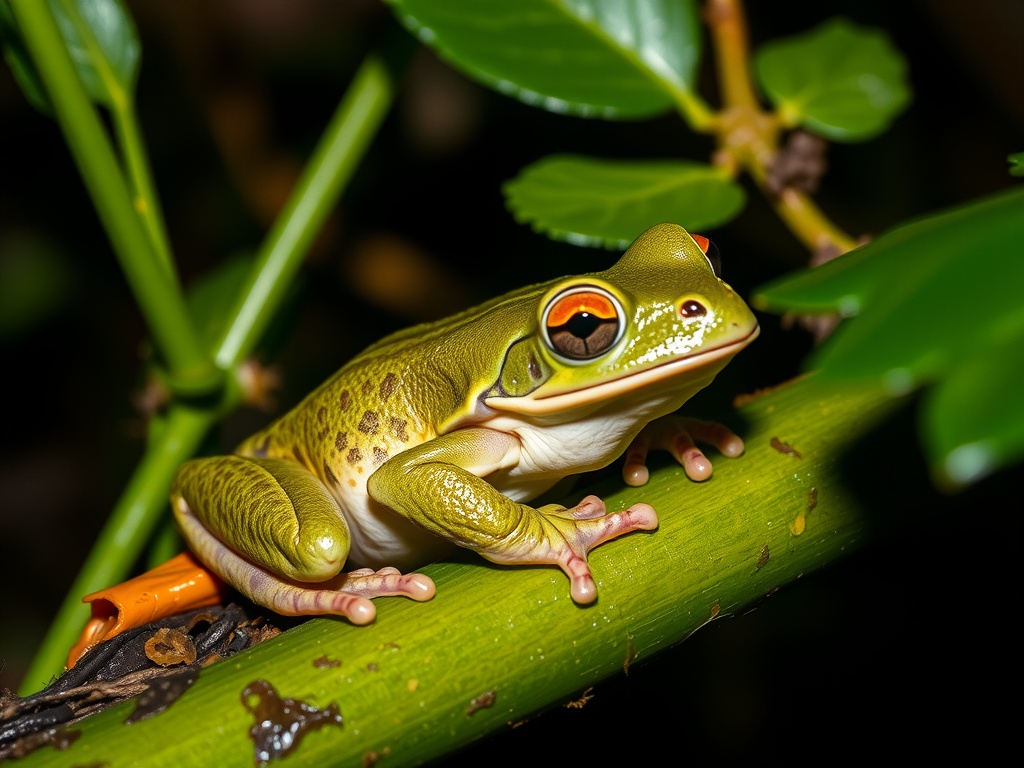
About the Barbour's Tree Frog
Barbour's Tree Frog is a small, nocturnal amphibian found in parts of South America, particularly in Brazil, Bolivia, and Paraguay. It is known for its adaptability, thriving in both pristine forests and disturbed habitats such as gardens and cattle pastures. This frog is recognized for its slender body, long limbs, and distinctive coloration, which often includes brown, yellow, or green hues with variable patterns. Barbour's Tree Frog is an excellent climber, using its adhesive toe pads to move among vegetation, where it feeds on small insects.
Fascinating facts
Arboreal Lifestyle
Barbour's Tree Frog spends most of its life in trees and shrubs, rarely descending to the ground except for breeding.
Distinctive Calls
Males produce rapid, high-pitched trills at night to attract females during the breeding season.
Insect Eater
The diet of Barbour's Tree Frog consists mainly of small insects and other invertebrates, which it hunts on leaves and branches.
Detailed description
Barbour's Tree Frog (Dendropsophus minutus) is a small, slender-bodied hylid frog, with adult snout-vent lengths typically ranging from 18 to 28 mm, females generally being larger than males. The dorsal coloration is highly variable, often featuring shades of brown, yellow, green, or gray, sometimes with longitudinal stripes or irregular blotches, which provide effective camouflage among leaves and branches. The ventral surface is usually pale or whitish. Its limbs are long and delicate, with well-developed adhesive toe pads that facilitate arboreal locomotion. The skin is smooth, and the head is relatively broad with prominent, laterally positioned eyes adapted for nocturnal vision. This species is primarily nocturnal, emerging at dusk to forage and breed. D. minutus is highly adaptable, occupying a wide range of habitats from primary rainforests to urban gardens and agricultural landscapes, and can be found at elevations from sea level up to 2,000 meters. Its vocalizations are a key aspect of its reproductive behavior, with males producing a series of high-pitched, pulsed calls to attract females and establish territories. The species is known for its explosive breeding during the rainy season, with large aggregations forming around temporary water bodies. Tadpoles are aquatic and undergo metamorphosis within a few weeks, depending on environmental conditions.
Did you know?
Barbour's Tree Frog is one of the most widespread tree frog species in South America, with populations adapting to both natural and urban environments.
Research & sources
Behaviour & social structure
Dendropsophus minutus exhibits primarily nocturnal activity, spending daylight hours concealed in vegetation or leaf litter to avoid desiccation and predation. At night, individuals ascend shrubs, grasses, or low branches to hunt for small invertebrates, including flies, mosquitoes, spiders, and other arthropods. Their hunting strategy is largely sit-and-wait, relying on their cryptic coloration and quick, precise jumps to capture prey. Social interactions intensify during the breeding season, when males congregate in chorus groups near water bodies, engaging in vocal competition. Aggressive encounters between males are rare but may include physical displays or brief wrestling. Outside the breeding season, the species is generally solitary. D. minutus is also known for its tolerance of disturbed habitats and can be found in human-modified environments, often exploiting artificial water sources for breeding.
Reproduction & life cycle
Breeding in Barbour's Tree Frog is closely tied to rainfall, with reproduction occurring during the wet season, which varies regionally but typically spans from October to March in much of its range. Males establish calling sites near temporary or permanent water bodies, such as ponds, ditches, or flooded fields. The advertisement call is a rapid, pulsed trill, repeated at intervals to attract females. Amplexus is axillary, and females lay clutches of 100–400 eggs, usually attached to submerged vegetation or directly in the water. Embryonic development is rapid, with hatching occurring within 1–3 days depending on temperature. Tadpoles are free-swimming and feed on detritus and algae; metamorphosis is completed in 3–6 weeks. There is no parental care after egg deposition. The species’ ability to exploit ephemeral water bodies reduces predation risk for eggs and larvae.
Adaptations & survival
D. minutus possesses several adaptations for arboreal and aquatic life. Its expanded toe pads contain specialized epithelial cells that secrete mucus, enhancing adhesion to smooth or wet surfaces. The species’ variable coloration provides camouflage in diverse habitats, aiding in predator avoidance. Nocturnal habits reduce exposure to diurnal predators and minimize water loss. Rapid reproductive cycles and the ability to breed in temporary water bodies allow the species to exploit unpredictable environments and avoid aquatic predators. Physiologically, the species can tolerate a wide range of temperatures and humidity levels, contributing to its broad geographic distribution.
Cultural significance
Barbour's Tree Frog does not have significant roles in indigenous folklore or mythology, likely due to its small size and cryptic habits. However, like many Neotropical frogs, it is an important component of local ecosystems and is occasionally referenced in environmental education programs as an indicator of ecosystem health. Its adaptability and presence in urban areas make it a familiar species to rural and suburban communities in South America, where its nighttime calls are a common sound during the rainy season.
Recent research
Recent research on D. minutus has focused on its remarkable genetic diversity and cryptic speciation. Molecular studies have revealed that what was once considered a single species may comprise a complex of several genetically distinct lineages, some of which may warrant recognition as separate species. Studies on its call variation have provided insights into reproductive isolation and speciation processes. Additionally, D. minutus has been used as a model organism in studies of amphibian disease ecology, particularly in relation to chytrid fungus susceptibility and environmental stressors. Ongoing research is examining the species’ adaptability to urban environments and the potential impacts of climate change on its reproductive phenology.
Sources
Cryptic diversity in the widespread tree frog Dendropsophus minutus (Anura, Hylidae): Integrative taxonomy reveals multiple species
Fouquet, A. et al. (2016)
scientificDendropsophus minutus: The IUCN Red List of Threatened Species 2020
IUCN SSC Amphibian Specialist Group
conservationVideos
Habitat
Tropical and subtropical forests, shrublands, and wetlands
 Various Continental Regions
Grassland
Open areas dominated by grasses rather than trees, supporting numerous herbivores and their predators.
 Tropical Regions
Rainforest
Dense, wet forests with the highest biodiversity on Earth, containing more than half of the world's plant and animal species.
 Global
Forest
Wooded areas with significant tree cover and diverse plant and animal communities.
 Global
Freshwater
Lakes, rivers, and wetlands with diverse aquatic ecosystems.
Conservation
The Barbour's Tree Frog is currently classified as Least Concern on the IUCN Red List.
Threats & challenges
Although currently listed as Least Concern by the IUCN, D. minutus faces localized threats from habitat loss due to deforestation, agricultural expansion, urbanization, and pollution of aquatic breeding sites. The species’ adaptability has allowed it to persist in many disturbed environments, but populations may decline in areas with intensive pesticide use or severe habitat fragmentation. Emerging infectious diseases, such as chytridiomycosis caused by Batrachochytrium dendrobatidis, have been detected in some populations, though the impact appears limited compared to more sensitive amphibian species. Climate change, particularly alterations in rainfall patterns, may affect breeding success in the future. Overall, the species remains widespread and abundant, with stable population trends across most of its range.
Taxonomy
Scientific name
Dendropsophus minutus
- Kingdom
- Animalia
- Phylum
- Chordata
- Class
- Amphibia
- Order
- Anura
- Family
- Hylidae
- Genus
- Dendropsophus
- Species
- minutus
Community notes
Share your observations about the Barbour's Tree Frog.
No community notes yet. Be the first!
Discover more wildlife
More fascinating animals from the encyclopedia.