
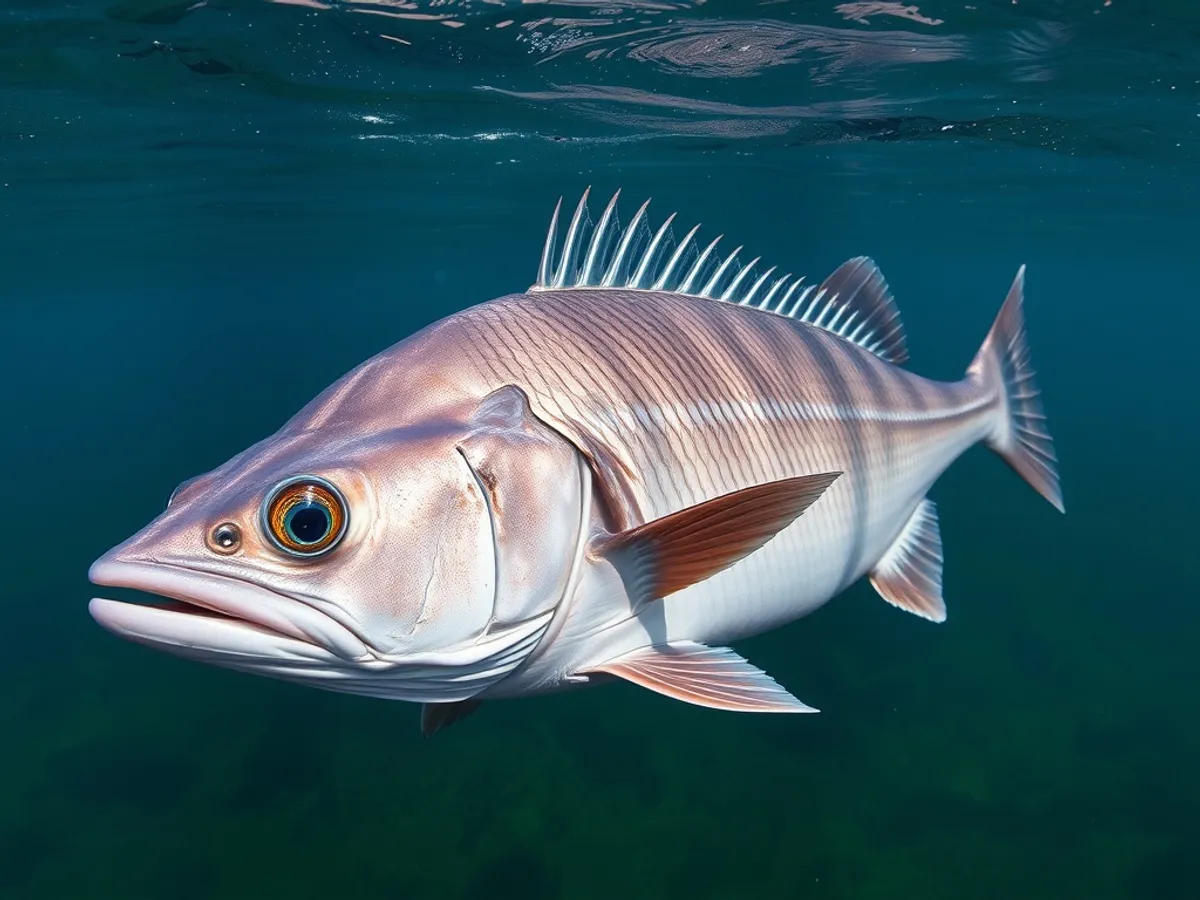
About the Barramundi
The barramundi is a large, predatory fish native to the Indo-West Pacific region, particularly found in northern Australia and Southeast Asia. This species is known for its adaptability, thriving in both freshwater and saltwater environments, including rivers, estuaries, and coastal waters. Barramundi are highly regarded both as a sport fish and for their culinary value, owing to their mild-flavored, flaky flesh. They exhibit fascinating reproductive behavior, changing sex from male to female as they mature, and play an important role in local ecosystems.
Fascinating facts
Amphidromous Lifestyle
Barramundi can live in both freshwater and saltwater, migrating between habitats throughout their life.
Sex Change
Most barramundi are born male and change to female as they grow older and larger, typically after spawning at least once.
Important Food Source
Barramundi is a popular fish for both commercial fisheries and aquaculture, prized for its mild flavor and high nutritional value.
Detailed description
The barramundi (Lates calcarifer) is a robust, elongated fish that can reach lengths of up to 1.8 meters and weights exceeding 60 kilograms, though most individuals encountered are considerably smaller. Its body is laterally compressed with a large, slightly oblique mouth and a protruding lower jaw, well-adapted for ambush predation. The coloration is typically silvery with a darker dorsal surface, providing camouflage in both turbid and clear waters. Barramundi possess a deeply forked tail and two distinct dorsal fins, the first spiny and the second soft-rayed. Their scales are large, cycloid, and contribute to their streamlined form. This species is catadromous, migrating from freshwater habitats to estuarine or marine environments to spawn. Barramundi are euryhaline, tolerating a wide range of salinities, which allows them to inhabit rivers, floodplains, billabongs, estuaries, and coastal lagoons. They exhibit protandrous hermaphroditism, maturing first as males and later transforming into females, a reproductive strategy that maximizes fecundity. Highly valued in commercial and recreational fisheries, barramundi are also extensively farmed in aquaculture due to their rapid growth and adaptability. In the wild, they are apex predators, playing a crucial ecological role in controlling populations of smaller fish and crustaceans.
Did you know?
Some barramundi can grow over 1.8 meters (6 feet) in length, making them one of the largest fish in their range.
Research & sources
Wikipedia summary
The barramundi, Asian sea bass, or giant sea perch is a species of catadromous fish in the family Latidae of the order Carangiformes. The species is widely distributed in the Indo-West Pacific, spanning the waters of the Middle East, South Asia, Southeast Asia, East Asia, and Oceania.
Behaviour & social structure
Barramundi are primarily solitary and crepuscular, most active during dawn and dusk when they hunt. As opportunistic carnivores, they employ a sit-and-wait strategy, using their excellent vision and lateral line system to detect prey. Their diet consists mainly of smaller fish, crustaceans, and insects, with juveniles focusing on zooplankton and aquatic invertebrates. Barramundi are capable of rapid acceleration, using a powerful suction feeding mechanism to engulf prey. During the wet season, they often move into flooded areas to exploit abundant food resources. Social interactions are limited outside of the breeding season, though aggregations may form during spawning migrations. They are known to exhibit site fidelity, especially in freshwater habitats, but will undertake long-distance movements to reach spawning grounds.
Reproduction & life cycle
Barramundi exhibit protandrous hermaphroditism: individuals mature as males at around 3–4 years of age (typically 50–60 cm in length) and may later transition to females, usually after one or more spawning seasons and at larger sizes (80–100 cm). Spawning occurs seasonally, often triggered by rising water temperatures and increased salinity during the wet season (November to February in northern Australia). Females release millions of pelagic eggs into estuarine or coastal waters, where external fertilization takes place. The eggs hatch within 12–17 hours, and larvae are planktonic for several weeks before settling into nursery habitats such as mangroves and tidal creeks. There is no parental care post-spawning. High fecundity and rapid early growth are key reproductive strategies, but larval survival is heavily dependent on environmental conditions.
Adaptations & survival
Barramundi are highly euryhaline, able to osmoregulate efficiently across a broad range of salinities, which enables them to exploit both freshwater and marine environments. Their protandrous hermaphroditism ensures optimal reproductive output by allowing larger, older individuals to become females, which produce more eggs. The species has a streamlined body and powerful caudal fin for rapid bursts of speed, aiding both in predation and escape from predators. Their large mouth and protrusible jaws enable effective suction feeding. Barramundi also possess a well-developed lateral line system for detecting vibrations, crucial for hunting in turbid or low-visibility waters. The ability to tolerate low dissolved oxygen levels allows them to survive in hypoxic floodplain habitats during the dry season.
Cultural significance
Barramundi hold significant cultural value for Indigenous Australians, featuring prominently in traditional stories, art, and as a staple food source for millennia. The name 'barramundi' is derived from the Australian Aboriginal language of the Rockhampton area in Queensland, meaning 'large-scaled river fish.' The species is celebrated in recreational fishing communities for its fighting ability and culinary qualities. In Southeast Asia, barramundi is a popular food fish, commonly found in markets and restaurants, and is also important in aquaculture industries across the Indo-Pacific. Symbolically, barramundi are associated with abundance and adaptability in various local cultures.
Recent research
Recent research has focused on the genetic diversity and population structure of barramundi across its vast range, revealing significant regional differentiation that has implications for fisheries management and conservation. Advances in aquaculture have led to improved breeding techniques, disease management, and feed efficiency, making barramundi one of the fastest-growing farmed fish species. Studies on their reproductive biology have provided insights into the mechanisms of sex change and environmental triggers for spawning. Ongoing ecological research is examining the impact of climate change on barramundi migration patterns and estuarine nursery habitats. Additionally, investigations into their role as apex predators are shedding light on their influence within aquatic food webs.
Videos
Habitat
Rivers, estuaries, and coastal waters

Conservation
The Barramundi is currently classified as Least Concern on the IUCN Red List.
Threats & challenges
While barramundi are currently listed as Least Concern by the IUCN, they face localized threats from overfishing, habitat degradation (especially loss of mangroves and estuaries), water pollution, and barriers to migration such as dams and weirs. Climate change poses additional risks by altering rainfall patterns and estuarine salinity regimes, potentially impacting spawning success. In some regions, the introduction of invasive species and diseases has also affected wild populations. Sustainable management and aquaculture practices are essential to maintaining healthy stocks, as demand for barramundi continues to grow globally.
Taxonomy
Scientific name
Lates calcarifer
- Kingdom
- Animalia
- Phylum
- Chordata
- Class
- Actinopterygii
- Order
- Perciformes
- Family
- Latidae
- Genus
- Lates
- Species
- calcarifer
Where to see a barramundi
2 zoos and aquariums in 1 country are recorded as keeping this species.


Community notes
Share your observations about the Barramundi.
No community notes yet. Be the first!
Discover more wildlife
More fascinating animals from the encyclopedia.