
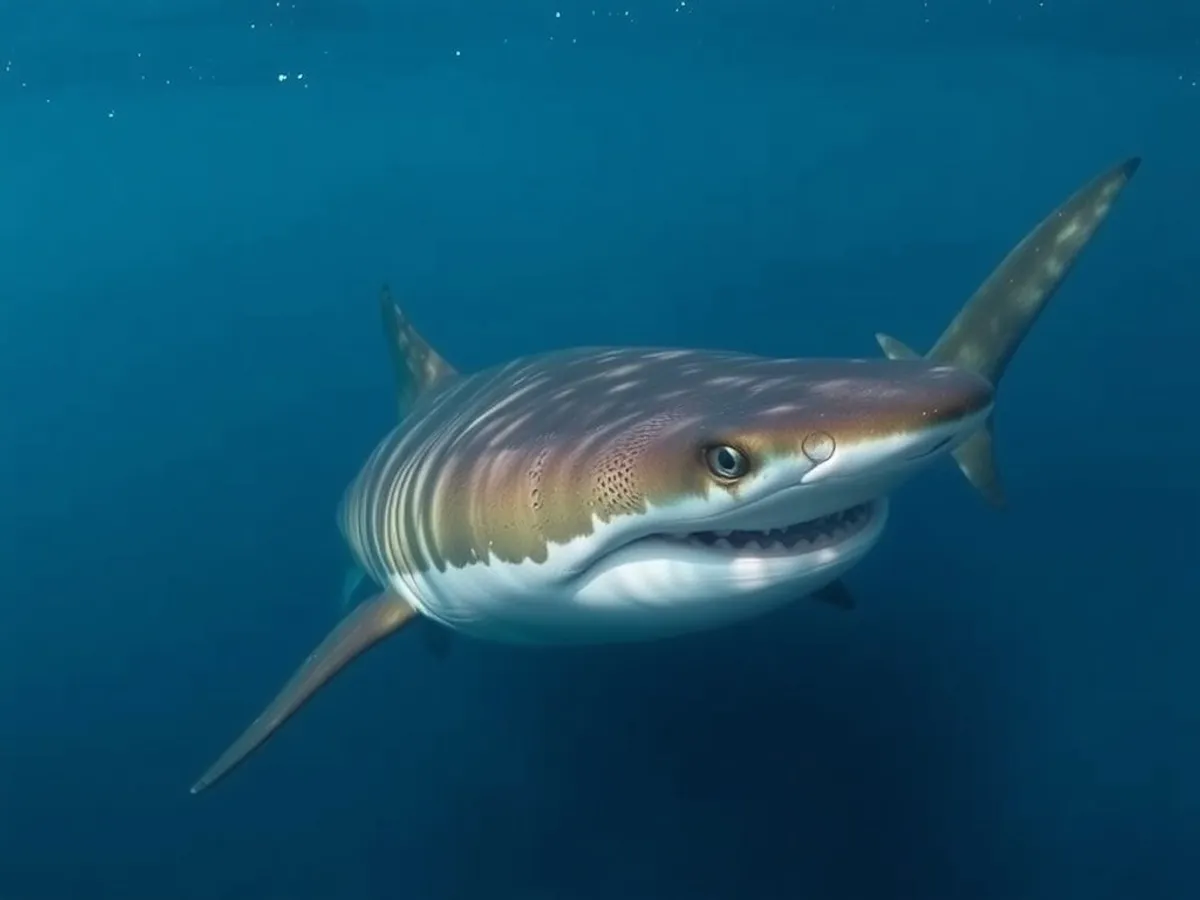
About the Basking Shark
The basking shark is the second-largest fish in the world and one of the most harmless. It feeds by simply swimming forward with its mouth open, a gape wide enough to swallow a person whole, straining plankton from the water with gill rakers — bristly combs lining the gill arches — and processing an enormous volume of seawater every hour. It has teeth, but they are tiny and effectively useless, vestiges of an ancestor that ate very differently. Because it filters passively rather than pumping, it must keep moving to feed at all, which is why it cruises slowly at the surface with its dorsal fin cutting the water — the behaviour that gave it its name, since it looks as though it is basking in the sun. It sheds and regrows its gill rakers seasonally, and where it goes and what it does during those months was a mystery until satellite tagging revealed long migrations and deep dives. It is slow to mature and slow to breed, which is why centuries of hunting for its enormous, oil-rich liver hit it so hard.
Fascinating facts
Giant Filter Feeder
The basking shark's mouth can open over 1 meter wide, allowing it to filter huge volumes of water for plankton.
Surface Swimmer
They often swim close to the surface with dorsal and snout fins visible, leading to frequent sightings by sailors and coastal observers.
Long Migrator
Basking sharks are highly migratory, with some individuals traveling thousands of kilometers between feeding and breeding grounds.
Detailed description
The basking shark (Cetorhinus maximus) is a colossal pelagic filter-feeder, second only to the whale shark in size, with adults typically measuring 7–10 meters (23–33 feet) in length and weighing up to 5.2 metric tons. Its most distinctive features are its cavernous mouth, which can open up to 1 meter (3.3 feet) wide, and five massive gill slits that nearly encircle the head, facilitating efficient filter-feeding. The body is fusiform and streamlined, with a conical snout, large dorsal fin, and a crescent-shaped caudal (tail) fin with a pronounced lateral keel. Skin coloration ranges from slate gray to brownish-gray, often mottled, and the skin itself is rough, covered in dermal denticles. The basking shark's liver is enormous, constituting up to 25% of its body weight, and is rich in squalene, aiding buoyancy. This species is ectothermic and migratory, inhabiting temperate coastal and open ocean waters worldwide, often seen near the surface in spring and summer. Basking sharks are generally solitary but may aggregate in groups of up to 100 individuals during feeding or courtship. Despite their formidable size and gaping mouths, they are gentle, non-aggressive, and pose no threat to humans. Their slow swimming speed, around 3.7 km/h (2.3 mph), and placid demeanor make them easily observable by researchers and ecotourists.
Did you know?
Despite their massive size, basking sharks feed on some of the ocean's smallest organisms—tiny plankton.
Research & sources
Wikipedia summary
The basking shark is the second-largest living shark and fish, after the whale shark. It is one of three plankton-eating shark species, along with the whale shark and megamouth shark. Typically, basking sharks reach 7.9 m (26 ft) in length, but large individuals have been known to grow more than 10 m (33 ft) long. It is usually greyish-brown, with mottled skin, with the inside of the mouth being white in colour. The caudal fin has a strong lateral keel and a crescent shape. Other common names include bone shark, elephant shark, sailfish, and sunfish.
Behaviour & social structure
Basking sharks are obligate filter-feeders, swimming with their mouths wide open to sieve plankton, primarily copepods, small fish, and invertebrate larvae, from the water. They can filter up to 1,500–2,000 cubic meters (53,000–71,000 cubic feet) of water per hour using gill rakers—specialized, comb-like structures that trap food particles. Feeding typically occurs near the surface, but recent tagging studies reveal they also feed at depths up to 1,000 meters (3,280 feet), especially outside peak plankton blooms. Basking sharks are diurnal, with feeding activity peaking during daylight hours when plankton concentrations are highest. While often solitary, they may form loose aggregations, particularly during feeding or courtship, and exhibit synchronized swimming or parallel swimming behaviors. Social interactions are generally peaceful, though courtship can involve more dynamic behaviors such as breaching, circling, and following. They are known to undertake long seasonal migrations, sometimes crossing entire ocean basins in search of optimal feeding grounds.
Reproduction & life cycle
Basking sharks are ovoviviparous, meaning embryos develop inside eggs that hatch within the mother's body, and she gives birth to live young. Mating is believed to occur in early summer, with courtship involving parallel swimming, following, and occasional breaching. Gestation is estimated to last 2.5–3.5 years—one of the longest among vertebrates—though precise data are limited due to the rarity of observations. Litters are small, typically 2–6 pups, each measuring 1.5–2 meters (5–6.5 feet) at birth. There is no parental care post-birth; pups are independent immediately. Sexual maturity is reached at 12–16 years for females and 6–13 years for males, with a likely reproductive cycle of 2–4 years, contributing to the species' vulnerability to overexploitation.
Adaptations & survival
The basking shark exhibits several remarkable adaptations for its filter-feeding lifestyle. Its enormous mouth and highly developed gill rakers enable efficient extraction of plankton from large volumes of water. The liver, filled with squalene, provides buoyancy and energy reserves for long migrations and periods of low food availability. The skin's dermal denticles reduce drag and protect against parasites. Basking sharks can regulate their vertical position in the water column, allowing them to exploit different plankton layers. Their slow metabolism is suited to a low-energy, plankton-based diet. Behavioral adaptations include seasonal migrations to exploit plankton blooms and the ability to enter deep water to avoid predators or unfavorable conditions.
Cultural significance
Historically, basking sharks were exploited in Europe and Asia for their oil-rich livers, which were used for lamp oil, lubricants, and later in cosmetics and pharmaceuticals. Their fins were also valued in the shark fin trade. In folklore, basking sharks were sometimes mistaken for sea monsters or the remains of mythical creatures due to their size and unusual appearance. Today, they are increasingly recognized as icons of marine conservation and ecotourism, particularly in the British Isles, Canada, and New Zealand, where sightings attract wildlife enthusiasts and support local economies.
Recent research
Recent research using satellite tagging and genetic analysis has revealed complex migratory patterns, including transoceanic movements and deep-diving behavior. Studies have shown that basking sharks can switch between surface and deep-water feeding, challenging the earlier belief that they were strictly surface feeders. Genetic studies indicate low global genetic diversity, raising concerns about resilience to environmental change. Ongoing research focuses on population structure, reproductive biology, and the impacts of climate change on plankton availability. Conservation genetics and non-invasive tagging technologies are helping to inform management strategies and international protection efforts.
Videos
Habitat
Temperate coastal and open ocean waters

Conservation
The Basking Shark is currently classified as Endangered on the IUCN Red List.
Threats & challenges
Basking sharks face significant threats from historical and ongoing human activities. They were heavily targeted for their liver oil, fins, meat, and cartilage, leading to drastic population declines in the 20th century. Bycatch in commercial fisheries, ship strikes, and entanglement in fishing gear remain persistent threats. Their slow growth, late maturity, and low reproductive rate hinder population recovery. Habitat degradation, climate change, and shifts in plankton distribution due to ocean warming may further impact their survival. The species is listed as Endangered by the IUCN and is protected under CITES Appendix II, with various national and international conservation measures in place. Population trends suggest slow or uncertain recovery in many regions.
Taxonomy
Scientific name
Cetorhinus maximus
- Kingdom
- Animalia
- Phylum
- Chordata
- Class
- Chondrichthyes
- Order
- Lamniformes
- Family
- Cetorhinidae
- Genus
- Cetorhinus
- Species
- maximus
Community notes
Share your observations about the Basking Shark.
No community notes yet. Be the first!
Discover more wildlife
More fascinating animals from the encyclopedia.