
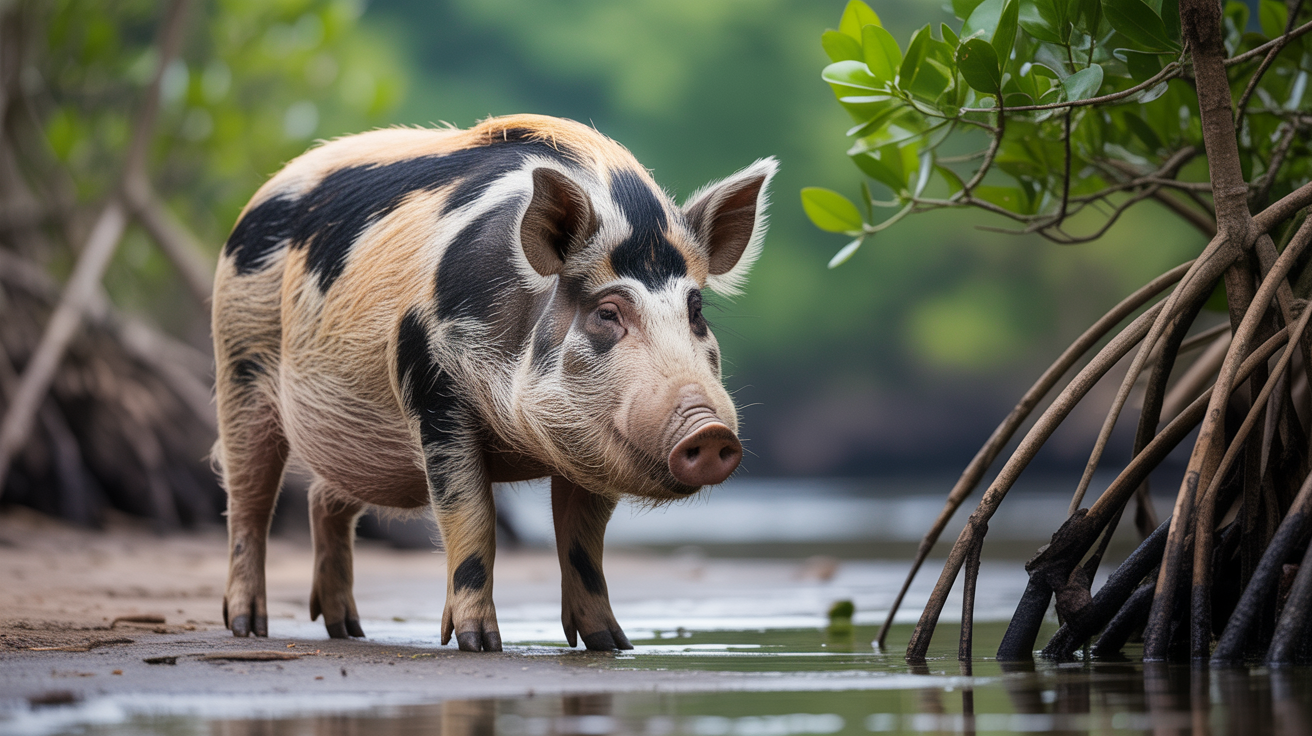
About the Bearded Pig
The bearded pig is a wild pig species native to Southeast Asia, easily recognizable by the distinctive beard-like whiskers that grow along its snout and cheeks. It has a relatively slender body, long legs, and a shaggy coat that ranges from gray to brown, providing effective camouflage in its forested habitat. Bearded pigs are highly adaptable foragers, often traveling long distances in search of food, and are known for their migratory behavior in response to fruiting events. They play a vital ecological role in seed dispersal and forest regeneration. Social and intelligent, bearded pigs often form small groups called sounders, especially when food is abundant.
Fascinating facts
Not Just a Forest Pig
Bearded pigs also inhabit mangroves, swamps, and coastal areas, showing tremendous adaptability to different environments.
Forest Regenerators
Their foraging habits help disperse seeds throughout the forest, making them important contributors to ecosystem health.
Long-Distance Travelers
Bearded pigs are known for their impressive migrations, sometimes traveling over 50 kilometers in search of seasonal food sources.
Detailed description
The bearded pig (Sus barbatus) is a medium-to-large wild suid distinguished by its prominent facial 'beard'—a dense fringe of coarse, whitish bristles extending from the jaw and cheeks. Adults typically measure 100–165 cm in body length, stand 60–100 cm at the shoulder, and weigh between 40–100 kg, with males generally larger than females. Their elongated heads, narrow snouts, and relatively long legs give them a more slender and agile appearance compared to other wild pigs. The coat is shaggy and varies from grayish-brown to dark brown, often interspersed with lighter guard hairs, aiding in camouflage among leaf litter and undergrowth. Bearded pigs are highly social, forming sounders of up to 30 individuals, primarily composed of females and their offspring, while adult males are more solitary outside the breeding season. They are known for their remarkable migratory behavior, sometimes traveling tens of kilometers in response to the fruiting cycles of dipterocarp trees, which dominate their Southeast Asian rainforest habitats. Their omnivorous diet includes fruits, roots, tubers, invertebrates, small vertebrates, and carrion, and they are especially important seed dispersers. Bearded pigs communicate through a variety of vocalizations, grunts, and scent marking, and display complex social interactions including mutual grooming and cooperative foraging. Their ecological role is vital in maintaining forest dynamics, particularly through soil disturbance and seed dispersal.
Did you know?
Bearded pigs have been observed following groups of macaques to feed on leftover fruit dropped by the monkeys.
Research & sources
Wikipedia summary
Bearded pig may refer to:Bornean bearded pig, Sus barbatus, native to Sumatra, Borneo, and the Malay Peninsula Palawan bearded pig, Sus ahoenobarbus, native to the Philippines
Behaviour & social structure
Bearded pigs exhibit crepuscular to nocturnal activity patterns, foraging primarily at dawn and dusk but also during the night, especially in areas with high human disturbance. Their foraging behavior is characterized by rooting and digging with their strong snouts, often leaving conspicuous patches of disturbed soil. They are opportunistic feeders, adjusting their diet seasonally to exploit available resources such as fallen fruits during mast events, as well as earthworms, insects, and small vertebrates. Social structure is matrilineal, with females and their young forming stable sounders, while adult males join groups only during the breeding season. Communication within groups involves a repertoire of grunts, squeals, and body postures, facilitating coordination during migration and foraging. Bearded pigs are known for their seasonal migrations, which can span over 50 km, a rare behavior among wild pigs, triggered by large-scale fruiting events. They are also adept swimmers, capable of crossing rivers and even coastal waters to reach new habitats or islands.
Reproduction & life cycle
Bearded pigs are polygynous, with dominant males competing for access to receptive females during the breeding season, which typically coincides with periods of fruit abundance (often between November and January, but variable by region). Courtship involves vocalizations, scent marking, and physical displays. After mating, females undergo a gestation period of approximately 120 days (about 4 months). Litters usually consist of 2–8 piglets, which are born in well-concealed nests constructed from vegetation. Piglets are precocial, with distinctive longitudinal stripes that provide camouflage, and they begin foraging alongside the mother within a few weeks. Maternal care is pronounced, with females fiercely protective of their young. Weaning occurs at around 3–4 months, but juveniles may remain with the mother for up to a year. Sexual maturity is reached at 18–24 months.
Adaptations & survival
The bearded pig's most distinctive adaptation is its facial beard, which may serve as protection against undergrowth or play a role in social signaling. Their elongated, flexible snouts are highly sensitive and adapted for rooting and detecting food underground. Long legs and a streamlined body facilitate efficient movement through dense forests and enable long-distance migrations. Their omnivorous diet and flexible foraging strategies allow them to exploit a wide range of food resources, contributing to their ecological resilience. Behavioral adaptations include group living for enhanced predator detection and cooperative foraging, as well as migratory responses to resource fluctuations. Their swimming ability enables them to colonize offshore islands and traverse flooded habitats.
Cultural significance
Bearded pigs hold cultural importance for several indigenous groups in Borneo and Sumatra, where they are featured in folklore, rituals, and traditional hunting practices. In some Dayak communities, bearded pigs are considered a symbol of abundance and are hunted during communal feasts and ceremonies. Their meat is a valued protein source, and various body parts are used in traditional medicine or as ornaments. The species also appears in local myths, often associated with forest spirits or as a totem animal. However, increasing commercialization and habitat loss have altered traditional relationships, sometimes leading to overexploitation.
Recent research
Recent research has focused on the genetic differentiation between Bornean bearded pigs (Sus barbatus) and the closely related Palawan bearded pig (Sus ahoenobarbus), supporting the recognition of distinct species based on mitochondrial DNA and morphological differences. Studies using GPS tracking have documented the extensive migratory movements of bearded pigs in response to mast fruiting, highlighting the importance of landscape connectivity. Ongoing research is investigating the ecological role of bearded pigs in seed dispersal and forest regeneration, as well as the impacts of habitat fragmentation on their population genetics and disease susceptibility. Conservation genetics studies are underway to assess genetic diversity and inform management strategies. There is also increasing interest in the effects of zoonotic disease transmission between wild and domestic pigs in Southeast Asia.
Videos
Habitat
Tropical rainforest and mangrove forest


Conservation
The Bearded Pig is currently classified as Vulnerable on the IUCN Red List.
Threats & challenges
Bearded pigs face significant threats from habitat loss due to deforestation, logging, and conversion of forests to oil palm plantations across their range in Borneo, Sumatra, and the Malay Peninsula. Hunting for meat and traditional medicine, both for subsistence and commercial purposes, has led to population declines, especially in accessible areas. Fragmentation of habitats disrupts migratory routes, reducing access to critical seasonal food resources and increasing vulnerability to local extinctions. Disease transmission from domestic pigs, such as classical swine fever and African swine fever, poses additional risks. Population trends are generally declining, with some local extirpations reported. Conservation challenges include enforcing hunting regulations, protecting migratory corridors, and maintaining large tracts of contiguous forest.
Taxonomy
Scientific name
Sus barbatus
- Kingdom
- Animalia
- Phylum
- Chordata
- Class
- Mammalia
- Order
- Artiodactyla
- Family
- Suidae
- Genus
- Sus
- Species
- barbatus
Community notes
Share your observations about the Bearded Pig.
No community notes yet. Be the first!
Discover more wildlife
More fascinating animals from the encyclopedia.