
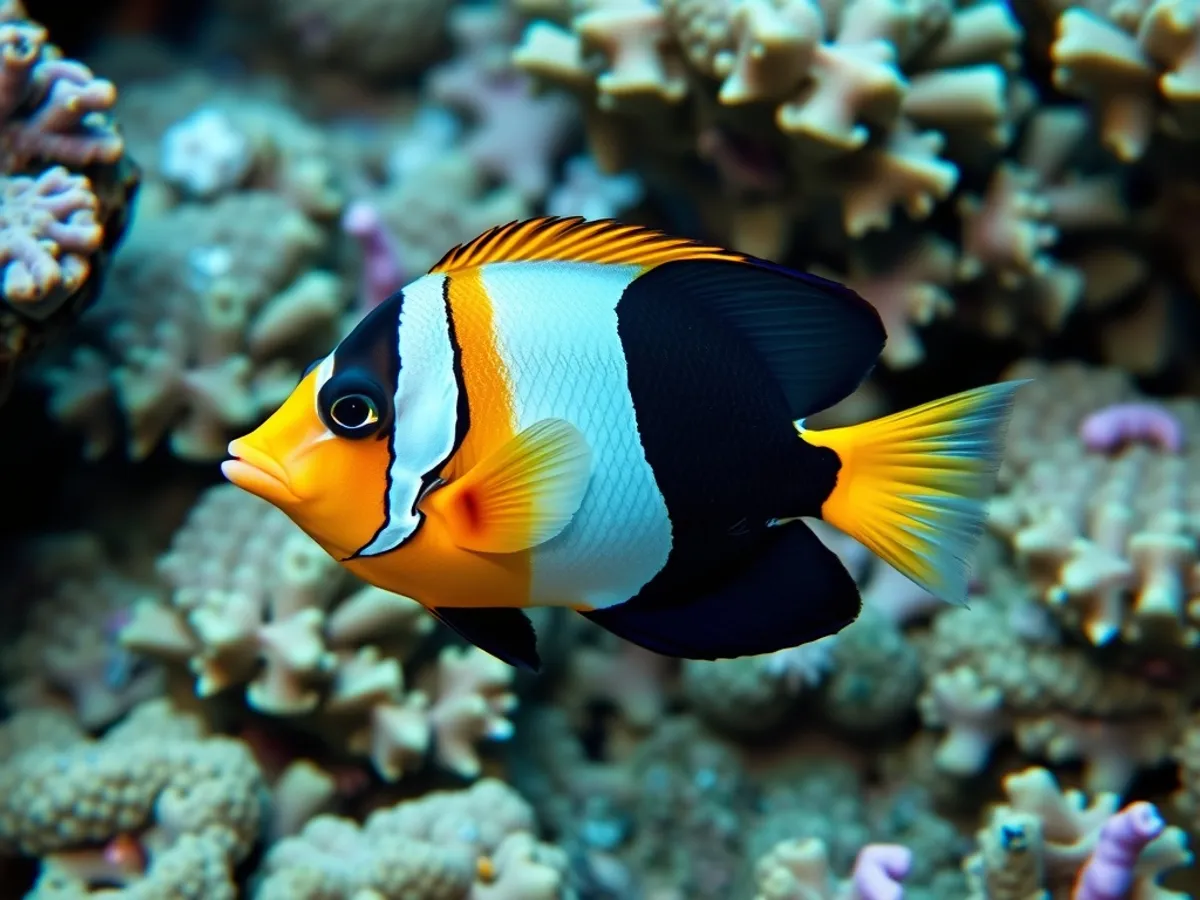
About the Bicolor Angelfish
The Bicolor Angelfish is a striking marine fish known for its vivid coloration, with a bright yellow anterior half and a deep blue posterior half. Native to the Indo-Pacific region, this small angelfish is a popular choice for home aquariums due to its bold appearance and manageable size. It prefers coral-rich lagoons and outer reef slopes, where it finds shelter among rocks and crevices. Bicolor Angelfish are generally shy but can become territorial, especially in confined spaces. In the wild, their diet consists mainly of algae, sponges, and small invertebrates.
Fascinating facts
Striking Colors
Bicolor Angelfish are easily recognized by their sharp color division—bright yellow from the head to mid-body and deep blue from mid-body to the tail.
Reef Dwellers
They inhabit coral-rich lagoons and outer reef slopes, where they hide among rocks and corals for protection.
Sex Changers
Bicolor Angelfish can change sex from female to male, a trait common among many marine angelfish species.
Detailed description
The Bicolor Angelfish (Centropyge bicolor) is a small, laterally compressed marine angelfish, typically reaching up to 15 cm (6 inches) in length. Its most distinguishing feature is its vivid coloration: the anterior half of the body, including the head and dorsal fin, is a bright canary yellow, while the posterior half is a deep royal blue, sharply demarcated at mid-body. The caudal fin is also yellow, and a characteristic blue bar runs vertically through the eye, with additional blue markings above the eye. The dorsal fin is continuous and elongated, containing 14–15 spines and 16–17 soft rays, while the anal fin has 3 spines and 17–18 soft rays. The body is covered in small, cycloid scales, and the mouth is small and terminal, adapted for grazing. Bicolor Angelfish are agile swimmers, using their pectoral fins for precise maneuvering among coral branches and rocky crevices. Their eyes are large and well-adapted for detecting movement and color in the complex reef environment. This species exhibits sexual dimorphism, with males often slightly larger and more vividly colored than females. In the wild, they are typically found at depths of 1–25 meters, favoring coral-rich lagoons and outer reef slopes. Their cryptic coloration and body shape provide effective camouflage among the corals, aiding in predator avoidance.
Did you know?
Despite their beauty, Bicolor Angelfish can be aggressive towards other small angelfish, especially when establishing their territory.
Research & sources
Wikipedia summary
The bicolor angelfish is a marine species of fish, easily recognizable by its yellow tail, yellow front half of their body, and blue rear with blue patterns above and around the eye. Other names of this angelfish include: Pacific rock beauty, oriole angelfish, oriole dwarf angel, blue and gold angel, and two-colored angel. The life expectancy of this fish in the wild varies greatly, depending on location, and ranges between 5 and 13 years. These fish tend to grow to a maximum of 6 inches in length. The larval stages lasts approximately 32 days.
Behaviour & social structure
Bicolor Angelfish are diurnal, spending daylight hours actively foraging and retreating to crevices or caves at night for protection. They are omnivorous, feeding primarily on benthic algae, detritus, sponges, tunicates, and small invertebrates such as polychaete worms and crustaceans. Their feeding behavior involves picking at substrate surfaces and probing into crevices with their small mouths. Socially, they are often observed singly or in pairs, though small loose groups may form in areas of high population density. They are territorial, with individuals or pairs defending feeding and sheltering territories against conspecifics and other small angelfish. Displays of aggression include lateral displays, chasing, and fin spreading. Juveniles are more secretive and tend to remain close to shelter. Daily routines include periods of active foraging interspersed with rest and vigilance for predators.
Reproduction & life cycle
Centropyge bicolor is a protogynous hermaphrodite, meaning individuals begin life as females and can transition to males, typically when a dominant male is absent. Spawning occurs at dusk, often during the warmer months, though seasonality varies by location. Courtship involves males displaying vibrant colors and performing a series of rapid, looping swims to attract females. Pairs ascend into the water column to release gametes simultaneously in a pelagic spawning event, after which fertilized eggs drift with the currents. There is no parental care; eggs hatch into planktonic larvae after approximately 24–48 hours. The larval stage lasts around 32 days, during which time larvae feed on zooplankton before settling onto the reef and metamorphosing into juveniles.
Adaptations & survival
The Bicolor Angelfish possesses several adaptations for reef life. Its laterally compressed body and small size allow it to navigate tight crevices and complex coral structures, providing both access to food and refuge from predators. Its bright coloration may serve as a warning to potential competitors or as camouflage among the vibrant reef backdrop. The species has a specialized digestive tract capable of processing both plant and animal matter, enabling dietary flexibility. Behavioral adaptations include territoriality and the ability to rapidly change direction to evade predators. The capacity for sex change (protogynous hermaphroditism) allows populations to maintain reproductive output even when sex ratios are skewed.
Cultural significance
The Bicolor Angelfish is highly valued in the marine aquarium trade due to its striking appearance and manageable size. It is sometimes featured in public aquaria and marine-themed art, symbolizing the beauty and diversity of coral reefs. In some Pacific cultures, angelfish are regarded as symbols of good fortune or are associated with reef health, though the Bicolor Angelfish itself does not have a prominent role in traditional mythology or folklore.
Recent research
Recent research on Centropyge bicolor has focused on its reproductive biology, particularly the mechanisms and triggers of sex change, which are of interest for understanding social hierarchies and population dynamics in reef fishes. Genetic studies have examined population structure across its Indo-Pacific range, revealing moderate genetic differentiation among island populations, likely due to larval dispersal patterns. Ongoing studies are assessing the impact of climate change and habitat degradation on its distribution and abundance. Additionally, research into captive breeding and larval rearing techniques is ongoing, aiming to reduce wild collection for the aquarium trade.
Videos
Habitat
Coral reefs in the Indo-Pacific region

Conservation
The Bicolor Angelfish is currently classified as Least Concern on the IUCN Red List.
Threats & challenges
Currently assessed as Least Concern by the IUCN, the Bicolor Angelfish faces localized threats from habitat degradation, particularly coral reef loss due to climate change, ocean acidification, and destructive fishing practices. Collection for the aquarium trade is another pressure, though populations remain stable in most areas due to the species' wide distribution and resilience. Overfishing and pollution can impact local populations, especially in areas with high human activity. Long-term threats include continued coral decline and potential overexploitation if not managed sustainably.
Taxonomy
Scientific name
Centropyge bicolor
- Kingdom
- Animalia
- Phylum
- Chordata
- Class
- Actinopterygii
- Order
- Perciformes
- Family
- Pomacanthidae
- Genus
- Centropyge
- Species
- bicolor
Community notes
Share your observations about the Bicolor Angelfish.
No community notes yet. Be the first!
Discover more wildlife
More fascinating animals from the encyclopedia.