
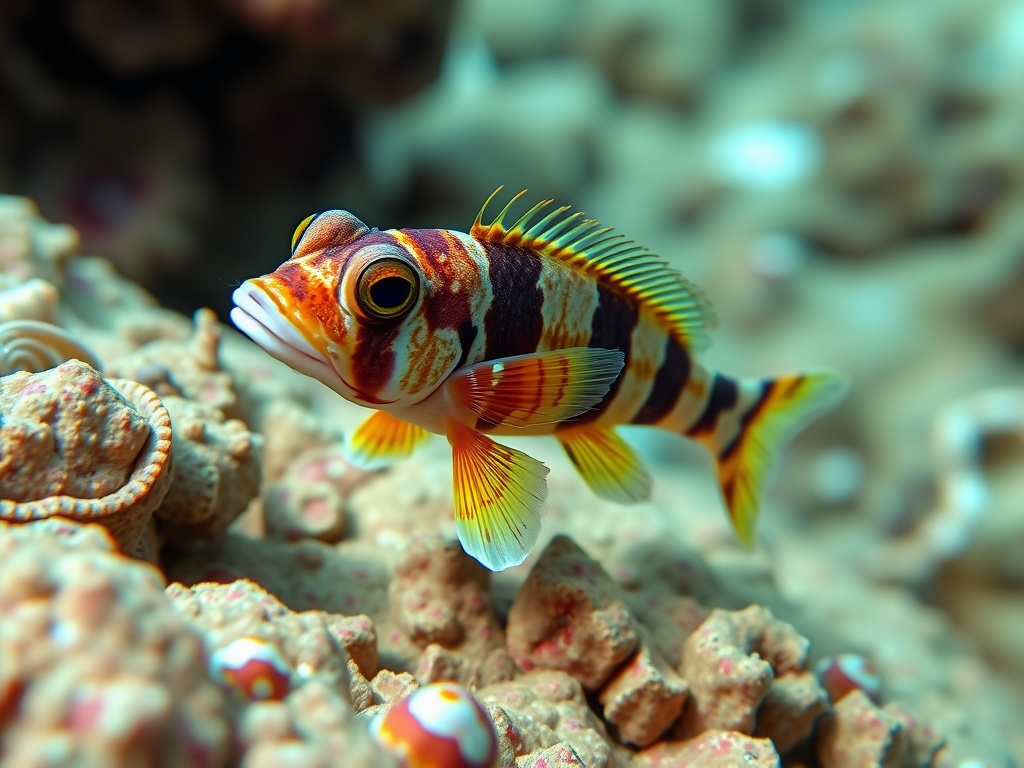
About the Bicolor blenny
The bicolor blenny is a small, vibrant marine fish known for its distinct coloration, featuring a dark brown to blue-black anterior half and a bright yellow to orange posterior half. Native to the reefs of the Indo-Pacific, this species frequently inhabits shallow rocky and coral areas, often perching on rocks or darting into crevices for safety. Bicolor blennies are popular in home aquariums due to their hardy nature and entertaining behaviors, such as their habit of perching and 'watching' their surroundings. They play a role in controlling algae growth on reefs, making them ecologically significant.
Fascinating facts
Colorful Appearance
The bicolor blenny is easily recognized by its striking two-tone coloration, with a dark upper body and a vividly contrasting yellow or orange tail.
Specialized Teeth
This species has comb-like teeth specially adapted for scraping algae off hard surfaces, helping keep coral reefs healthy.
Territorial Nature
Bicolor blennies are fiercely territorial, defending their small patch of reef or rock from other blennies and similarly sized fish.
Detailed description
The bicolor blenny (Ecsenius bicolor) is a small, elongate marine fish reaching up to 11 cm in total length, with a laterally compressed body and a blunt, rounded head. It is easily recognized by its striking coloration: the anterior half of the body is typically a dark brown to blue-black, sharply transitioning at mid-body to a vivid yellow or orange posterior, including the caudal fin. The species has a continuous dorsal fin with 12 spines and 15–17 soft rays, and a distinctive, fleshy cirrus above each eye. Its mouth is small and terminal, equipped with comb-like teeth adapted for grazing. The eyes are large and positioned high on the head, providing a wide field of vision. Ecsenius bicolor is primarily benthic, spending much of its time perched on rocks or coral heads, using its pectoral fins for support. It is diurnal, actively foraging during daylight hours and retreating to crevices at night. The species exhibits territoriality, especially among males, and is generally solitary or found in loose aggregations. Its vibrant coloration and engaging behaviors make it a popular aquarium species, but in the wild, its cryptic habits and rapid darting movements help it evade predators.
Did you know?
Despite their small size, bicolor blennies can be territorial and will defend their chosen crevice or hole from intruders, including much larger fish.
Research & sources
Wikipedia summary
Ecsenius bicolor, commonly known as the flame tail blenny or bicolor blenny, is a blenny from the Indo-Pacific. It frequently makes its way into the aquarium trade. It grows to a size of 11 centimetres (4.3 in) in length.
Behaviour & social structure
Bicolor blennies are highly active and display complex behaviors associated with foraging, territory defense, and predator avoidance. They are primarily herbivorous, grazing on benthic algae, particularly filamentous and turf algae, which they scrape from hard substrates using their specialized dentition. Occasionally, they may consume detritus or small invertebrates. Males are territorial, defending small patches of reef or rock against conspecifics and other blenny species, often displaying threat postures such as gaping mouths and raised dorsal fins. Social interactions are generally limited outside the breeding season, with individuals maintaining personal space. They exhibit a characteristic 'perching' behavior, resting on their pelvic fins while scanning their surroundings. Daily routines involve alternating periods of active feeding and vigilant observation, with increased sheltering behavior during periods of high predation risk or at night.
Reproduction & life cycle
Ecsenius bicolor is oviparous, with external fertilization. Breeding typically occurs during warmer months, though in tropical regions, reproduction may take place year-round. Courtship involves males displaying vibrant coloration and performing undulating swimming displays to attract females. After successful courtship, females deposit adhesive eggs in hidden crevices or under rocks within the male's territory. Males then guard the eggs, fanning them with their fins to ensure oxygenation and protect them from predators and fungal infection. Incubation lasts approximately 5–7 days, depending on water temperature. There is no parental care after hatching; larvae are planktonic and disperse with ocean currents before settling onto the reef as juveniles.
Adaptations & survival
The bicolor blenny exhibits several adaptations for survival in reef environments. Its cryptic coloration helps it blend into the patchy light and shadow of coral and rocky habitats, reducing predation risk. The comb-like teeth and robust jaws are specialized for scraping algae from hard surfaces, allowing efficient exploitation of a primary food source. Its elongated body and flexible pectoral fins facilitate maneuvering in tight crevices and rapid darting movements to escape threats. The fleshy cirri above the eyes may enhance sensory perception or aid in camouflage. Behavioral adaptations include territoriality, which secures feeding grounds, and the use of visual displays for communication and deterrence.
Cultural significance
The bicolor blenny holds limited traditional cultural significance but is well-known in the marine aquarium hobby, where it is valued for its hardiness, algae-eating habits, and attractive appearance. It is sometimes featured in educational materials about reef ecosystems and is used as a model organism in studies of territoriality and reef fish ecology. There are no known mythological or symbolic associations in indigenous cultures.
Recent research
Recent research on Ecsenius bicolor has focused on its role in reef ecosystem dynamics, particularly its contribution to algal control and reef health. Studies have examined its feeding selectivity, showing a preference for certain algal species, which can influence algal community structure. Genetic analyses have clarified its phylogenetic relationships within the Blenniidae family and revealed significant population connectivity across the Indo-Pacific. Ongoing research is investigating the impacts of aquarium trade collection on wild populations and the species' resilience to environmental stressors such as ocean acidification and warming.
Videos
Habitat
Coral reefs and rocky reef areas

Conservation
The Bicolor blenny is currently classified as Least Concern on the IUCN Red List.
Threats & challenges
Currently, Ecsenius bicolor is classified as Least Concern by the IUCN, with stable populations across its wide Indo-Pacific range. However, localized threats include habitat degradation due to coral reef destruction, pollution, and sedimentation. Collection for the aquarium trade is significant but not considered a major threat at present, as the species is abundant and reproduces readily. Climate change, leading to coral bleaching and altered reef ecosystems, poses a potential long-term risk. Monitoring of population trends and habitat health is recommended to ensure continued stability.
Taxonomy
Scientific name
Ecsenius bicolor
- Kingdom
- Animalia
- Phylum
- Chordata
- Class
- Actinopterygii
- Order
- Blenniiformes
- Family
- Blenniidae
- Genus
- Ecsenius
- Species
- bicolor
Community notes
Share your observations about the Bicolor blenny.
No community notes yet. Be the first!
Discover more wildlife
More fascinating animals from the encyclopedia.