
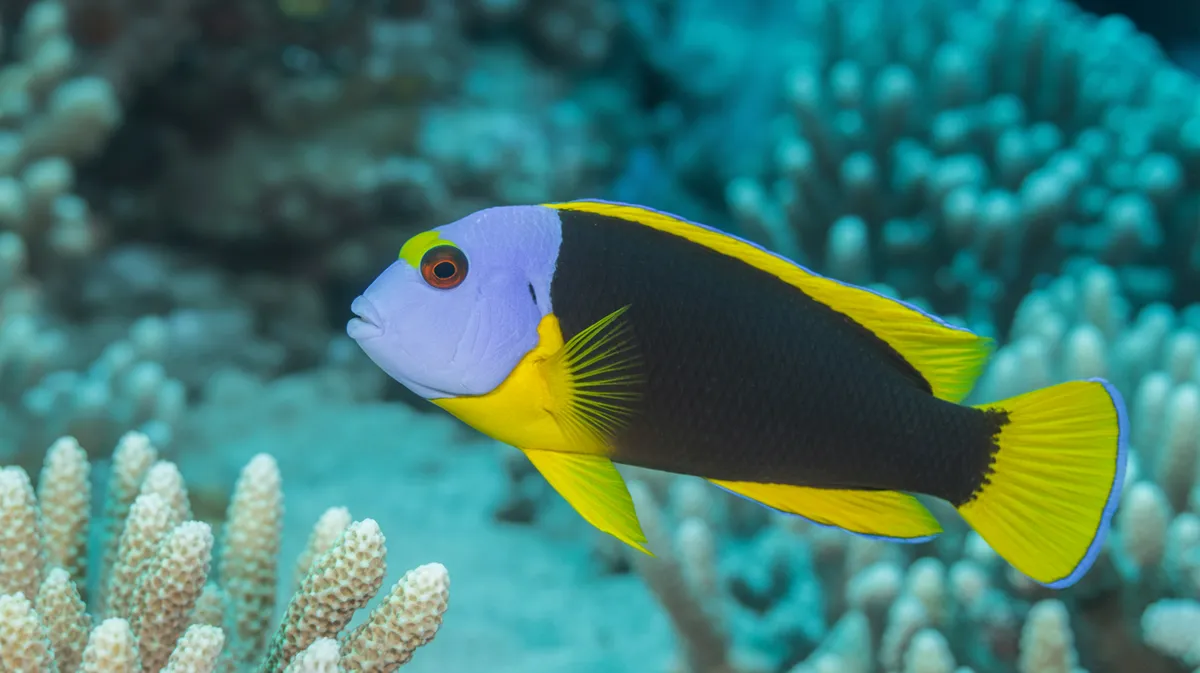
About the Bicolor Dottyback
The Bicolor Dottyback is a small, vibrantly colored marine fish known for its striking two-tone appearance: a vivid purple front half and a bright yellow rear. Native to the coral reefs of the Indo-Pacific, this species is popular among aquarium enthusiasts due to its bold coloration and manageable size. Despite its beauty, the Bicolor Dottyback is known for its territorial and sometimes aggressive behavior, especially toward similar-looking fish. It is a hardy species, well-adapted to the complex environments of coral reef systems.
Fascinating facts
Striking Colors
This species' iconic purple and yellow split coloration helps them blend into the vibrant hues of coral reefs.
Territorial Nature
Bicolor Dottybacks are fiercely territorial and will defend their chosen crevice or shelter from intruders, especially those of similar size or appearance.
Sequential Hermaphrodite
If the dominant male in a group disappears, the largest female can change sex to become the new male.
Detailed description
The Bicolor Dottyback (Pseudochromis paccagnellae) is a small, ray-finned marine fish reaching an adult length of approximately 6–8 cm (2.4–3.1 inches). Its most distinguishing feature is its vivid bicoloration: the anterior half of the body is a deep, electric violet or purple, sharply transitioning at mid-body to a bright, lemon-yellow posterior. The body is laterally compressed, with a continuous dorsal fin running nearly the entire length of the back, and a slightly forked caudal fin. The mouth is terminal and slightly oblique, equipped with small, conical teeth adapted for grasping prey. The eyes are relatively large, providing acute vision for hunting in complex reef environments. Scales are cycloid and smooth, offering minimal resistance as the fish darts among coral branches. P. paccagnellae is a benthic species, typically found sheltering in crevices or under ledges within coral reefs at depths of 3–40 meters. It is highly territorial, often defending a small home range against conspecifics and similar-looking species. This species exhibits sexual dimorphism, with males generally being larger and sometimes displaying more intense coloration during breeding. Its bold coloration serves both as camouflage among corals and as a warning to potential rivals. The Bicolor Dottyback is a protogynous hermaphrodite, capable of changing sex from female to male, a trait that supports flexible social structures within its population.
Did you know?
The Bicolor Dottyback can mimic the coloration of other reef fish, which helps it avoid predators and sneak up on prey.
Research & sources
Behaviour & social structure
Bicolor Dottybacks are diurnal and spend much of their day patrolling and defending their territory, which typically consists of a small patch of reef with ample hiding spots. They are solitary or found in loosely associated pairs, rarely forming groups. Their feeding behavior is characterized by ambush predation: they remain concealed among coral branches or rocks, darting out swiftly to capture small crustaceans, polychaete worms, and occasionally fish larvae. They use their acute vision and rapid bursts of speed to surprise prey. Aggression is pronounced, especially toward conspecifics and similarly colored fish, and they may engage in threat displays involving flared fins and open mouths. At night, they retreat deep into crevices to avoid nocturnal predators. Social interactions are mostly antagonistic, with limited tolerance for other dottybacks except during breeding.
Reproduction & life cycle
Pseudochromis paccagnellae exhibits oviparous reproduction with external fertilization. During the breeding season, which is not strictly seasonal in tropical waters but may peak with increased food availability, males establish and defend nesting sites within crevices or under rocks. Females are attracted to these sites, where courtship involves color intensification and display behaviors. After spawning, females lay adhesive eggs in clusters on the substrate within the nest. Males guard and aerate the eggs, fanning them with their fins to prevent fungal growth and ensure oxygenation. Incubation lasts approximately 5–7 days, after which the larvae hatch and become planktonic, drifting with currents before settling onto the reef. The species is a protogynous hermaphrodite: individuals can change sex from female to male, usually in response to social cues such as the absence of a dominant male.
Adaptations & survival
The Bicolor Dottyback’s striking coloration provides both camouflage among brightly colored corals and a visual deterrent to rivals. Its slender, laterally compressed body allows it to navigate narrow crevices for both hunting and evasion. The species’ territoriality and aggression are adaptive in the crowded reef environment, ensuring access to resources and breeding sites. Protogynous hermaphroditism allows for rapid adjustment of sex ratios in response to population dynamics, maximizing reproductive success. Its acute vision and rapid acceleration enable effective ambush predation. The adhesive nature of its eggs and male parental care increase offspring survival in a habitat with high predation pressure.
Cultural significance
The Bicolor Dottyback holds no significant role in traditional folklore or subsistence fisheries but is highly valued in the global marine aquarium trade for its vivid coloration and manageable size. It is often featured in aquarium literature and marine hobbyist communities as a symbol of the beauty and diversity of coral reef ecosystems. Its popularity has spurred advances in captive breeding techniques, contributing to sustainable aquarium practices.
Recent research
Recent research has focused on the species’ reproductive biology, particularly its protogynous hermaphroditism and social control of sex change. Studies have examined the genetic basis of coloration and its role in species recognition and mate selection. Behavioral research has highlighted the impact of habitat complexity on territoriality and aggression. Captive breeding programs have been successful in reducing wild collection pressures, and ongoing studies are assessing the species’ resilience to environmental changes such as ocean acidification and warming.
Sources
Pseudochromis paccagnellae (Bicolor Dottyback): Taxonomy, Distribution, and Ecology
Allen, G.R. & Erdmann, M.V. (2012)
scientificPseudochromis paccagnellae (Bicolor Dottyback): Species Profile
Froese, R. & Pauly, D. (eds), FishBase (2024)
scientificVideos
Habitat
Coral reefs

Conservation
The Bicolor Dottyback is currently classified as Least Concern on the IUCN Red List.
Threats & challenges
Currently listed as Least Concern by the IUCN, P. paccagnellae faces few direct threats due to its wide distribution and adaptability. However, localized threats include habitat degradation from coral reef destruction, pollution, and climate change-induced bleaching. Collection for the aquarium trade is significant but generally sustainable due to captive breeding programs. Overfishing and reef damage could pose future risks if not managed. Population trends are stable, but ongoing monitoring is recommended due to the species’ reliance on healthy reef ecosystems.
Taxonomy
Scientific name
Pseudochromis paccagnellae
- Kingdom
- Animalia
- Phylum
- Chordata
- Class
- Actinopterygii
- Order
- Perciformes
- Family
- Pseudochromidae
- Genus
- Pseudochromis
- Species
- paccagnellae
Community notes
Share your observations about the Bicolor Dottyback.
No community notes yet. Be the first!
Discover more wildlife
More fascinating animals from the encyclopedia.