
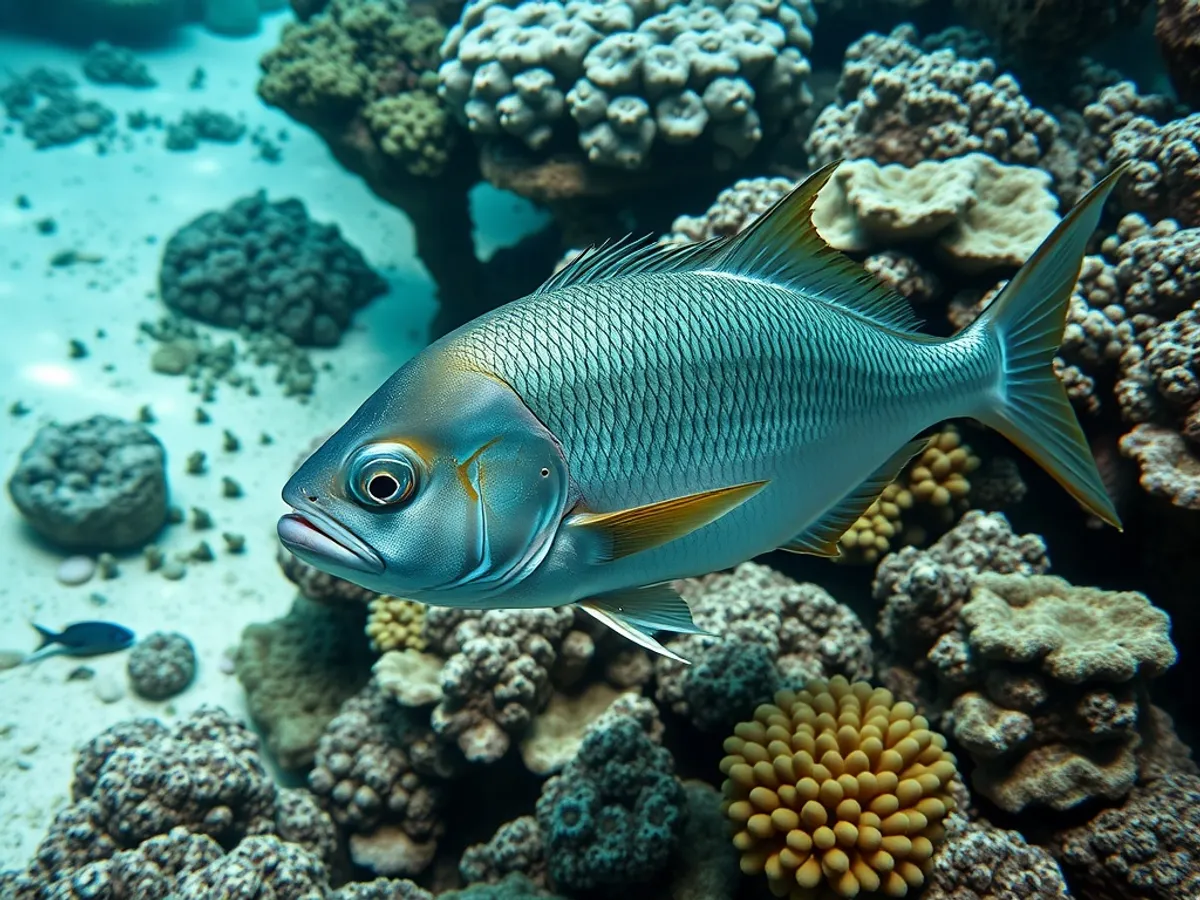
About the Bigeye Trevally
The Bigeye Trevally is a robust, fast-swimming fish recognized for its large, reflective eyes and silvery body with distinctive black markings. Commonly found in the warm waters of the Indo-Pacific, this species often forms large, swirling schools, especially at dawn and dusk. Bigeye Trevallies are active predators, feeding on smaller fish and invertebrates, and are well-known for their synchronized movements. Due to their striking appearance and behavior, they are a favorite sight for divers and underwater photographers.
Fascinating facts
Schooling Masters
Bigeye Trevallies are known to form massive, swirling schools that can contain thousands of individuals, providing safety in numbers.
Large Eyes for Night Hunting
Their oversized eyes allow them to see well in low light, making them effective nocturnal hunters.
Wide Distribution
They are found throughout the tropical and subtropical waters of the Indo-Pacific, from the Red Sea and East Africa to Hawaii and the western Americas.
Detailed description
The Bigeye Trevally (Caranx sexfasciatus) is a medium to large-sized carangid fish, reaching up to 120 cm in length and weighing as much as 18 kg, though most individuals are considerably smaller. Its body is deep and laterally compressed, with a blunt snout and a prominent, steep forehead. The species is named for its proportionally large, reflective eyes, an adaptation for enhanced vision in low-light conditions. The coloration is typically silvery with a bluish-green dorsal surface and a white underside, while juveniles display vertical dark bars that fade with age. Adults feature a distinctive black opercular spot and a dark margin on the caudal fin. Bigeye Trevallies are known for their highly synchronized schooling behavior, often forming dense, swirling aggregations that can number in the hundreds or thousands, especially around coral reef drop-offs and pinnacles. These schools provide protection from predators and are a spectacular sight for divers. The species is crepuscular, with peak activity at dawn and dusk, coinciding with their primary feeding times. Anatomically, the species possesses a strong, forked tail and streamlined body, enabling bursts of speed to chase down prey. Their jaws are equipped with small, sharp teeth suited for grasping slippery prey such as small fishes, crustaceans, and cephalopods.
Did you know?
Bigeye Trevallies can coordinate their movements so precisely that thousands of individuals appear to move as a single organism, confusing potential predators.
Research & sources
Behaviour & social structure
Bigeye Trevallies exhibit complex social behaviors, forming large, tightly coordinated schools that serve both defensive and foraging functions. During the day, they often remain in midwater or near reef structures, displaying slow, synchronized swimming patterns that reduce individual predation risk. At dusk and dawn, these schools break up as individuals or smaller groups hunt more actively, using their keen vision to ambush prey in low-light conditions. They are opportunistic predators, employing both cooperative hunting—where groups herd or trap prey—and solitary ambush tactics. Juveniles are more solitary or form smaller schools in shallow lagoons or estuaries, gradually joining larger adult schools as they mature. Aggressive interactions are rare within schools, but dominance hierarchies may form during feeding or spawning events. Nocturnal resting behavior has been observed, with fish becoming less active and seeking shelter near reef structures.
Reproduction & life cycle
Bigeye Trevally are oviparous, with external fertilization. Spawning typically occurs in large aggregations, often at specific sites and times linked to lunar cycles, with peaks around the new or full moon. Breeding seasons vary geographically but often coincide with warmer water temperatures. During spawning, males and females release gametes simultaneously into the water column, maximizing fertilization success. Eggs are pelagic and hatch within 24-48 hours, depending on temperature. Larvae are planktonic and undergo several developmental stages before settling into juvenile habitats such as shallow lagoons. There is no parental care; survival of offspring depends on dispersal and suitable nursery habitats. Sexual maturity is generally reached at 35-40 cm in length, which may take 2-3 years.
Adaptations & survival
Bigeye Trevallies possess several adaptations for survival in dynamic reef environments. Their large eyes are highly sensitive to low light, allowing effective hunting at dawn, dusk, and in deeper waters. The streamlined, laterally compressed body and powerful forked tail enable rapid acceleration and agile maneuvering, essential for both predator evasion and prey capture. Schooling behavior provides safety in numbers and enhances foraging efficiency through coordinated movements. Their coloration offers countershading camouflage, reducing visibility to both prey and predators. The species also exhibits physiological tolerance to a range of salinities and temperatures, allowing occupation of diverse habitats from estuaries to outer reef slopes.
Cultural significance
Bigeye Trevally hold significance in many Indo-Pacific coastal communities, where they are valued as a food source and occasionally featured in local markets. In some regions, they are used as bait for larger game fish. Their dramatic schooling behavior has made them a popular subject in underwater photography and ecotourism, contributing to the appeal of reef diving destinations. While not prominent in mythology, their presence in traditional fisheries and local economies underscores their importance to human livelihoods.
Recent research
Recent research has focused on the species' spawning aggregations, with studies using acoustic telemetry and genetic analysis to understand population connectivity and reproductive behavior. Investigations into their role as mesopredators highlight their influence on reef fish community structure and trophic dynamics. Ongoing studies are examining the impacts of climate change and habitat degradation on their distribution and recruitment success. Notably, research into their visual adaptations has provided insights into the evolution of crepuscular hunting strategies among carangids.
Videos
Habitat
Coastal coral reefs and adjacent sandy or rocky areas

Conservation
The Bigeye Trevally is currently classified as Least Concern on the IUCN Red List.
Threats & challenges
While currently listed as Least Concern by the IUCN, Bigeye Trevally populations face localized threats from overfishing, particularly in areas where they are targeted for food, bait, or the aquarium trade. Spawning aggregations are especially vulnerable to exploitation, as large numbers can be captured in a short time. Habitat degradation, including coral reef loss and coastal development, poses additional risks, particularly to juvenile nursery areas. Bycatch in commercial fisheries and pollution are ongoing challenges. Although global population trends are stable, regional declines have been reported, emphasizing the need for continued monitoring and management of fisheries and critical habitats.
Taxonomy
Scientific name
Caranx sexfasciatus
- Kingdom
- Animalia
- Phylum
- Chordata
- Class
- Actinopterygii
- Order
- Carangiformes
- Family
- Carangidae
- Genus
- Caranx
- Species
- sexfasciatus
Community notes
Share your observations about the Bigeye Trevally.
No community notes yet. Be the first!
Discover more wildlife
More fascinating animals from the encyclopedia.