
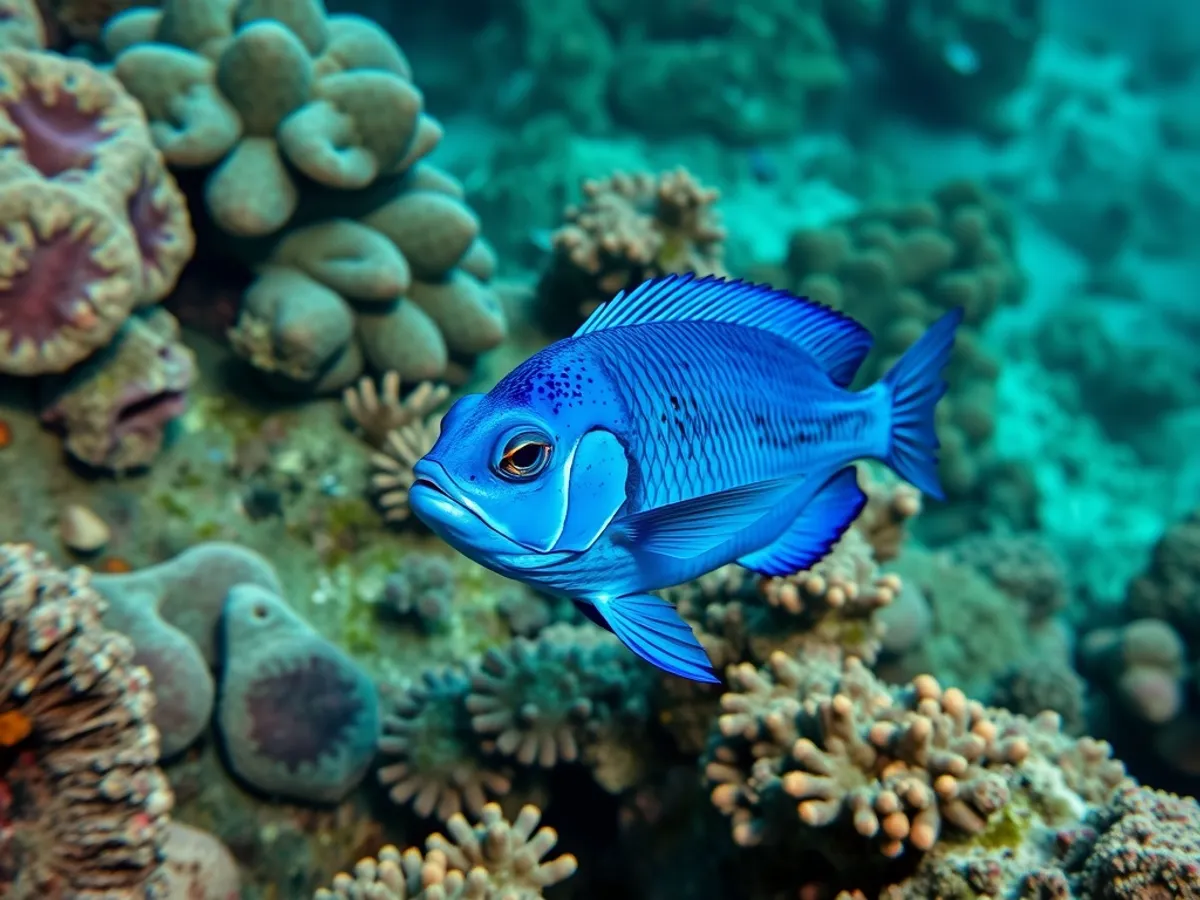
About the Blue Parrotfish
A parrotfish's beak is not a beak: it is a mass of teeth fused into a cutting plate, and behind it, in the throat, sits a second set of pharyngeal teeth that works like a mill. The blue parrotfish scrapes algae and the thin turf growing on and in dead coral rock, swallows the rock with it, grinds the whole lot to powder, and excretes it as fine white sand. A single large parrotfish can produce hundreds of kilograms of sand a year, and a substantial fraction of a Caribbean white-sand beach has passed through a parrotfish's gut. The teeth doing this are made of fluorapatite crystals woven into one of the stiffest and most damage-tolerant biominerals known — harder than copper. At night it secretes a mucus cocoon and sleeps inside it, a sleeping bag that masks its scent from hunting moray eels and appears to block parasitic isopods. It is a sequential hermaphrodite: most begin life as females and later change sex into large terminal-phase males with a bulbous, blunted forehead.
Fascinating facts
Beak-like Teeth
The Blue Parrotfish has teeth that are fused together into a beak, which it uses to scrape algae from rocks and coral.
Uniform Coloration
Unlike many parrotfish species, both juvenile and adult Blue Parrotfish are almost completely blue, with only a hint of yellow on their heads when young.
Sand Producers
By grinding up coral while feeding, Blue Parrotfish contribute to the production of sandy beaches in their native habitats.
Detailed description
The blue parrotfish (Scarus coeruleus) is a large, robust marine fish distinguished by its uniform, vibrant blue coloration, which is present in both juveniles and adults—a rarity among parrotfish. Adults typically reach lengths of 30–75 cm, with some individuals growing up to 1.2 meters and weighing as much as 9–10 kg. The body is laterally compressed with a blunt, rounded head and a prominent, beak-like dental structure formed by fused teeth, specialized for scraping algae and detritus from hard substrates. Unlike many parrotfish species, S. coeruleus does not exhibit pronounced sexual dichromatism or dramatic color changes during its life cycle. The caudal fin is lunate, aiding in swift maneuvering among reefs. The species possesses pharyngeal teeth in the throat, which further grind ingested material. Blue parrotfish are diurnal, spending daylight hours actively foraging and retreating to crevices or constructing mucus cocoons at night for protection from predators and parasites. Their feeding activity plays a crucial ecological role by bioeroding coral, facilitating sand production, and maintaining reef health. Socially, they are often observed in small groups, but can aggregate in large spawning groups numbering several hundred individuals. Their lifespan is estimated at up to 20 years in the wild. Juveniles are typically found in seagrass beds, which provide shelter and abundant food resources.
Did you know?
A significant portion of the white sandy beaches in the Caribbean is made up of parrotfish-generated sand produced from their digestion of coral.
Research & sources
Wikipedia summary
The blue parrotfish is a member of the parrotfish genus Scarus. It is found on coral reefs in shallow water in the tropical and subtropical parts of the western Atlantic Ocean and the Caribbean Sea. They usually forage in a group of 500 individuals for spawning and deterring predators while feeding.
Behaviour & social structure
Blue parrotfish exhibit complex social and foraging behaviors. During the day, they are highly active, grazing on algae, cyanobacteria, and detritus growing on rocks and dead coral. Their powerful jaws and beak-like teeth allow them to scrape and even excavate pieces of substrate, contributing to reef bioerosion and sand formation. Foraging is often conducted in loose groups, which may provide safety from predators such as barracudas and groupers. These aggregations can swell to several hundred individuals during spawning periods. At night, individuals seek shelter in reef crevices or secrete a mucous cocoon that masks their scent from nocturnal predators and parasites. Blue parrotfish are generally non-territorial but may display dominance hierarchies within groups, particularly among males during breeding. Communication involves body posturing and rapid color intensity changes, although their coloration is less variable than in other parrotfish species.
Reproduction & life cycle
Blue parrotfish are oviparous and exhibit group spawning, typically during the warmer months (late spring to early summer), with peaks varying by location. Spawning occurs in large aggregations, often at dawn or dusk, where multiple males and females release gametes into the water column simultaneously, maximizing fertilization success and reducing predation risk on eggs. The species is believed to be protogynous hermaphroditic, with some females transitioning to males as they mature, although this is less pronounced than in other parrotfish. Fertilized eggs are pelagic, drifting with currents until hatching. Larvae remain planktonic for several weeks before settling in seagrass beds or shallow reef areas. There is no parental care post-spawning; survival of offspring depends on dispersal and habitat quality.
Adaptations & survival
Scarus coeruleus has evolved several adaptations for its niche. The fused beak-like teeth and robust pharyngeal jaws are specialized for scraping and grinding tough algal material and coral substrate, enabling efficient nutrient extraction. The production of a mucous cocoon at night is a unique behavioral adaptation, providing protection from predators and ectoparasites. Their vivid blue coloration may serve as camouflage among blue-lit reef waters or as a social signal within aggregations. The species’ ability to bioerode coral and produce sand is an important ecological adaptation, influencing reef geomorphology. Physiologically, they possess a highly efficient digestive system capable of processing large amounts of indigestible material, extracting nutrients from otherwise inaccessible sources.
Cultural significance
While not as prominent in folklore as some reef species, blue parrotfish are valued in local fisheries and occasionally featured in Caribbean cuisine. Their striking appearance makes them popular in ecotourism and underwater photography, contributing to the appeal of coral reef destinations. In some Caribbean cultures, parrotfish are recognized for their role in sand production and reef maintenance, and there is growing advocacy for their protection due to their ecological importance.
Recent research
Recent research has focused on the blue parrotfish’s role in reef bioerosion and sediment production, with studies quantifying their contribution to sand formation and nutrient cycling. Genetic analyses have improved understanding of population connectivity across the Caribbean and western Atlantic, informing conservation management. Ongoing studies are examining the impacts of climate change and habitat degradation on their feeding behavior and reproductive success. There is also interest in their mucous cocoon production as a model for natural antifouling and antimicrobial strategies.
Sources
Scarus coeruleus (Blue Parrotfish): Species account
L.A. Rocha et al., IUCN Red List (2012)
scientificThe IUCN Red List of Threatened Species: Scarus coeruleus
International Union for Conservation of Nature (IUCN)
conservationParrotfish bioerosion and sediment production on Caribbean reefs
Morgan S. Pratchett, David R. Bellwood (2015)
scientificVideos
Habitat
Coral reefs and seagrass beds in shallow tropical and subtropical waters

Conservation
The Blue Parrotfish is currently classified as Least Concern on the IUCN Red List.
Threats & challenges
Currently classified as 'Least Concern' by the IUCN, blue parrotfish populations are generally stable, but they face several localized threats. Overfishing, particularly for the aquarium trade and as a food source, can impact populations in some regions. Habitat degradation from coral bleaching, coastal development, and pollution reduces available foraging and breeding grounds. Climate change poses a long-term threat by altering reef structure and algal communities. Additionally, their ecological role as bioeroders means that population declines could disrupt sediment dynamics and reef health. Despite these challenges, the species’ broad distribution and high reproductive output provide some resilience.
Taxonomy
Scientific name
Scarus coeruleus
- Kingdom
- Animalia
- Phylum
- Chordata
- Class
- Actinopterygii
- Order
- Labriformes
- Family
- Scaridae
- Genus
- Scarus
- Species
- coeruleus
Community notes
Share your observations about the Blue Parrotfish.
No community notes yet. Be the first!
Discover more wildlife
More fascinating animals from the encyclopedia.