
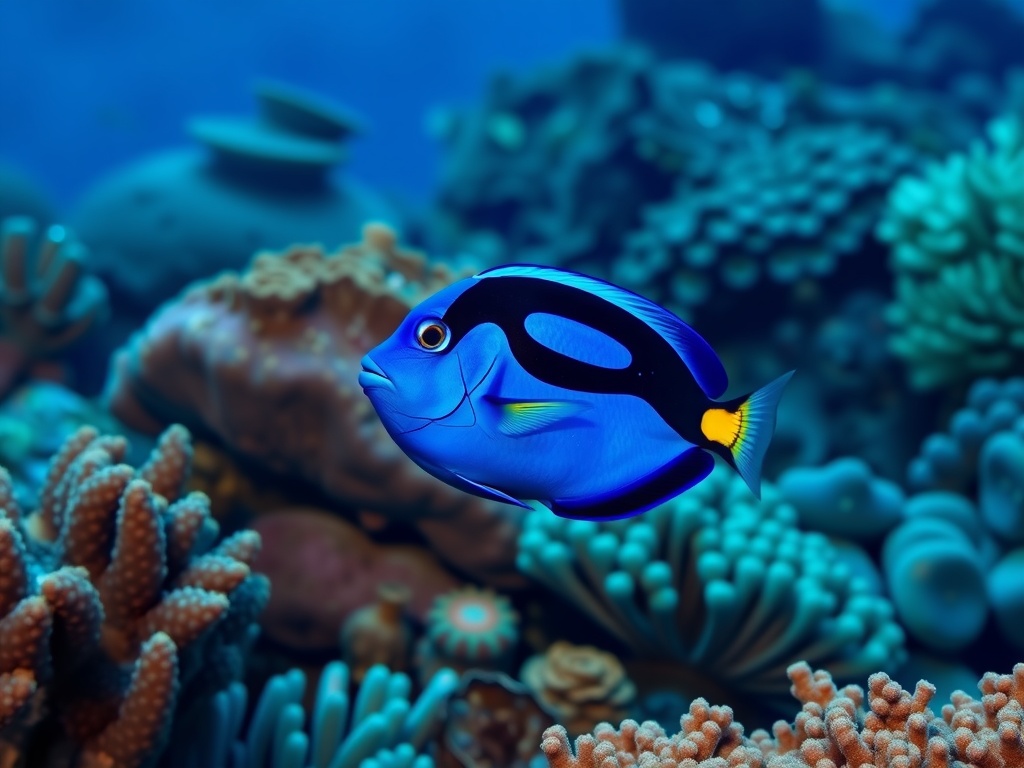
About the Blue tang
The blue tang carries a switchblade. At the base of its tail sits a hinged, razor-sharp spine that folds flat into a groove and flicks out when the fish is threatened or fighting; it is used with a sideways lash of the tail and will slice a careless hand open. That spine is why the whole family is called surgeonfish. Its second defence is theatre: threatened, a blue tang will jam itself into a coral crevice, lock in place with its spines, and lie on its side playing dead until the danger passes. It is a grazer, working algae off reef surfaces in loose roving groups that overwhelm the territorial damselfish which try to defend their algal gardens. Its most consequential modern fact is commercial: unlike the clownfish, the blue tang was not successfully bred in captivity until 2016, at the University of Florida, which meant that essentially every one in an aquarium had been taken from a wild reef — and the release of Finding Dory sent demand for a wild-caught fish through the roof.
Fascinating facts
Color Transformation
Juvenile blue tangs are yellow and gradually develop their iconic blue coloration as they mature.
Natural Defenses
The blue tang's tail is equipped with scalpel-like spines that can inflict painful wounds on predators or threats.
Reef Cleaners
Blue tangs play an important ecological role by grazing on algae, preventing algae overgrowth on coral reefs.
Detailed description
The blue tang (Paracanthurus hepatus) is a striking marine fish recognized for its deep royal blue coloration, accented by a bold black palette-shaped marking along its sides and a vivid yellow caudal (tail) fin. Adults typically reach lengths of 20–25 cm (8–10 inches), with a laterally compressed, oval-shaped body that aids in maneuverability among coral branches. The species exhibits sexual monomorphism, with males and females appearing similar externally. Blue tangs possess a pair of sharp, retractable scalpel-like spines on either side of the caudal peduncle, used primarily for defense. Their small, terminal mouths are equipped with closely set, spatulate teeth adapted for scraping algae from rocks and coral surfaces. Juveniles are bright yellow with blue spots near the eyes, gradually developing the adult coloration as they mature. Blue tangs are diurnal, spending daylight hours actively foraging and seeking shelter within the reef at night. Their vibrant coloration serves as both a warning to potential predators and a means of intraspecific communication. The species is distributed widely across the Indo-Pacific, from East Africa and Japan to the Great Barrier Reef and Samoa, inhabiting clear, outer reef slopes at depths of 2–40 meters.
Did you know?
Despite their popularity in aquariums, blue tangs cannot be bred commercially in captivity and are almost always wild-caught.
Research & sources
Wikipedia summary
Blue tang is the common name of several species of surgeonfish.
Behaviour & social structure
Blue tangs are primarily herbivorous, feeding on filamentous algae and detritus, which helps control algal growth and maintain coral health. They exhibit a combination of solitary and schooling behaviors: juveniles often form small groups for protection, while adults may be seen alone or in loose aggregations, especially during feeding. Blue tangs are highly territorial, with individuals defending feeding areas against conspecifics and other herbivores using their caudal spines. They display a daily rhythm, emerging from crevices at dawn to graze and retreating to shelter at dusk to avoid nocturnal predators. When threatened, blue tangs may display lateral body posturing to expose their spines or rapidly dart into coral branches. Social interactions include color changes and body postures used in dominance displays and courtship.
Reproduction & life cycle
Blue tangs are broadcast spawners, with reproduction typically synchronized to lunar cycles and occurring at dusk. During spawning events, groups gather in the water column where males and females simultaneously release gametes, resulting in external fertilization. There is no parental care; fertilized eggs are pelagic, drifting with currents. The eggs hatch within 24–48 hours, producing planktonic larvae that remain in the open ocean for several weeks before settling onto reefs as juveniles. Spawning is seasonal, often peaking during warmer months, although in equatorial regions it may occur year-round. Sexual maturity is reached at approximately 9–12 months of age.
Adaptations & survival
The blue tang’s laterally compressed body and sharp caudal spines are key adaptations for navigating complex coral environments and deterring predators. Their vivid coloration serves as aposematic (warning) signaling, indicating their defensive capability. The ability to rapidly change coloration, becoming paler at night or when stressed, aids in camouflage and social signaling. Their specialized dentition allows efficient grazing of tough algal films, giving them an ecological role as reef 'cleaners.' The pelagic larval stage facilitates wide dispersal, enhancing genetic diversity and colonization of new habitats. Mucous secretions on their skin provide protection against parasites and minor injuries.
Cultural significance
The blue tang has gained international recognition as 'Dory' in the animated films Finding Nemo and Finding Dory, significantly increasing its popularity in the aquarium trade. In some Pacific cultures, surgeonfishes are featured in traditional art and folklore, symbolizing agility and resilience. However, there are no widespread traditional uses for blue tangs due to their toxicity when consumed. Their ecological role as reef grazers is increasingly highlighted in marine conservation education and outreach.
Recent research
Recent research has focused on the blue tang’s role in reef ecosystem dynamics, particularly its contribution to algal control and coral resilience. Genetic studies have revealed high connectivity among populations across the Indo-Pacific, attributed to the species’ extended pelagic larval phase. Ongoing studies are examining the impacts of aquarium trade collection on wild stocks and the effectiveness of captive breeding programs, which remain challenging due to the species’ complex life cycle. Investigations into the function and evolution of the caudal spines have provided insights into surgeonfish defense mechanisms. Additionally, research into their microbiome and mucous layers is shedding light on disease resistance and environmental adaptation.
Videos
Habitat
Coral reefs

Conservation
The Blue tang is currently classified as Least Concern on the IUCN Red List.
Threats & challenges
While currently listed as Least Concern by the IUCN, blue tang populations face several threats. Over-collection for the aquarium trade, particularly following popular media exposure, has led to localized declines. Habitat degradation from coral bleaching, pollution, and destructive fishing practices also poses significant risks. Climate change-induced shifts in ocean temperature and acidity threaten both coral reef health and blue tang food sources. Although not targeted for food due to their potential to cause ciguatera poisoning, bycatch and habitat loss remain concerns. Population trends are stable in most regions, but ongoing monitoring is recommended.
Taxonomy
Scientific name
Paracanthurus hepatus
- Kingdom
- Animalia
- Phylum
- Chordata
- Class
- Actinopterygii
- Order
- Acanthuriformes
- Family
- Acanthuridae
- Genus
- Paracanthurus
- Species
- hepatus
Where to see a blue tang
6 zoos and aquariums in 3 countries are recorded as keeping this species.
 Aquarium of Genoa🇮🇹 Genova, Italy
 Georgia Aquarium🇺🇸 Atlanta, United States
 New England Aquarium🇺🇸 Boston, United States
- 🦁Dakota Zoo🇺🇸 Bismarck, United States
 Tierpark und Fossilium Bochum🇩🇪 Bochum, Germany
Community notes
Share your observations about the Blue tang.
No community notes yet. Be the first!
Discover more wildlife
More fascinating animals from the encyclopedia.