
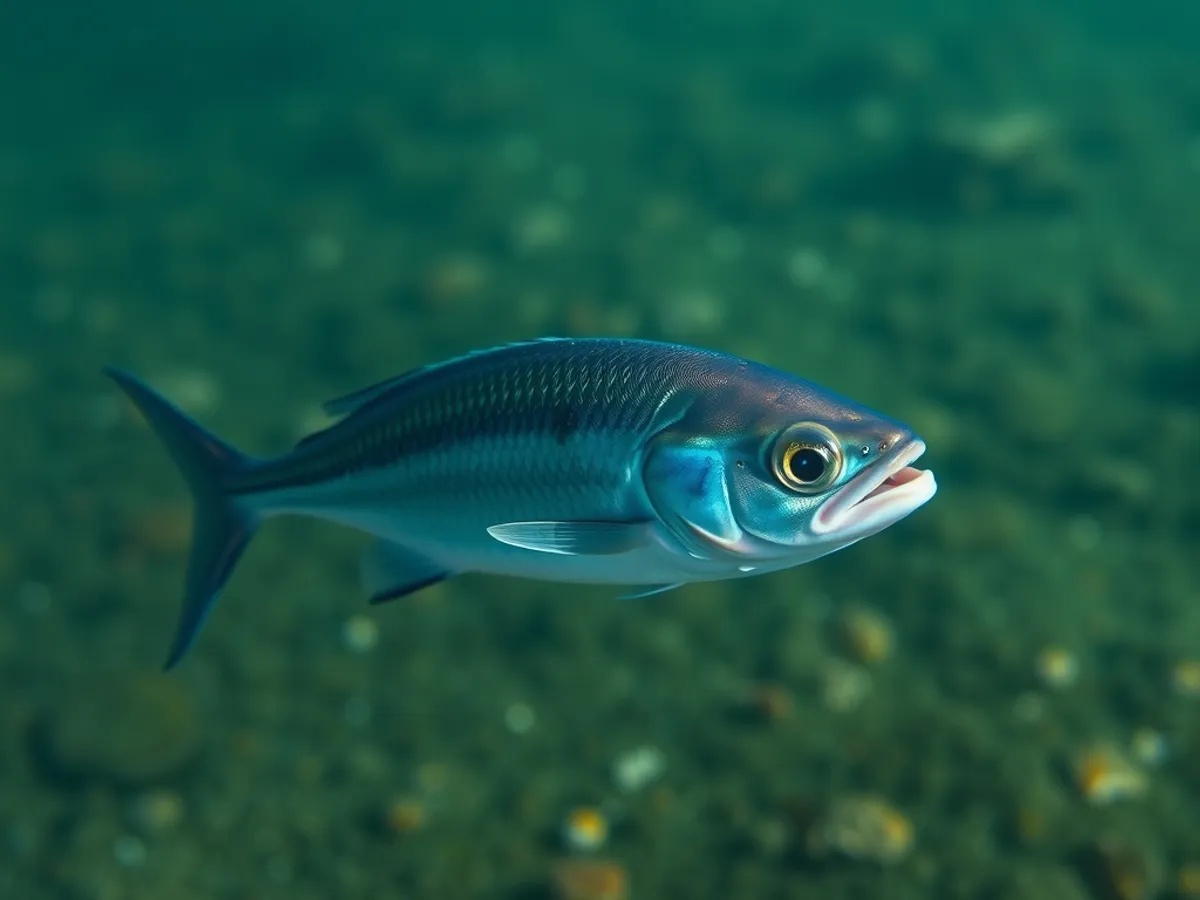
About the Blue whiting
The Blue whiting is a small, slender fish found predominantly in the North-East Atlantic Ocean and parts of the Mediterranean Sea. It has a silvery-blue body with a slightly darker back and can form immense schools in deep offshore waters. Blue whiting are important both ecologically and commercially, serving as prey for larger marine animals and as a significant fishery resource for fishmeal and food. They are fast-growing and can reach maturity within a few years, playing a critical role in oceanic food webs. Their populations are subject to fluctuations due to environmental factors and fishing pressure.
Fascinating facts
Schooling Fish
Blue whiting are highly social and often gather in enormous schools, sometimes stretching for kilometers.
Deep Dwellers
They typically inhabit depths ranging from 150 to 3,000 meters, moving deeper during the day and rising at night to feed.
Commercial Value
Blue whiting are an important commercial fish, mainly used for fishmeal, fish oil, and sometimes for human consumption.
Detailed description
The blue whiting (Micromesistius poutassou) is a slender, elongate gadiform fish characterized by a streamlined body adapted to pelagic life in deep offshore waters. Adults typically measure 22–35 cm in length, though some individuals can exceed 40 cm, with a maximum recorded length of 47 cm. The body is laterally compressed, with a silvery-blue coloration on the flanks and a darker, bluish-grey dorsal surface, aiding in camouflage in the open ocean. The ventral side is pale or silvery. Blue whiting possess a relatively large mouth with a protruding lower jaw and fine, villiform teeth suited for capturing small prey. They have three dorsal fins and two anal fins, a feature common to the Gadidae family. The lateral line is well developed and slightly curved, enhancing their ability to detect vibrations and movement in the water column. Blue whiting are highly gregarious, forming dense schools that can number in the millions, which is both a defense mechanism and a strategy for efficient foraging. Their eyes are relatively large, an adaptation for detecting prey in the dimly lit mesopelagic zone (typically 150–1000 m depth). The species exhibits diel vertical migrations, ascending at night to feed in shallower waters and descending during the day. Blue whiting play a pivotal ecological role as mid-trophic level predators and prey for larger fish, marine mammals, and seabirds. Their rapid growth and early maturity (often within 2–3 years) enable them to sustain large populations despite significant predation and fishing pressure.
Did you know?
Despite their small size, blue whiting are among the most heavily fished species in the northeast Atlantic, with annual catches reaching over a million tonnes in some years.
Research & sources
Wikipedia summary
The blue whiting one of the two species in the genus Micromesistius in the order of Gadiformes, which also contains cod, haddock, whiting, and pollock. It is common in the northeast Atlantic Ocean from Morocco to Iceland and Spitsbergen. It also occurs in the northern parts of the Mediterranean, where it may be locally abundant. Blue whiting also occur in the northwest Atlantic Ocean between Canada and Greenland, but is considered rare. It has a long, narrow body and a silvery underbody. The fish can attain a length of more than 40 cm. The average length of blue whiting caught off the west shores of the UK is 31 cm.
Behaviour & social structure
Blue whiting are predominantly schooling fish, exhibiting strong social cohesion that provides safety from predators and facilitates synchronized feeding. These schools are dynamic, with individuals constantly joining or leaving, and can extend over several kilometers. Feeding activity peaks during nighttime hours when the fish ascend to shallower depths (100–400 m) to exploit the abundance of zooplankton and small pelagic crustaceans, such as euphausiids, copepods, and amphipods. They also consume small fish and cephalopods when available. Blue whiting use their acute lateral line system and vision to locate prey in low-light environments. During the day, they retreat to deeper waters (up to 1000 m), reducing predation risk. Their daily routines are closely tied to the vertical migrations of their prey. Social interactions within schools are primarily coordinated by visual and mechanosensory cues, and there is little evidence of territoriality or aggression outside of spawning aggregations.
Reproduction & life cycle
Blue whiting are batch spawners with a protracted spawning season that varies geographically but generally occurs from February to May in the Northeast Atlantic. Spawning takes place at depths of 200–600 m, often along continental shelf edges and slopes. Females are highly fecund, producing between 100,000 and 1.5 million pelagic eggs per season, depending on size and age. Fertilization is external, and eggs are buoyant, drifting with ocean currents. Embryonic development is rapid, with hatching occurring within 5–7 days at typical ocean temperatures. There is no parental care; larvae are planktonic and undergo several developmental stages before settling into deeper waters as juveniles. Sexual maturity is reached at 2–3 years of age, with some regional variation. Spawning aggregations are large and may be targeted by commercial fisheries.
Adaptations & survival
Blue whiting exhibit several adaptations for survival in the mesopelagic zone. Their streamlined, laterally compressed bodies minimize energy expenditure during sustained swimming and enable rapid schooling maneuvers. The silvery-blue coloration provides countershading, reducing visibility to predators from both above and below. Their large eyes enhance sensitivity to low light, crucial for detecting prey and predators at depth. The well-developed lateral line system allows detection of subtle water movements, facilitating schooling and prey capture. Physiologically, blue whiting can tolerate a range of temperatures (typically 4–10°C) and salinities, enabling them to exploit diverse habitats from the North Atlantic to the Mediterranean. Their rapid growth and early maturity are evolutionary responses to high predation and variable environmental conditions.
Cultural significance
Blue whiting has limited direct cultural significance compared to other gadids like cod or haddock, but it is economically important in several European countries. It is a key species in the production of fishmeal and fish oil, supporting aquaculture and agriculture industries. In some regions, blue whiting is consumed directly, often processed into surimi, fish sticks, or canned products. The species does not feature prominently in folklore or mythology, but its abundance and accessibility have made it a staple in industrial fisheries since the mid-20th century. Management of blue whiting stocks is a subject of international cooperation, reflecting its importance to the fishing economies of the North Atlantic.
Recent research
Recent scientific research on blue whiting has focused on population dynamics, stock structure, and the effects of climate variability on recruitment. Genetic studies have revealed the existence of distinct spawning components in the Northeast Atlantic, which may require separate management. Acoustic surveys and advanced modeling are used to estimate biomass and monitor migration patterns. Studies on trophic ecology have highlighted the species’ role as a key link between zooplankton and higher trophic levels. Ongoing research also examines the impacts of ocean warming and acidification on blue whiting distribution and reproductive success. There is increasing interest in the sustainability of blue whiting fisheries, with efforts to improve selectivity and reduce bycatch.
Videos
Habitat
Deep offshore ocean waters

Conservation
The Blue whiting is currently classified as Least Concern on the IUCN Red List.
Threats & challenges
Major threats to blue whiting populations include intensive commercial fishing, particularly for fishmeal and oil production, as well as direct human consumption. The species is subject to large-scale trawl fisheries, especially in the Northeast Atlantic, with annual catches sometimes exceeding one million tonnes. Overfishing has led to notable population declines and recruitment failures in some years, prompting the implementation of international management measures (e.g., TACs, quotas). Environmental variability, such as changes in ocean temperature, currents, and plankton productivity, also affects spawning success and juvenile survival. Bycatch in other fisheries and potential impacts from climate change (e.g., shifting distribution, altered food webs) are additional concerns. Despite these challenges, blue whiting is currently listed as Least Concern by the IUCN, owing to its wide distribution and high reproductive potential, though continued monitoring is warranted.
Taxonomy
Scientific name
Micromesistius poutassou
- Kingdom
- Animalia
- Phylum
- Chordata
- Class
- Actinopterygii
- Order
- Gadiformes
- Family
- Gadidae
- Genus
- Micromesistius
- Species
- poutassou
Community notes
Share your observations about the Blue whiting.
No community notes yet. Be the first!
Discover more wildlife
More fascinating animals from the encyclopedia.