
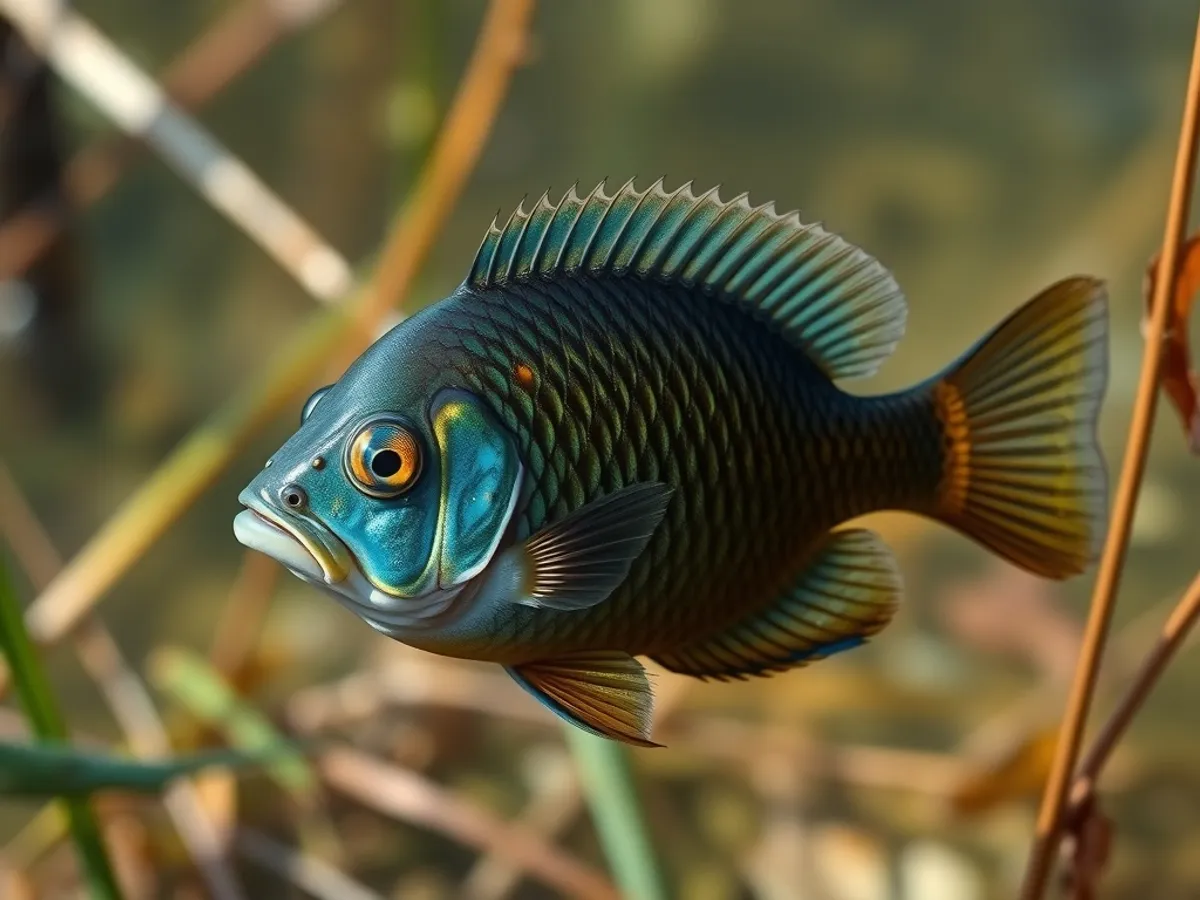
About the Bluegill
A bluegill lake contains at least three kinds of male, and they are not just different in behaviour but on different biological schedules. The "parental" male grows for around seven years, then builds a nest in a dense colony, courts, guards the eggs and fans them. Competing with him are two cheats: the tiny "sneaker" male, which matures at around two years while still small, hides in vegetation, and darts into the nest at the moment of spawning to release sperm; and the "satellite" male, which develops female-like colouration and behaviour, hovers over the nest pretending to be a second female, and spawns while the parental male is fooled. These are alternative life histories, not stages — a sneaker never becomes a parental male. Bluegill are also among the most extreme suction feeders studied, opening a protrusible mouth so fast that the resulting pressure drop pulls water and prey in before the prey can react. Their nesting colonies can hold hundreds of adjacent nests in the shallows.
Fascinating facts
Spawning Colonies
Male bluegills build and defend circular nests in colonies, often with dozens of closely packed nests in shallow waters during the breeding season.
Diet Variety
Bluegills eat insects, small crustaceans, zooplankton, and even plant material, making them true omnivores in their habitats.
Wide Distribution
While native to eastern and central North America, bluegills have been widely introduced across the United States and other continents for sport fishing.
Detailed description
The Bluegill (Lepomis macrochirus) is a small to medium-sized freshwater sunfish, typically reaching 15–23 cm (6–9 in) in length, though individuals can occasionally exceed 30 cm (12 in). Adults usually weigh between 0.2–0.5 kg (0.44–1.1 lb). Bluegills are characterized by a deep, laterally compressed body, a small mouth with a slightly protruding lower jaw, and a long, pointed pectoral fin. Their coloration is highly variable, but generally features an olive-green to bluish back, yellow to orange breast and belly, and iridescent blue or purple highlights on the operculum (gill cover) and lower jaw. A distinctive black 'ear' or opercular flap is present, and a dark spot is found at the base of the soft dorsal fin. Bluegills possess ctenoid scales and a spiny dorsal fin, which provides protection from predators. They have a well-developed lateral line system for detecting vibrations in the water. Bluegills are highly adaptable and can tolerate a wide range of environmental conditions, including low oxygen and varying temperatures. Their omnivorous diet and flexible feeding strategies contribute to their success in diverse habitats. Socially, bluegills often form large schools, especially as juveniles, and exhibit complex reproductive and territorial behaviors. They are a keystone species in many North American freshwater ecosystems, influencing community structure through their roles as both predator and prey.
Did you know?
Bluegills have been introduced to many countries outside their native range, sometimes becoming invasive and impacting local aquatic ecosystems.
Research & sources
Wikipedia summary
The bluegill, sometimes referred to as "bream", "brim", "sunny", or, in Texas, "copper nose", is a species of North American freshwater fish, native to and commonly found in streams, rivers, lakes, ponds and wetlands east of the Rocky Mountains. It is the type species of the genus Lepomis, from the family Centrarchidae in the order Centrarchiformes.
Behaviour & social structure
Bluegills display diurnal activity patterns, being most active during daylight hours. They are opportunistic feeders, foraging on aquatic and terrestrial insects, small crustaceans, zooplankton, and occasionally plant material. Bluegills use a combination of visual and mechanosensory cues to locate prey, often feeding near submerged vegetation or structures that provide cover. They exhibit social schooling behavior, particularly among juveniles and subadults, which offers protection from predators and increases foraging efficiency. During non-breeding periods, bluegills may form mixed-species schools with other sunfish. Adults become more solitary and territorial during the breeding season. Bluegills are known for their 'sit-and-wait' ambush tactics as well as active foraging. They communicate through body postures, fin displays, and subtle color changes, especially during aggressive or courtship interactions.
Reproduction & life cycle
Bluegills exhibit a highly organized and communal spawning system, typically breeding from late spring to midsummer when water temperatures reach 20–28°C (68–82°F). Males construct circular nests in shallow, sandy or gravelly substrates, often forming dense colonies with dozens or even hundreds of nests in close proximity. Males use their tails to fan out depressions and aggressively defend their nests from intruders. Females are courted through visual displays and are induced to spawn by the male's circling and nest-tending behaviors. Females may deposit 2,000–60,000 eggs per spawning event, often visiting multiple nests. Fertilized eggs hatch within 2–5 days, depending on temperature. Males provide sole parental care, guarding the eggs and fry from predators and fanning the nest to ensure oxygenation. Fry become free-swimming within a week and gradually disperse. Bluegills reach sexual maturity at 1–2 years of age, with larger males (so-called 'parental males') achieving greater reproductive success. Alternative male reproductive strategies, such as 'sneaker' and 'satellite' males, are well documented in this species.
Adaptations & survival
Bluegills possess several adaptations that enhance their survival. Their laterally compressed bodies allow for agile maneuvering through dense aquatic vegetation, aiding both escape from predators and efficient foraging. The spiny dorsal and anal fins deter predation. Their highly sensitive lateral line system enables detection of subtle water movements, facilitating prey capture and predator avoidance. Bluegills exhibit phenotypic plasticity in growth and morphology, adjusting their body shape and size in response to environmental conditions and predation pressure. Their broad diet and ability to exploit both benthic and pelagic food resources make them resilient to changes in food availability. Behavioral adaptations such as colonial nesting and alternative reproductive tactics increase reproductive success and genetic diversity.
Cultural significance
Bluegills hold significant cultural value in North America, especially as a popular target for recreational anglers due to their abundance, willingness to bite, and spirited fight. They are often a child's first catch and are celebrated in local fishing traditions and folklore. Bluegills are also important in educational programs and as a model organism in ecological and behavioral research. In some regions, they are referred to by colloquial names such as 'bream,' 'brim,' 'sunny,' or 'copper nose.' Their image appears in artwork, literature, and as state symbols (e.g., state fish of Illinois). Bluegills are occasionally used in aquaculture and as a food source, valued for their mild, flaky flesh.
Recent research
Recent research on bluegills has focused on their role in aquatic food webs, the genetic basis of alternative reproductive tactics, and their responses to environmental stressors such as hypoxia and pollution. Studies have examined the impact of bluegill introductions on non-native ecosystems, highlighting their potential to disrupt local biodiversity. Bluegills are also used as bioindicators for monitoring water quality due to their sensitivity to contaminants. Advances in telemetry and behavioral ecology have provided insights into their movement patterns, habitat use, and social dynamics. Ongoing research is exploring the effects of climate change on bluegill distribution and phenology, as well as the evolutionary mechanisms underlying their remarkable adaptability.
Videos
Habitat
Freshwater lakes, ponds, rivers, and streams with vegetation

Conservation
The Bluegill is currently classified as Least Concern on the IUCN Red List.
Threats & challenges
While Bluegills are currently listed as Least Concern by the IUCN, localized threats exist. Habitat degradation from pollution, siltation, and shoreline development can reduce spawning success and juvenile survival. Eutrophication and invasive aquatic plants may alter habitat structure and food webs. Overfishing is generally not a major concern due to their high reproductive output, but intense angling pressure can affect population structure in some areas. The introduction of bluegills outside their native range has led to ecological imbalances, sometimes outcompeting native species. Climate change may impact bluegill populations through altered water temperatures, hydrology, and oxygen levels. Despite these challenges, bluegills remain one of the most abundant and widespread freshwater fish in North America.
Taxonomy
Scientific name
Lepomis macrochirus
- Kingdom
- Animalia
- Phylum
- Chordata
- Class
- Actinopterygii
- Order
- Perciformes
- Family
- Centrarchidae
- Genus
- Lepomis
- Species
- macrochirus
Where to see a bluegill
1 zoo and aquarium in 1 country are recorded as keeping this species.

Community notes
Share your observations about the Bluegill.
No community notes yet. Be the first!
Discover more wildlife
More fascinating animals from the encyclopedia.