
About the Borneo Angle-headed Lizard
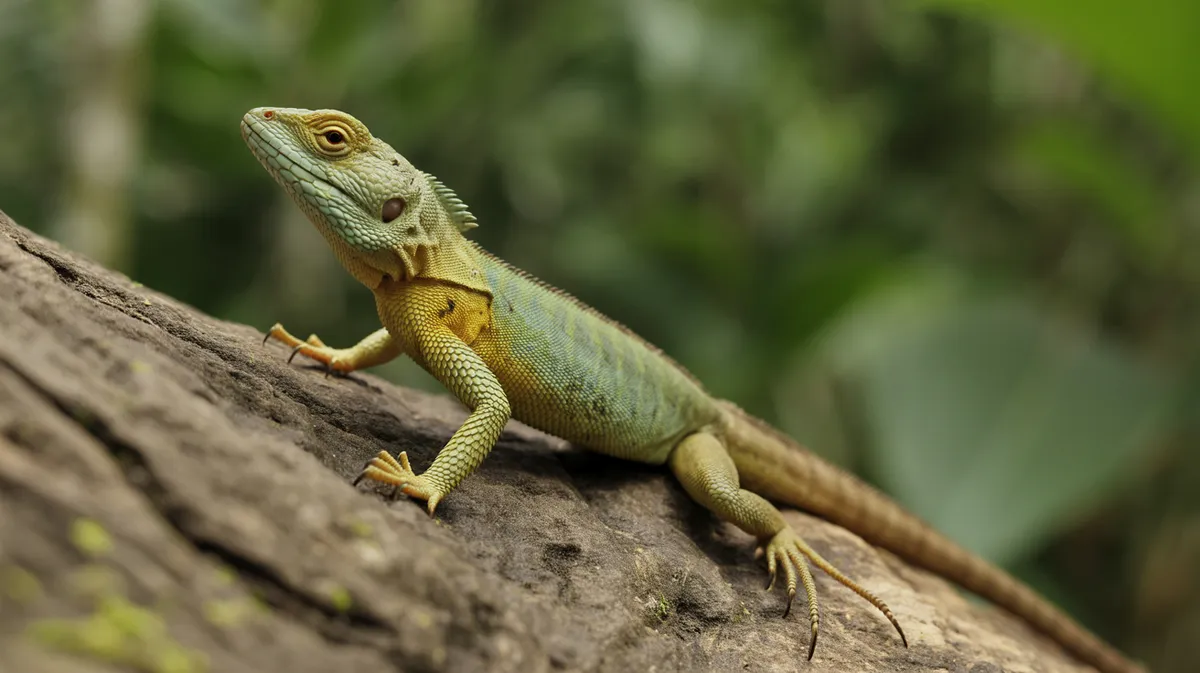
The Borneo Angle-headed Lizard is a striking arboreal reptile endemic to the rainforests of Borneo. Characterized by its angular head, elongated limbs, and crest along the neck, this lizard is well camouflaged among mossy tree trunks and foliage. It typically displays shades of green and brown, blending seamlessly with its environment to avoid predators. This species is primarily diurnal and spends most of its life in the forest canopy, rarely descending to the ground.
Fascinating facts
Arboreal Lifestyle
This lizard spends almost all its time in the trees, rarely venturing to the forest floor, which helps it avoid ground-dwelling predators.
Unique Camouflage
Its coloration and textured skin allow it to blend perfectly with mossy bark and lichen, making it exceptionally hard to spot.
Insect Hunter
The Borneo Angle-headed Lizard primarily feeds on insects such as ants, beetles, and other small arthropods found in the rainforest canopy.
Detailed description
The Borneo Angle-headed Lizard (Gonocephalus borneensis) is a medium-sized agamid, with adults typically reaching a snout-vent length of 120–160 mm and a total length (including tail) of up to 350 mm. Its most distinctive feature is the prominent, angular casque or crest on the back of its head, which is more pronounced in males and may serve both as a display structure and for species recognition. The body is laterally compressed, aiding in maneuverability among dense foliage, and the limbs are long and robust, equipped with sharp claws for gripping bark and branches. The dorsal coloration ranges from vibrant green to olive or brown, often with irregular blotches or banding, providing exceptional camouflage against mossy trunks and epiphytic vegetation. The ventral surface is usually lighter, sometimes tinged with yellow or blue hues. This lizard possesses a row of nuchal and dorsal spines, which may deter predators and play a role in intraspecific displays. Its large, expressive eyes are adapted for acute vision in the dappled light of the rainforest canopy. G. borneensis is primarily arboreal and diurnal, spending most of its life in the mid to upper canopy, where it is seldom seen on the ground. When threatened, it can remain motionless for extended periods, relying on its cryptic coloration, but it is also capable of rapid, agile movement through the branches.
Did you know?
Unlike most lizards, the Borneo Angle-headed Lizard does not drop its tail (autotomy) as a primary defense mechanism.
Research & sources
Behaviour & social structure
Gonocephalus borneensis is a solitary and territorial species, with individuals maintaining defined home ranges in the forest canopy. It is most active during the early morning and late afternoon, engaging in basking, foraging, and territorial patrols. The lizard primarily hunts by sit-and-wait ambush, remaining motionless until prey such as insects, spiders, and other small arthropods come within striking distance. It uses its long, sticky tongue to capture prey with precision. Social interactions are generally limited to the breeding season, when males may display head-bobbing, dewlap extension, and body inflation to deter rivals or attract females. Aggressive encounters can involve chasing and biting. At night, individuals seek shelter on the undersides of large leaves or in tree hollows, where they remain motionless to avoid nocturnal predators.
Reproduction & life cycle
Breeding in G. borneensis is believed to coincide with the onset of the rainy season (typically October to March), when food resources are abundant. Males establish and defend territories, performing visual displays to attract females and ward off competitors. Courtship involves a series of head-bobs, push-ups, and color changes. After mating, females descend to the forest floor or select a moist, concealed site among leaf litter to lay clutches of 4–10 leathery eggs. Incubation lasts approximately 60–80 days, depending on ambient temperature and humidity. There is no parental care post-oviposition; hatchlings are independent from birth and immediately climb into the understory to avoid ground-dwelling predators. Sexual maturity is reached at around 18–24 months.
Adaptations & survival
G. borneensis exhibits several key adaptations for arboreal life. Its laterally compressed body and elongated limbs facilitate movement through dense vegetation, while specialized toe pads and sharp claws provide excellent grip on smooth or mossy surfaces. The cryptic coloration, often enhanced by the ability to darken or lighten skin tones, allows it to blend seamlessly with its environment. The angular casque and nuchal spines may serve as deterrents to predators and as visual signals in social interactions. Its large eyes offer enhanced depth perception and motion detection, critical for both predator avoidance and prey capture in the complex three-dimensional canopy. Behavioral adaptations include motionless ambush hunting and the use of vertical escape routes when threatened.
Cultural significance
The Borneo Angle-headed Lizard holds little direct significance in local folklore or traditional practices, likely due to its secretive, arboreal habits and lack of economic value. However, it is occasionally featured in ecotourism and wildlife photography, symbolizing the rich biodiversity of Borneo's rainforests. Its presence is considered an indicator of healthy, undisturbed forest ecosystems.
Recent research
Recent herpetological surveys have refined the known distribution of G. borneensis, confirming its presence in both Malaysian and Indonesian Borneo, as well as in Brunei. Molecular phylogenetic studies have clarified its relationship to other Gonocephalus species, supporting its status as a distinct species. Ongoing research focuses on its ecological role as an insectivore in canopy food webs and its sensitivity to habitat disturbance. There is growing interest in the species as a model for studying arboreal lizard adaptations and the impacts of rainforest fragmentation on canopy-dwelling reptiles.
Videos
Habitat
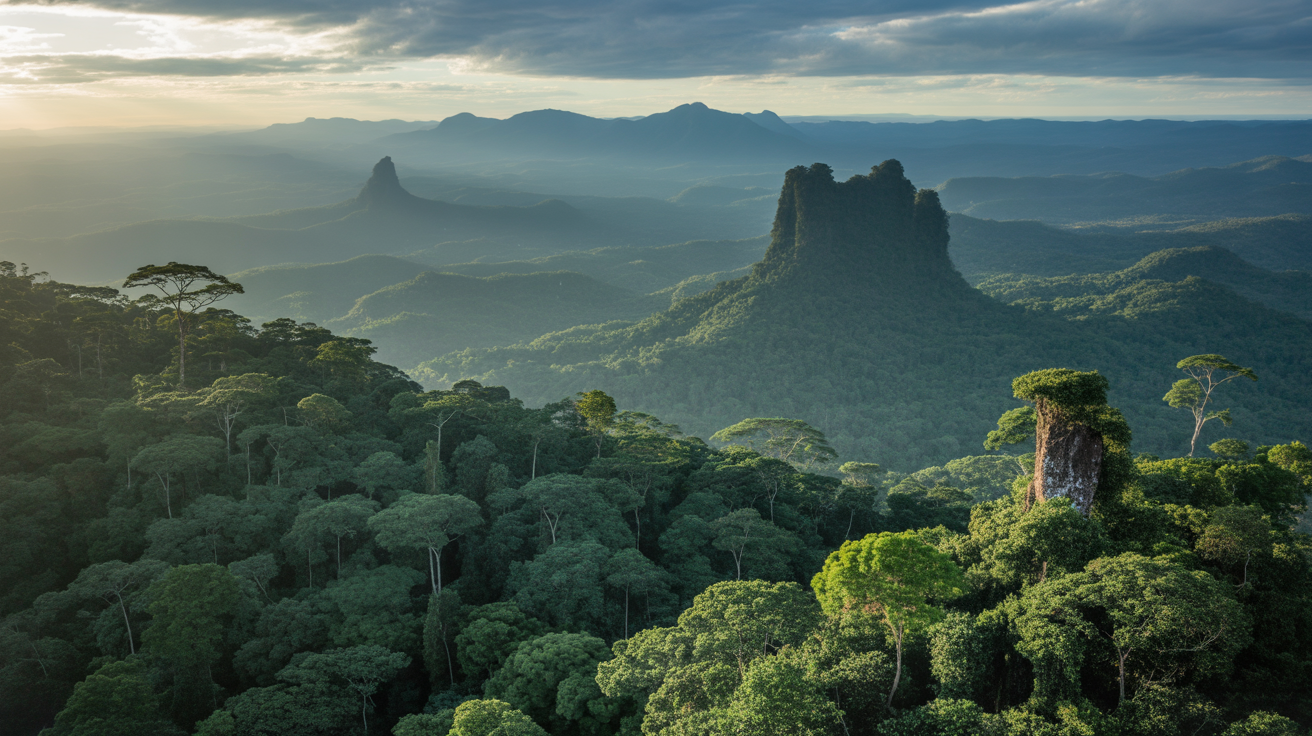
Tropical rainforest
 Elevated Terrain
Mountain
High-altitude environments with varying climates and specialized wildlife adapted to rugged terrain and thin air.
 Tropical Regions
Rainforest
Dense, wet forests with the highest biodiversity on Earth, containing more than half of the world's plant and animal species.
 Global
Forest
Wooded areas with significant tree cover and diverse plant and animal communities.
Conservation
The Borneo Angle-headed Lizard is currently classified as Least Concern on the IUCN Red List.
Threats & challenges
Although currently listed as Least Concern by the IUCN, G. borneensis faces localized threats from ongoing deforestation, habitat fragmentation, and illegal collection for the pet trade. The rapid conversion of lowland rainforest to oil palm plantations and logging activities in Borneo are reducing suitable habitat, especially in lowland and foothill regions. While the species shows some resilience in secondary forests, its dependence on complex canopy structure makes it vulnerable to large-scale habitat loss. There is limited data on population trends, but continued habitat degradation could pose future risks.
Taxonomy
Scientific name
Gonocephalus borneensis
- Kingdom
- Animalia
- Phylum
- Chordata
- Class
- Reptilia
- Order
- Squamata
- Family
- Agamidae
- Genus
- Gonocephalus
- Species
- borneensis
Community notes
Share your observations about the Borneo Angle-headed Lizard.
No community notes yet. Be the first!
Discover more wildlife
More fascinating animals from the encyclopedia.