

Insectivores
42 species in the encyclopedia
Specialists that feed mainly on insects and other invertebrates.
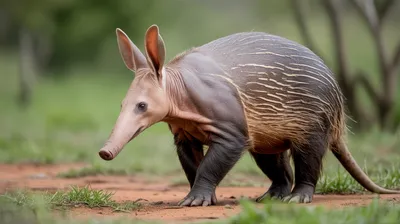
Aardvark
Orycteropus afer
The aardvark looks like an animal assembled from spare parts — rabbit ears, a pig's snout, a kangaroo's tail — and it is related to none of them, nor to the anteaters and pangolins it so closely resembles. It is the only living member of an entire order, Tubulidentata, named for its strange teeth: they have no enamel, are built from bundles of upright dentine tubes, grow continuously to replace what wears away, and sit only at the back of the jaw. It is a phenomenal digger, able to excavate faster than several people with shovels, and its burrows matter far beyond itself — warthogs, hyenas, porcupines, owls and hares all shelter in abandoned aardvark holes, making it a keystone species whose loss would evict an entire community. It hunts ants and termites by night, sweeping a long sticky tongue through nests it has torn open, and can seal its nostrils to keep the insects out. One plant depends on it entirely: the aardvark cucumber fruits underground, and the aardvark digs it up for its water and buries the seeds in its dung. Its likeness to other ant-eating mammals is convergent evolution — the same diet, solved the same way, by animals that are not related at all.
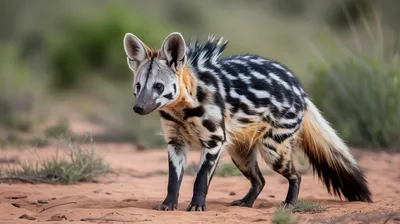
Aardwolf
Proteles cristata
The aardwolf is a hyena that gave up being a hyena. It looks like a small striped hyena and it is one, but where its relatives evolved bone-crushing jaws, the aardwolf abandoned the entire carnivore project and went after termites. It eats almost nothing else — as many as a quarter of a million in a single night, lapped up with a broad, sticky tongue — and it does not dig into their mounds but takes them from the surface as they forage. It specialises on one genus, Trinervitermes, which defends itself with a noxious terpene secretion that deters almost every other predator, and the aardwolf simply tolerates it. Its jaws have collapsed accordingly: the cheek teeth are reduced to widely spaced, useless pegs, and only the canines remain, kept for fighting rather than eating. It is nocturnal, largely solitary but monogamous, and it defends a territory containing enough termite mounds to see it through the year, marking the boundary meticulously.

Amazonian Royal Flycatcher
Onychorhynchus coronatus
The Amazonian Royal Flycatcher is a small, insectivorous bird best known for its spectacular fan-shaped crest, which is vividly colored and usually displayed during courtship or when threatened. This bird inhabits the humid lowland forests and river edges of the Amazon Basin, often remaining inconspicuous as it forages for insects. With olive-brown upperparts and yellowish underparts, its remarkable crest—red in males and yellow to orange in females—remains mostly hidden except during displays. The species builds long, hanging nests suspended over water to protect its young from predators. Despite its striking appearance, the Amazonian Royal Flycatcher is seldom seen due to its secretive habits and preference for dense forest undergrowth.
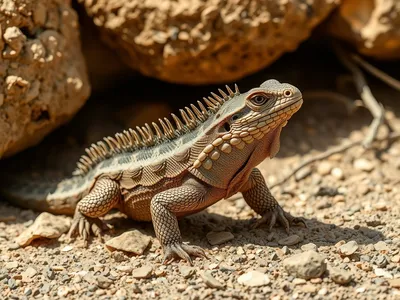
Armadillo girdled lizard
Ouroborus cataphractus
The armadillo girdled lizard defends itself exactly the way its namesake does. Threatened, it takes its own tail in its mouth and curls into a tight ring, turning the soft belly inward and presenting nothing but a wall of heavy, spined scales — an armoured doughnut that a predator can get no purchase on and cannot easily swallow. It lives in the rocky, arid scrub of western South Africa, sheltering in cracks in sandstone outcrops, and unusually for a lizard it is social: groups of up to several dozen share the same crevices. That sociality is precisely why it has become such a target for the illegal pet trade, since an entire colony can be taken at once by cracking open a single rock. It is unusual in another way too — it gives birth to live young, one or two at a time, rather than laying eggs, and females have been recorded feeding their offspring, which is close to unheard of among lizards. It reproduces very slowly and is now protected.
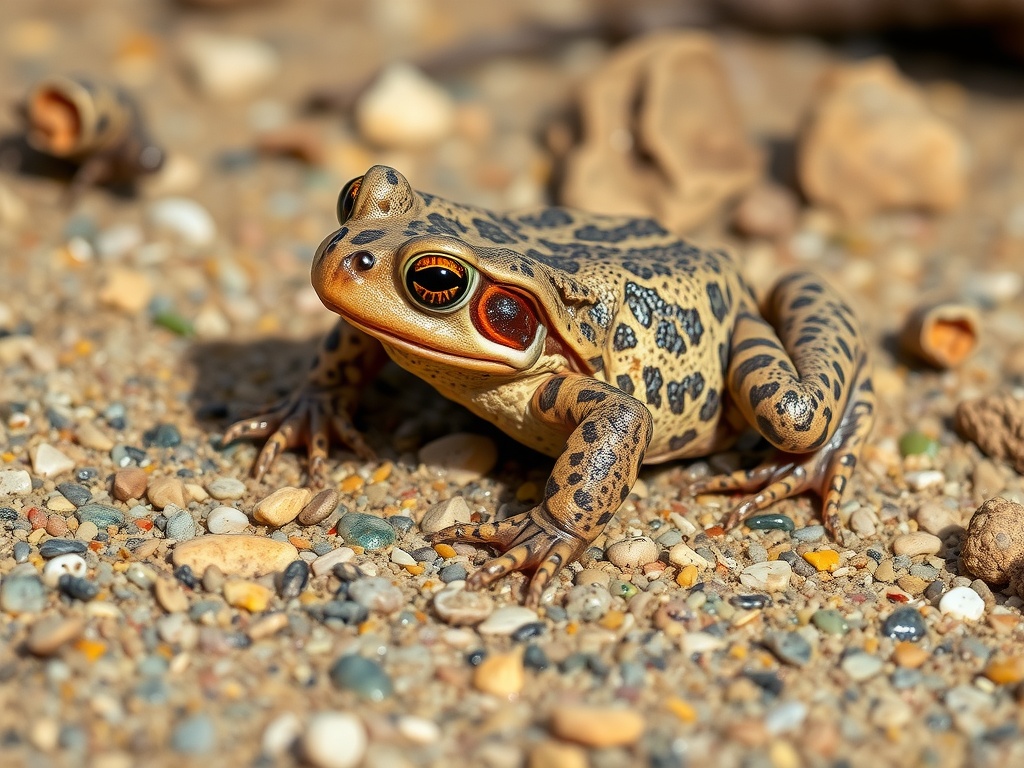
Arroyo Toad
Anaxyrus californicus
The Arroyo Toad is a small, stocky amphibian native to southwestern California and Baja California, Mexico. Characterized by its olive-gray warty skin and pale stripe across its head and back, this toad is specialized for life in sandy streamside habitats. Arroyo Toads are nocturnal and spend much of their life buried underground, emerging mainly during the breeding season after spring rains. Their populations are vulnerable due to habitat destruction, altered water flow, and invasive species.
Barbary Coast Agama
Agama bibronii
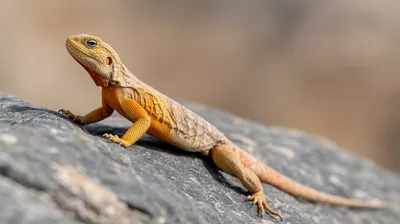
The Barbary Coast Agama is a robust, medium-sized lizard native to the rocky and arid regions along the northwestern coast of Africa. It displays striking sexual dimorphism, with males often showing vivid blue or reddish hues during the breeding season, while females are generally more subdued in color. This diurnal reptile is well-adapted for climbing and can be seen basking on rocks or walls during the day. Its energetic movements and territorial displays make it a fascinating subject for behavioral observation. The Barbary Coast Agama plays a vital role in its ecosystem by controlling insect populations.
Black rain frog
Breviceps fuscus
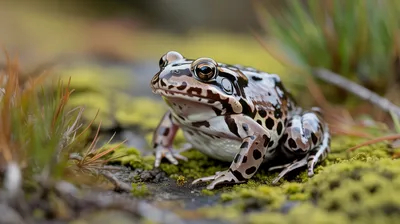
The black rain frog can neither hop nor swim. Its legs are far too short and its body is a near-perfect sphere, so it walks, and if it falls in water it flounders. It is a burrower from the southern Cape mountains of South Africa, and it has cut water out of its life cycle entirely: there is no tadpole. Eggs are laid in a moist underground chamber and the young develop directly inside them, emerging as tiny fully formed froglets, which means the frog does not need a pond and can live in fynbos and forest floor far from any stream. Its defence is inflation. Threatened, it puffs itself up like a balloon and wedges into its tunnel, becoming impossible to pull out, and it squeaks and grunts while doing it, which is why photographs of it circulate online as the world's grumpiest animal. Mating creates an engineering problem, because the male is much smaller and his arms cannot reach around her sphere — so the female secretes a glue that sticks him to her back until the eggs are laid.
Borneo Angle-headed Lizard
Gonocephalus borneensis
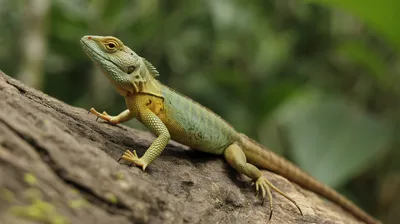
The Borneo Angle-headed Lizard is a striking arboreal reptile endemic to the rainforests of Borneo. Characterized by its angular head, elongated limbs, and crest along the neck, this lizard is well camouflaged among mossy tree trunks and foliage. It typically displays shades of green and brown, blending seamlessly with its environment to avoid predators. This species is primarily diurnal and spends most of its life in the forest canopy, rarely descending to the ground.
Bumblebee Bat
Craseonycteris thonglongyai
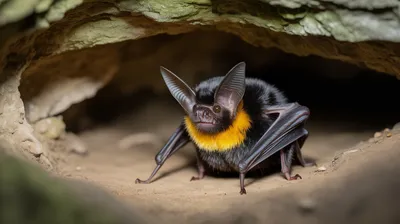
Kitti's hog-nosed bat, or bumblebee bat, weighs about 2 g and has a body 29 to 33 mm long — it is the smallest mammal in the world by body length, and it vies with the Etruscan shrew, which is fractionally lighter, for the title overall. It is so distinct that it is the sole member of its own family, Craseonycteridae, with no close relatives at all; a whole branch of the mammal tree that consists of one tiny animal. It was found only in 1973, in limestone caves in western Thailand, by the Thai zoologist Kitti Thonglongya, who died before he could publish the description. Its life is compressed into two short windows: it emerges for perhaps half an hour at dusk and again briefly at dawn, foraging around bamboo clumps and teak, hovering like a hummingbird to pluck insects and spiders directly off leaves. That hovering — expensive, precise flight — is what its pig-like nose and broad wings support. It roosts in a few dozen limestone caves in Thailand and southeast Myanmar and nowhere else on Earth.

Common Firecrest
Regulus ignicapilla
The Common Firecrest is a tiny, brightly colored songbird native to Europe and parts of North Africa. It is known for its olive-green upperparts, white underparts, distinctive black and white face pattern, and a striking orange or yellow crown stripe bordered by black. The Firecrest is often seen flitting rapidly through coniferous and mixed forests, foraging for small insects and spiders among the foliage. Despite its small size, it is a highly active and agile bird with a sharp, high-pitched song. Its secretive nesting habits and vivid plumage make it a favorite among birdwatchers.

Common Nightjar
Caprimulgus europaeus
The Common Nightjar is a medium-sized nocturnal bird renowned for its cryptic plumage and distinctive churring song that echoes through open woodlands and heathlands at dusk and dawn. Its mottled brown, grey, and buff feathers provide exceptional camouflage against leaf litter and fallen branches. During the day, the nightjar rests motionless on the ground, blending perfectly with its surroundings, while at night it becomes active, feeding on flying insects caught in mid-air. This species undertakes long migratory journeys between its breeding grounds in Europe and wintering areas in sub-Saharan Africa.
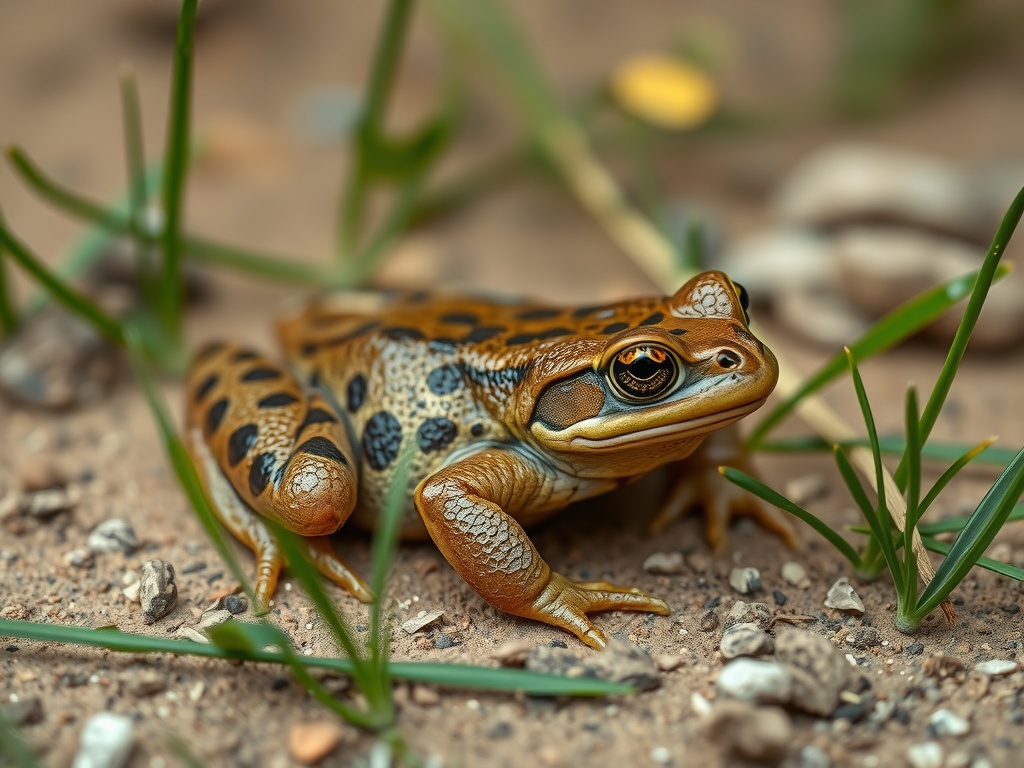
Common Rain Frog
Breviceps adspersus
The Common Rain Frog is a small, burrowing amphibian native to southern Africa. It has a stout, round body with short limbs and is well-adapted to a subterranean lifestyle, spending much of its life underground to avoid dry conditions. This frog emerges mainly during heavy rains, when it becomes active to breed and feed. Its skin is usually brown or grayish, providing camouflage among leaf litter and sandy soils. The Common Rain Frog is known for its distinctive, squeaky vocalizations and its ability to inflate its body when threatened.
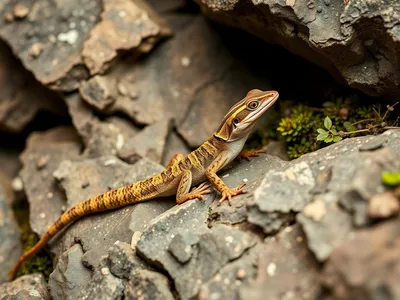
Common Wall Lizard
Podarcis muralis
The Common Wall Lizard is a small, agile reptile native to southern and central Europe, easily recognized by its slender body and long tail. Its coloration varies widely, ranging from brown and grey to greenish hues, often with dark spots or stripes, providing excellent camouflage against stone walls and rocky habitats. This lizard is highly adaptable, thriving in both rural and urban environments, and is frequently seen basking on sunlit walls, rocks, and ruins. Known for its quick movements and climbing abilities, the Common Wall Lizard plays an important role in controlling insect populations.
Draco Lizard
Draco volans
Draco lizards glide on their ribs. Where every other gliding vertebrate stretches skin between its limbs, a Draco has five to seven pairs of enormously elongated ribs that swing outward like the spokes of a fan, opening a brightly coloured membrane along the flanks and folding it away flat against the body when it lands. The result is a wing that leaves all four legs free — and in flight the lizard actually reaches down and grabs the leading edge of the membrane with its forelimbs to control its shape, effectively steering by hand. Glides of 30 m or more between trunks are routine, and because the animal spends its entire life in the canopy of Southeast Asian forest, gliding is not an escape reflex so much as ordinary commuting between feeding trees. Draco eat almost nothing but ants and termites, patrolling a trunk and licking columns of them as they pass. Males defend territories on individual trees and signal with a long, brightly coloured throat flap stiffened by the hyoid bone, flicking it out and bobbing at rivals and passing females. The only time a Draco touches the ground is when a female descends to push her eggs into soil at the base of a tree, covers them, and leaves.
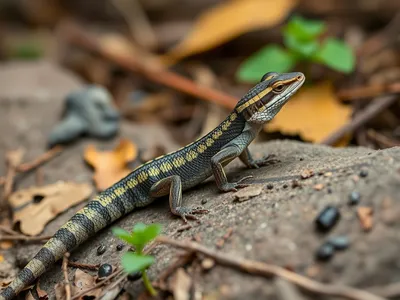
Eastern Fence Lizard
Sceloporus undulatus
The Eastern Fence Lizard is a medium-sized spiny lizard native to the eastern and central United States. Characterized by rough, keeled scales and a gray to brown coloration, it often displays striking blue patches on the sides of its belly, especially in males. These lizards are diurnal and are frequently seen basking on logs, rocks, and fences, using their agility to escape predators. Their cryptic coloration helps them blend into their woodland and edge habitats, while their keen eyesight aids in hunting insects.
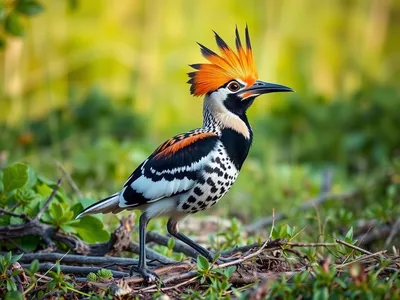
Eurasian Hoopoe
Upupa epops
Upupa epops is a pinkish, black-and-white barred bird with a fan of a crest and a long curved bill, and it defends its nest with chemical warfare. The female and her nestlings have a preen gland that switches, during breeding, to producing a dark brown fluid that smells powerfully of rotting meat. That secretion is not simply foul — it is loaded with symbiotic bacteria that produce antimicrobial compounds, and the female smears it on her eggs, where it appears to protect them from the pathogens that would otherwise thrive in a hot, filthy nest hole. On top of that, nestlings can squirt faeces at an intruder's face and hiss like a snake. The nest itself is left uncleaned, which is unusual among cavity-nesting birds and makes the antimicrobial defence necessary in the first place. The bill is a probe: hoopoes walk over short turf jabbing into the soil and can open the bill while it is buried, a manoeuvre called gaping, to seize mole crickets and beetle grubs underground. In flight the black-and-white wings flash like a giant butterfly in a flopping, irregular beat that looks barely controlled. The crest is normally flat and is raised on landing or in alarm.
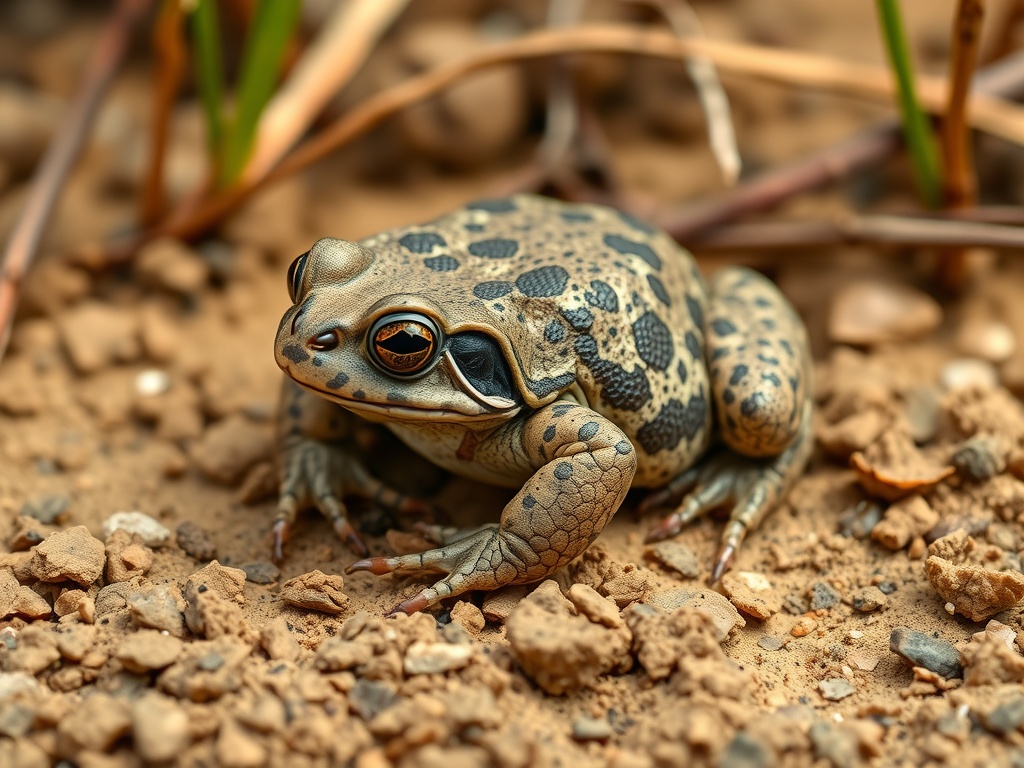
Fowler's Toad
Anaxyrus fowleri
Fowler's Toad is a medium-sized amphibian native to eastern North America, recognized for its rough, warty skin and cryptic coloring that ranges from gray to brown with dark blotches. This toad is often found in sandy soils near freshwater sources, such as ponds, lakes, and streams, where it breeds in spring and summer. Distinguished from similar species by the presence of three or more warts within each dark dorsal spot and a white belly, Fowler's Toad uses its excellent camouflage to avoid predators. Its distinctive, nasal call is a familiar sound during warm evenings in its range.
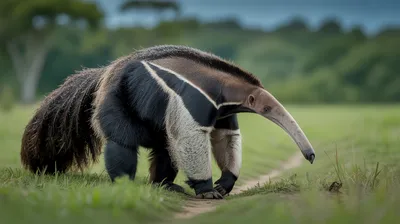
Giant Anteater
Myrmecophaga tridactyla
The giant anteater has no teeth at all. In their place it deploys a tongue up to about 60 cm long, coated in sticky saliva and anchored to the sternum rather than the skull, which it flicks in and out roughly 150 times a minute — fast enough to strip a nest before the insects mount a serious defence. It eats tens of thousands of ants and termites a day, yet rarely destroys a colony: it typically feeds at each nest for barely a minute before moving on, leaving the food source intact for a return visit. Its front claws are so long it cannot walk on its palms, so it knuckle-walks with the claws folded inward — the same problem a gorilla has, solved the same way. It runs an unusually low body temperature for a mammal, around 33°C, part of a slow metabolism suited to a low-energy diet. It looks defenceless but is not: a cornered anteater rears onto its hind legs and slashes with those claws, and has killed jaguars. It is not related to aardvarks or pangolins — the resemblance is convergent evolution driven by the same diet.
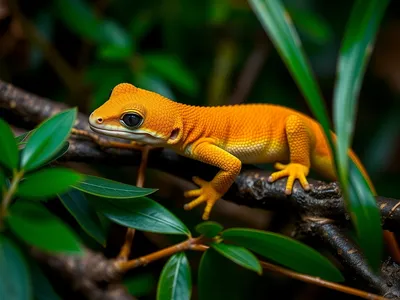
Golden Gecko
Gekko badenii
The Golden Gecko is a striking arboreal reptile native to the rainforests of Vietnam. It is well known for its vibrant golden-yellow coloration, which serves as camouflage among lichen and tree bark. Primarily nocturnal, this gecko is an agile climber, using its specialized toe pads to traverse vertical surfaces with ease. Golden Geckos are shy and secretive, often hiding in crevices or under loose bark during the day.
Golden Mantella
Mantella aurantiaca
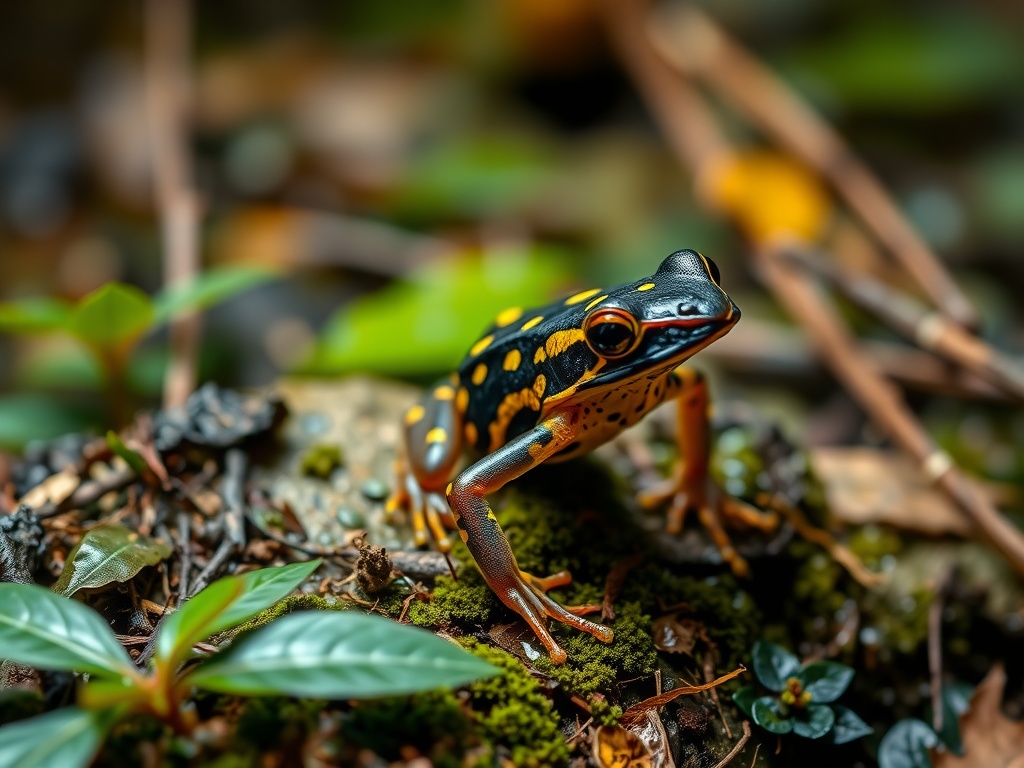
The Golden Mantella is a small, vividly colored amphibian native to the rainforests of Madagascar. Recognized for its bright orange to yellow skin, this tiny frog acts as a warning to predators about its toxicity. Golden Mantellas are terrestrial and are most often found near swamps, marshes, and seasonal pools in forested areas. Due to habitat loss and collection for the pet trade, their populations have declined significantly in the wild.
Green Woodpecker
Picus viridis
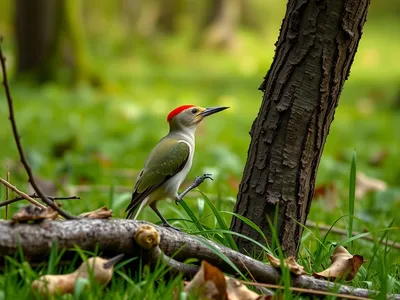
Picus viridis is a woodpecker that has largely given up woodpecking. It spends most of its time on the ground, hopping awkwardly across short grassland, lawns and heaths, hunting ants - and it is a specialist to an extreme degree, with ants and their pupae making up the overwhelming bulk of its diet. To exploit them it has the longest tongue relative to size of any European bird: around 10 cm, sticky-tipped, and stored when retracted by curling back over the skull and anchoring behind the eye socket. The bird probes an ant nest, floods the galleries with the tongue and hauls out brood by the hundred. Because it drills wood mainly for nest holes rather than food, it drums only rarely and weakly; instead its territorial signal is a loud, ringing, laughing call - the "yaffle" that gives it its old English folk name and inspired Professor Yaffle in Bagpuss. Hard winters with lying snow are the main killer, since frozen ground locks the ants away, and green woodpecker numbers crash after severe cold. Males and females are separated by the moustache stripe: red-centred in the male, solid black in the female.
Indian Pangolin
Manis crassicaudata
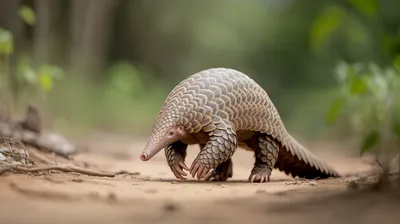
The Indian Pangolin is a nocturnal, solitary mammal covered in large, protective keratin scales. Found across the Indian subcontinent, it is specialized for feeding on ants and termites, using its long, sticky tongue to extract prey from nests. When threatened, the pangolin curls into a tight ball, using its tough scales as armor. Its digging claws and keen sense of smell aid in finding food and constructing burrows. Due to illegal hunting and habitat loss, the Indian Pangolin is increasingly rare and threatened in the wild.
Jackson's Chameleon
Trioceros jacksonii
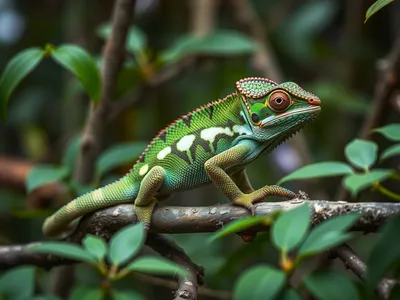
Trioceros jacksonii of the montane forests of Kenya and Tanzania is the "three-horned chameleon", and the horns are true bony structures covered in keratin, borne only by the males, who fight with them - two rivals lock horns and try to lever each other off a branch, a mode of combat far closer to a deer or a rhinoceros beetle than to anything else in the lizard world. Females of the common subspecies have no horns at all. Unlike most chameleons, Jackson's does not lay eggs: females retain the eggs internally and give birth to 8 to 30 live young after a gestation of five to six months, an adaptation to cold, high-altitude forests where eggs in the ground would not develop reliably. Its colour change, like all chameleons', is not about matching a background - it is driven by temperature, mood, social signalling and hormonal state, and works by adjusting the spacing of guanine nanocrystals in the skin's iridophore layer, tuning which wavelengths are reflected. A population introduced to Oahu in 1972 from a pet shipment released to recover after a stressful journey has since spread across the Hawaiian islands, where it eats native tree snails and insects and is now a recognised invasive.
Keeled Earless Lizard
Holbrookia propinqua
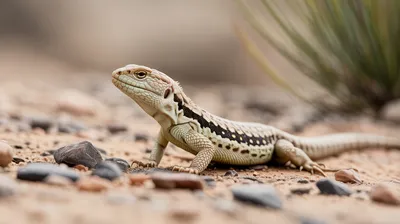
The Keeled Earless Lizard is a small, slender reptile distinguished by its lack of external ear openings and the presence of distinct, keeled scales on its dorsal surface. Native to the arid and semi-arid regions of southern Texas and northeastern Mexico, this lizard is well-adapted to sandy and gravelly habitats where it can quickly burrow to escape predators. Its cryptic coloration provides excellent camouflage against the substrate, while its swift, agile movements make it an effective insect hunter. Despite its elusive nature, the Keeled Earless Lizard plays an important role in the ecosystem as both predator and prey.