
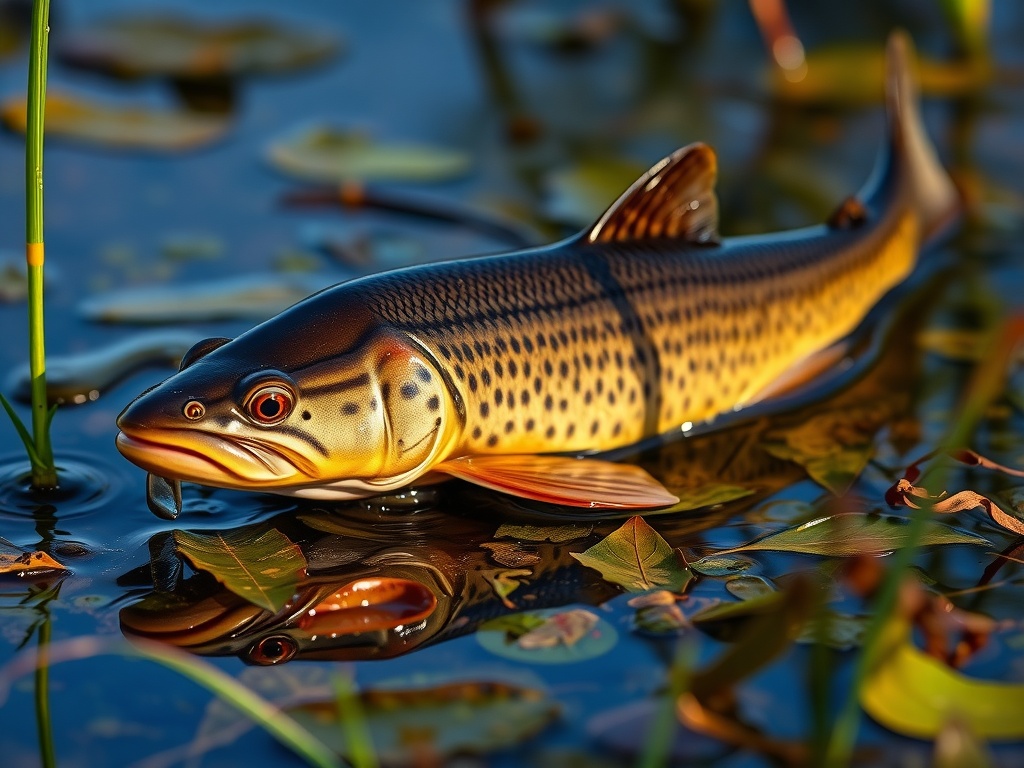
About the Bowfin
The bowfin is the sole survivor of an entire lineage. Every other member of the Halecomorphi is a fossil, and the bowfin has been swimming in North American swamps essentially unchanged for well over 100 million years — which makes it the closest living relative of all the teleosts, the 30,000 species that make up almost every fish you can name. It carries a gular plate, a single bony shield under the lower jaw, an archaic feature lost by modern fish. It gulps air into a lung-like, vascularised swim bladder, which lets it survive in the hot, stagnant, oxygen-dead backwaters where nothing else can live, and it can persist in mud as the water goes. In spring the male turns brilliant green on the belly and fins, clears a nest in vegetation, and then guards a dense, moving black swarm of fry for weeks, herding them like a sheepdog. It was persecuted for a century as a "trash fish" that ate game fish, and killed on sight.
Fascinating facts
Living Fossil
Bowfins are often called 'living fossils' because they have changed very little since the Jurassic period and are the only surviving members of their order.
Air Breather
Bowfins possess a specialized swim bladder that allows them to breathe atmospheric air, enabling them to survive in waters with very low oxygen.
Protective Parent
Male bowfins are known for their parental care, fiercely guarding their nests and offspring from predators.
Detailed description
The bowfin (Amia calva) is a robust, elongated freshwater fish reaching lengths of 50–70 cm (20–28 in), with some individuals exceeding 80 cm (31 in) and weights up to 9.75 kg (21.5 lbs). Its cylindrical body is covered with thick, cycloid scales, and it is characterized by a long dorsal fin that runs along much of its back, containing 45–52 soft rays. The head is broad and flattened, with a large mouth filled with sharp, conical teeth suited for grasping prey. Bowfins exhibit sexual dimorphism, with males often displaying a greenish spot (ocellus) near the upper base of the tail. The coloration is generally olive to brown dorsally, fading to a lighter belly, with mottled patterns providing camouflage among aquatic vegetation. Bowfins possess a highly vascularized swim bladder that functions as a lung, enabling facultative air breathing—an adaptation for surviving in hypoxic (low-oxygen) waters. Their gular plate, a bony structure beneath the lower jaw, is a primitive feature retained from ancient ancestors. Behaviorally, bowfins are solitary and primarily nocturnal, using stealth and ambush tactics to capture prey. They are opportunistic predators, consuming fish, amphibians, crustaceans, and insects. The species is notable for its resilience, tolerating a wide range of temperatures and water conditions, and is capable of aestivation during droughts by burrowing into mud. Bowfins are long-lived, with lifespans reported up to 30 years in the wild.
Did you know?
Despite their fierce appearance, bowfins are not related to true pikes or gars, but represent a unique evolutionary lineage dating back over 150 million years.
Research & sources
Wikipedia summary
The ruddy bowfin is a ray-finned fish native to North America. Common names include mudfish, mud pike, dogfish, grindle, grinnel, swamp trout, and choupique. It is regarded as a relict, being one of only two surviving species of the Halecomorphi, a group of fish that first appeared during the Early Triassic, around 250 million years ago. The bowfin is often considered a "living fossil" because they have retained some morphological characteristics of their early ancestors. It is one of two species in the genus Amia, along with Amia ocellicauda, the eyespot bowfin. The closest living relatives of bowfins are gars, with the two groups being united in the clade Holostei.
Behaviour & social structure
Bowfins are predominantly solitary and exhibit crepuscular to nocturnal activity patterns, becoming most active at dusk and during the night. They are ambush predators, remaining motionless among submerged vegetation or debris before lunging at prey with a rapid sideways motion. Their diet consists mainly of fish (including sunfish, catfish, and minnows), but they also consume crayfish, aquatic insects, frogs, and occasionally small mammals or birds. Bowfins use both visual and mechanosensory cues to detect prey, aided by a lateral line system. They are capable of rapid bursts of speed but generally rely on stealth and sudden strikes. Social interactions are limited outside the breeding season, with individuals maintaining territories. During periods of low oxygen, bowfins surface to gulp air, a behavior facilitated by their vascularized swim bladder. Juveniles may form loose schools for protection, but adults are highly territorial.
Reproduction & life cycle
Bowfin reproduction occurs in spring, typically from April to June, when water temperatures reach 16–19°C (60–66°F). Males construct nests in shallow, vegetated areas by clearing away debris and silt with their tails, creating depressions 30–60 cm (12–24 in) in diameter. Females are attracted to these nests, where spawning occurs at night or early morning. A single female may lay between 2,000 and 5,000 adhesive eggs, which adhere to the substrate. After fertilization, the female departs, and the male assumes sole responsibility for guarding the eggs and, later, the fry. Incubation lasts 8–10 days, depending on temperature. Upon hatching, larvae remain attached to vegetation or the nest by an adhesive organ until their yolk sacs are absorbed. The male continues to guard the fry for several weeks, herding them into tight schools and defending them from predators. This level of paternal care is unusual among North American freshwater fishes.
Adaptations & survival
Bowfins exhibit several remarkable adaptations for survival in variable and often harsh environments. Their vascularized swim bladder functions as a primitive lung, allowing them to breathe atmospheric air and survive in hypoxic or stagnant waters where other fish might perish. The gular plate is a unique skeletal feature, reflecting their ancient lineage. Their cryptic coloration and mottled patterns provide effective camouflage among aquatic plants and detritus. Bowfins possess a powerful, muscular body and a long dorsal fin, enabling sudden bursts of speed for ambush predation. Their dentition is adapted for grasping and holding slippery prey. Additionally, their ability to aestivate—entering a state of dormancy in mud during droughts—enhances their resilience to environmental stressors.
Cultural significance
Bowfins have held various roles in human culture, particularly among Indigenous peoples of North America, who utilized them as a food source and for making fish glue from their swim bladders. In the southern United States, they are known by regional names such as 'choupique' and have been featured in local folklore and cuisine, though their soft, oily flesh is not widely favored. Bowfins have sometimes been maligned by anglers, but recent interest in 'rough fish' angling has led to a reevaluation of their sporting qualities. Their status as a 'living fossil' has also made them a subject of scientific and public fascination.
Recent research
Recent genetic and morphological studies have clarified the taxonomy of Amia, leading to the recognition of a second species, Amia ocellicauda (eyespotted bowfin), previously considered a population of A. calva. Ongoing research focuses on the evolutionary history of Holostei (the group including bowfins and gars), providing insights into early ray-finned fish diversification. Studies of bowfin physiology have elucidated mechanisms of air breathing and hypoxia tolerance, with implications for understanding vertebrate respiratory evolution. Bowfins are also used as model organisms in research on parental care and the ecological impacts of predatory fish in freshwater ecosystems.
Sources
Videos
Habitat
Freshwater swamps, rivers, and lakes


Conservation
The Bowfin is currently classified as Least Concern on the IUCN Red List.
Threats & challenges
Currently, bowfins are classified as Least Concern by the IUCN, with stable populations across much of their range. However, localized threats include habitat degradation from wetland drainage, pollution, and dam construction, which can alter spawning grounds and water quality. Bowfins are sometimes persecuted by anglers who mistakenly view them as 'trash fish' or competitors with game species, leading to unnecessary culling. In some areas, overfishing and bycatch may impact local populations. Despite these pressures, their adaptability and broad ecological tolerance have allowed them to persist in many altered habitats. Climate change, with its potential to alter hydrological regimes and increase hypoxic events, could pose future challenges.
Taxonomy
Scientific name
Amia calva
- Kingdom
- Animalia
- Phylum
- Chordata
- Class
- Actinopterygii
- Order
- Amiiformes
- Family
- Amiidae
- Genus
- Amia
- Species
- calva
Where to see a bowfin
1 zoo and aquarium in 1 country are recorded as keeping this species.

Community notes
Share your observations about the Bowfin.
No community notes yet. Be the first!
Discover more wildlife
More fascinating animals from the encyclopedia.