
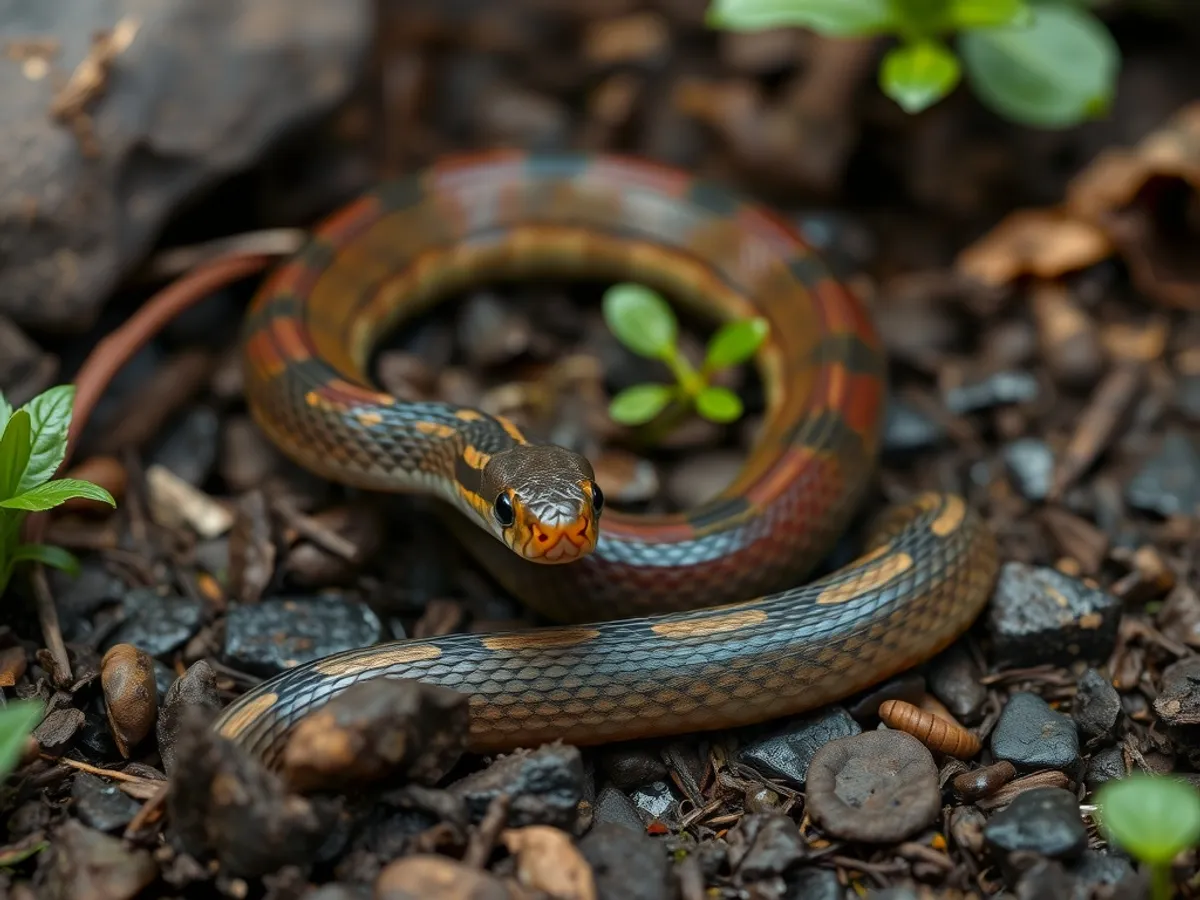
About the Brahminy Blind Snake
The Brahminy Blind Snake is a tiny, slender, non-venomous snake often mistaken for an earthworm due to its shiny, smooth, dark gray to purple-brown body. Native to Africa and Asia, this species has become the most widely distributed terrestrial snake in the world, largely because it is easily transported in soil and potted plants. The Brahminy Blind Snake is fossorial, spending most of its life underground and emerging only occasionally, usually after rain. Notably, it reproduces parthenogenetically, meaning all individuals are female and capable of laying fertile eggs without mating.
Fascinating facts
Global Hitchhiker
Brahminy Blind Snakes have spread across every continent except Antarctica, mostly by hitching rides in soil and plant pots.
Completely Blind
These snakes lack functional eyes and cannot see; instead, they sense their environment using touch and smell.
Unique Reproduction
They are parthenogenetic, so all individuals are female and can lay eggs that hatch without fertilization.
Detailed description
The Brahminy Blind Snake (Indotyphlops braminus) is a diminutive, slender snake, typically measuring 60–175 mm in total length, with a maximum recorded length of about 210 mm. Its cylindrical body is uniform in diameter, rarely exceeding 2.5 mm, and is covered with smooth, glossy scales that give it a metallic sheen, ranging in color from dark gray to purplish-brown or even black. The head is barely distinct from the body, with a blunt, rounded snout adapted for burrowing, and vestigial eyes that appear as tiny dark spots beneath the scales, rendering the snake effectively blind. The tail is short and ends in a small, pointed tip, sometimes called a 'spine,' which is not venomous. The mouth is small and ventrally positioned, suited for consuming minute prey. This species is entirely fossorial, spending nearly its entire life underground in loose, moist soils, leaf litter, compost, or under stones and logs. It is highly secretive and rarely seen above ground except after heavy rains or during soil disturbance. The Brahminy Blind Snake is parthenogenetic, with all individuals being female and capable of laying viable eggs without fertilization, making it unique among snakes. Its widespread distribution is facilitated by its ability to survive in disturbed habitats and its inadvertent transport in soil and potted plants, leading to its introduction on every continent except Antarctica.
Did you know?
Every single Brahminy Blind Snake found anywhere in the world is female—no males of this species have ever been discovered.
Research & sources
Wikipedia summary
Indotyphlops braminus, commonly known as the brahminy blind snake and other names, is a non-venomous blind snake species, found mostly in Africa and Asia, and has been introduced in many other parts of the world. It is a completely fossorial reptile, with habits and appearance similar to an earthworm, for which it is often mistaken, although close examination reveals tiny scales and eyes rather than the annular segments characteristic of a true earthworm. The species is parthenogenetic and all known specimens have been female. The specific name is a Latinized form of the word Brahmin. No subspecies are currently recognized as being valid.
Behaviour & social structure
Indotyphlops braminus is primarily nocturnal and crepuscular, remaining hidden underground or beneath debris during the day to avoid desiccation and predation. It exhibits a solitary lifestyle, with minimal social interaction except in areas of high population density, where multiple individuals may be found in favorable microhabitats. The snake actively forages by burrowing through loose soil, using its reinforced skull to push aside substrate. Its diet consists mainly of the larvae, pupae, and eggs of ants and termites, which it locates using chemosensory cues. Feeding is accomplished by ingesting prey whole, aided by its flexible jaws. The snake's movements are slow and deliberate, and it rarely attempts to flee rapidly when disturbed, instead relying on its cryptic coloration and subterranean habits for protection. Surface activity is most commonly observed after rainfall, when the soil is moist and prey is abundant.
Reproduction & life cycle
Reproduction in the Brahminy Blind Snake is exclusively parthenogenetic, meaning females produce genetically identical offspring without the involvement of males. Oviposition typically occurs during the rainy season, when environmental moisture is optimal for egg development. Females lay clutches of 1–7 small, elongated eggs, each measuring approximately 2–4 mm in length. The incubation period varies with temperature and humidity but generally lasts 45–60 days. There is no parental care; hatchlings are independent and fully capable of burrowing and feeding immediately upon emergence. The absence of males and the ability to reproduce from a single individual have enabled this species to rapidly colonize new areas. Multiple generations may be produced annually in favorable climates.
Adaptations & survival
Indotyphlops braminus exhibits several adaptations for a fossorial lifestyle: its streamlined, cylindrical body and smooth scales facilitate movement through soil; the skull is reinforced for burrowing; and the eyes are reduced and covered by scales to prevent injury underground. The snake's chemosensory system is highly developed, with a keen sense of smell and taste to detect prey and navigate subterranean environments. Its parthenogenetic reproduction is a remarkable evolutionary adaptation, allowing a single individual to establish a new population. The species also tolerates a wide range of environmental conditions and can survive in urban, agricultural, and natural habitats, contributing to its cosmopolitan distribution.
Cultural significance
Due to its secretive habits and resemblance to earthworms, the Brahminy Blind Snake is often overlooked in human culture. In some regions, it is regarded as a sign of healthy soil or good luck, while in others, it is mistakenly believed to be venomous or harmful. There are few records of its use in traditional medicine or folklore, likely due to its small size and unobtrusive nature. Its inadvertent transport in potted plants has led to its nickname, the 'flowerpot snake.'
Recent research
Recent genetic studies have confirmed the clonal nature of Indotyphlops braminus populations worldwide, with extremely low genetic diversity due to its parthenogenetic reproduction. Molecular phylogenetics has clarified its taxonomic placement within the Typhlopidae family and its separation from related genera. Ongoing research focuses on the mechanisms of parthenogenesis, the species' invasive potential, and its ecological interactions in introduced habitats. Studies have also examined its resistance to desiccation and ability to survive long periods without food, contributing to its success as a global invader.
Videos
Habitat
Loose, moist soils in gardens, forests, and urban areas


Conservation
The Brahminy Blind Snake is currently classified as Least Concern on the IUCN Red List.
Threats & challenges
Currently, the Brahminy Blind Snake faces few significant threats and is classified as Least Concern by the IUCN. Its ability to thrive in disturbed habitats and reproduce without mates has made it resilient to habitat loss and fragmentation. However, in some introduced regions, it may face predation from native fauna or competition with other fossorial species. There is limited evidence of negative ecological impact in areas where it has been introduced, though its effect on local invertebrate populations warrants further study. Human activities such as global trade in plants and soil continue to facilitate its spread. Population trends are stable or increasing globally.
Taxonomy
Scientific name
Indotyphlops braminus
- Kingdom
- Animalia
- Phylum
- Chordata
- Class
- Reptilia
- Order
- Squamata
- Family
- Typhlopidae
- Genus
- Indotyphlops
- Species
- braminus
Community notes
Share your observations about the Brahminy Blind Snake.
No community notes yet. Be the first!
Discover more wildlife
More fascinating animals from the encyclopedia.