
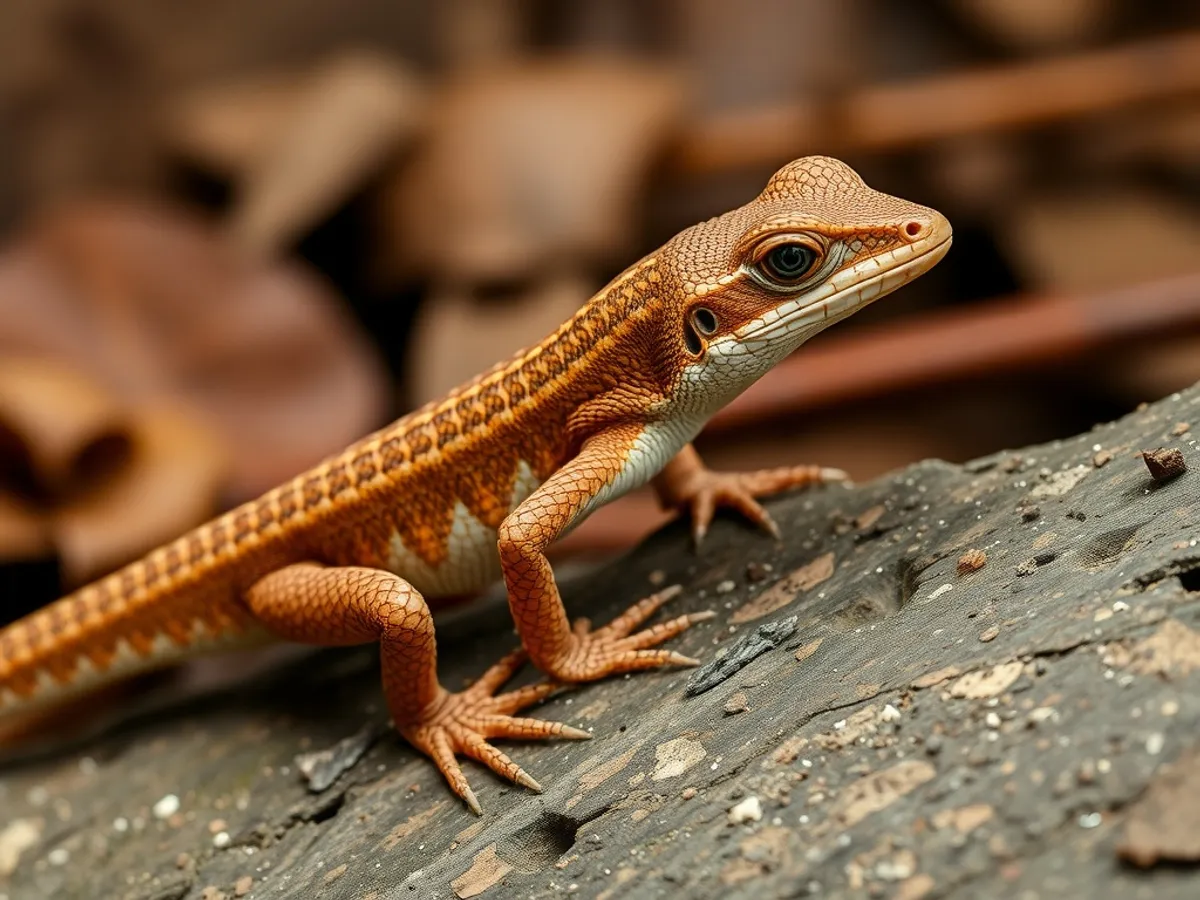
About the Brown Anole
The Brown Anole is a small, agile lizard native to Cuba and the Bahamas but has become widely established in the southeastern United States and other warm regions. It is characterized by its brown to grayish body, often adorned with darker markings, and a distinctive orange-red dewlap (throat fan) used in displays. Brown Anoles are highly adaptable, thriving in various habitats, especially urban and suburban environments. They are territorial and often seen basking on low vegetation, fences, or walls. Due to their rapid reproduction and adaptability, they have become one of the most common lizards in Florida and are considered an invasive species in many areas.
Fascinating facts
Tail Shedding
Brown Anoles can voluntarily shed their tails to distract predators and escape danger. The tail will regrow over time, but usually not to its original length.
Habitat Generalists
Unlike many lizards, Brown Anoles are highly adaptable and can thrive in natural forests, urban gardens, parks, and even on building structures.
Invasive Competitor
In areas where they have been introduced, Brown Anoles often outcompete native anole species for habitat and resources, causing shifts in local ecosystems.
Detailed description
The Brown Anole (Anolis sagrei) is a small, robust lizard typically measuring 12–20 cm (4.7–7.9 in) in total length, with males generally larger and more robust than females. Its coloration ranges from brown to grayish-brown, often with darker dorsal patterns such as diamond or chevron markings, and a lighter, sometimes cream-colored belly. Males are distinguished by a prominent, brightly colored dewlap—ranging from orange to red with a yellow border—which is used in territorial and courtship displays. The head is relatively short and blunt, with well-developed limbs and long toes equipped with adhesive lamellae, enabling efficient climbing on a variety of surfaces. The tail is long and can be autotomized (shed) as a defense mechanism, regenerating over time. Brown Anoles possess keen vision and are highly alert, relying on rapid movements to evade predators. Their skin texture is granular, aiding in camouflage among leaf litter and bark. This species exhibits pronounced sexual dimorphism, with males displaying larger dewlaps and more prominent dorsal crests. Brown Anoles are diurnal and highly adaptable, thriving in disturbed habitats, including urban landscapes, where they can be seen basking or foraging on low vegetation, walls, and fences.
Did you know?
The Brown Anole's introduction to new areas has caused a shift in native lizard populations, forcing green anoles to move higher into the trees to avoid competition.
Research & sources
Wikipedia summary
The brown anole, also known commonly as the Cuban brown anole, Bahaman anole, or De la Sagra's anole, is a species of lizard in the family Dactyloidae. The species is native to Cuba, the Bahamas, Little Cayman, Cayman Brac, Jamaica, the Swan Islands, the Yucatán Peninsula, Belize and the Caribbean coast of Guatemala and Honduras. It has been widely introduced elsewhere, via the importation and exportation of plants where the anole would lay eggs in the soil of the pots, and is now found in Florida and other regions of the United States including southern Georgia, Texas, Louisiana, Tennessee, Mississippi, Alabama, Hawaii, North Carolina, and Southern California. It has also been introduced to other Caribbean islands, Mexico, and Taiwan.
Behaviour & social structure
Brown Anoles are primarily diurnal, with peak activity during the early morning and late afternoon. They are territorial, especially males, which engage in visual displays such as head-bobbing, push-ups, and dewlap extensions to assert dominance and defend territories. Aggressive encounters between males can involve chasing, biting, and wrestling. Their hunting strategy is primarily sit-and-wait, preying on a wide range of arthropods, including insects, spiders, and occasionally smaller lizards or their eggs. They use rapid tongue flicks to capture prey and are opportunistic feeders, adjusting their diet based on availability. Social interactions are complex, with a dominance hierarchy established among males, while females maintain smaller, overlapping territories. Brown Anoles exhibit site fidelity, often returning to favored basking or foraging spots. They are also known for their escape behaviors, including tail autotomy and rapid dashing into dense vegetation when threatened.
Reproduction & life cycle
Brown Anoles have an extended breeding season in warm climates, typically from early spring through late summer. Courtship involves elaborate displays by males, including dewlap extension and body posturing. After mating, females lay single, leathery-shelled eggs every 7–14 days, often burying them in moist soil, leaf litter, or potted plants. Incubation lasts 30–45 days, depending on temperature and humidity. Females can store sperm for multiple clutches, allowing for continuous egg production throughout the season. There is no parental care; hatchlings are independent from birth and receive no protection or guidance from adults. Juveniles grow rapidly, reaching sexual maturity within 6–9 months under favorable conditions. High reproductive output and short generation times contribute to the species' invasive success.
Adaptations & survival
Brown Anoles exhibit several adaptations that enhance survival and dispersal. Their adhesive toe pads, composed of microscopic lamellae, allow for efficient climbing on smooth and rough surfaces. Cryptic coloration and patterning provide camouflage against predators and during ambush hunting. The ability to autotomize the tail serves as an effective anti-predator strategy, distracting attackers while the lizard escapes. Behavioral flexibility, such as exploiting urban environments and shifting perch heights to avoid competition with native anoles (e.g., Anolis carolinensis), has facilitated their invasive spread. Their high reproductive rate and capacity for sperm storage further enhance colonization potential. Physiologically, they tolerate a wide range of temperatures and humidity levels, contributing to their success in diverse habitats.
Cultural significance
While Brown Anoles do not have significant roles in traditional folklore or mythology, their presence in urban and suburban environments has made them familiar to residents in the southeastern United States and the Caribbean. They are sometimes kept as pets and used in educational settings to demonstrate reptilian biology and invasive species dynamics. In some regions, they are viewed as a nuisance due to their impact on native lizard populations, but they are also appreciated for their insect control abilities in gardens and yards.
Recent research
Recent research has focused on the ecological impacts of Brown Anole invasions, particularly their effects on native anole species and local arthropod communities. Studies have documented rapid evolutionary changes in both Brown Anoles and displaced Green Anoles, such as shifts in perch height and limb morphology. Genomic analyses have revealed high genetic diversity in introduced populations, likely due to multiple introduction events. Ongoing research explores their adaptive responses to urbanization, including behavioral plasticity and physiological tolerance to pollutants. Brown Anoles are also used as model organisms in studies of sexual selection, territoriality, and rapid evolution.
Videos
Habitat
Urban areas, gardens, forests, and shrublands


Conservation
The Brown Anole is currently classified as Least Concern on the IUCN Red List.
Threats & challenges
Currently, Brown Anoles face few significant natural threats within their introduced range, contributing to their population expansion. In their native range, predation by birds, snakes, and larger lizards is more common. Human-mediated habitat alteration has generally benefited the species, though pesticide use and habitat destruction can locally reduce populations. As an invasive species, Brown Anoles pose ecological challenges by outcompeting and displacing native anoles, particularly the Green Anole (Anolis carolinensis) in the southeastern United States. Hybridization is not a concern, but competition for resources and perch sites has led to shifts in native species' behavior and microhabitat use. Population trends are stable or increasing in both native and introduced areas, and the species is not considered at risk globally.
Taxonomy
Scientific name
Anolis sagrei
- Kingdom
- Animalia
- Phylum
- Chordata
- Class
- Reptilia
- Order
- Squamata
- Family
- Dactyloidae
- Genus
- Anolis
- Species
- sagrei
Where to see a brown anole
1 zoo and aquarium in 1 country are recorded as keeping this species.

Community notes
Share your observations about the Brown Anole.
No community notes yet. Be the first!
Discover more wildlife
More fascinating animals from the encyclopedia.