
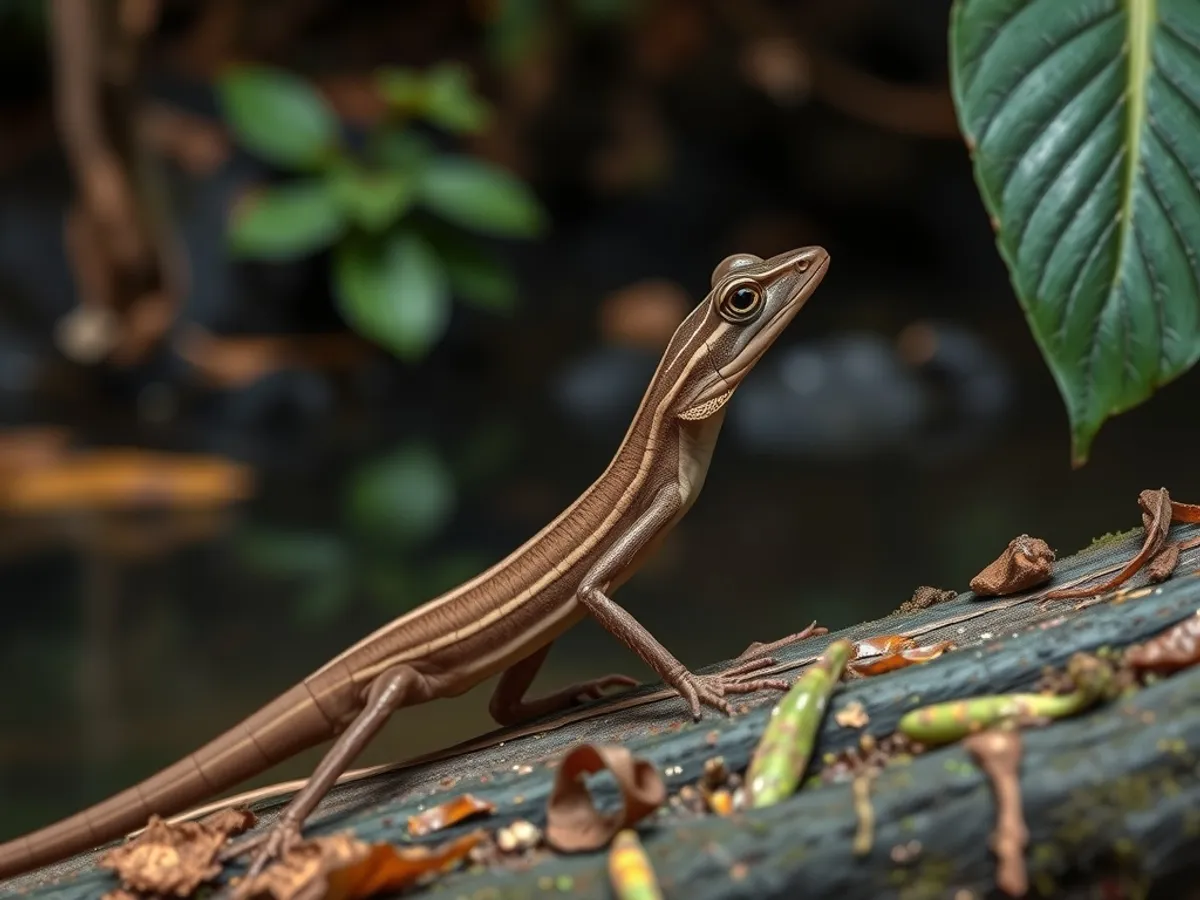
About the Brown basilisk
The brown basilisk is a medium-sized lizard native to Central America, recognized for the striking crest along its back and head. It is most famous for its remarkable ability to run across the surface of water, earning it the nickname 'Jesus lizard.' Brown basilisks are agile climbers and are typically found near rivers, lakes, and other bodies of freshwater in tropical forests. Their coloration provides excellent camouflage against leaf litter and tree bark, aiding in predator evasion.
Fascinating facts
Water Runner
Brown basilisks can run short distances on the surface of water to escape predators, using their long toes and fast speed.
Crested Appearance
They have a distinctive crest along their head, back, and tail, which is more pronounced in males.
Introduced Species
Outside of their native range in Central America, brown basilisks have successfully established populations in Florida, USA.
Detailed description
The brown basilisk (Basiliscus vittatus) is a medium-sized lizard, with adult males reaching total lengths of up to 61 cm (24 in), including the tail, while females are generally smaller. Its most distinctive features are the prominent sagittal crest on the head and a dorsal crest running along the back and tail, both more pronounced in males. The body is laterally compressed, aiding in swift movement through dense vegetation. The coloration is generally olive-brown to dark brown, with a pair of light, cream-colored stripes running from the eye down the length of the body and tail, providing effective camouflage among leaf litter and tree trunks. The limbs are long and muscular, with the hind feet being particularly large and equipped with elongated toes fringed by lateral skin flaps—an adaptation for running across water. The scales are small and granular, offering flexibility and protection. The eyes are large with round pupils, providing acute vision for detecting predators and prey. Brown basilisks are diurnal and highly alert, often basking on branches or rocks near water but quickly fleeing when disturbed. Their agility extends to both terrestrial and arboreal environments, and they are capable swimmers, diving underwater to evade threats. Sexual dimorphism is evident, with males displaying larger crests and brighter coloration during the breeding season.
Did you know?
Brown basilisks have been introduced to southern Florida, where they have established stable populations far from their native range.
Research & sources
Wikipedia summary
The brown basilisk, also commonly referred to as the striped basilisk or in some areas as the common basilisk, is a species of basilisk lizard in the family Corytophanidae. The species is native to Mexico, Central America and adjacent northwestern Colombia, and has been introduced into the U.S. state of Florida as an invasive species. The brown basilisk has large hind feet with narrow flaps of skin on the distal edge of each toe. The fact that it moves quickly across water gives it the appearance of "walking on water".
Behaviour & social structure
Brown basilisks are primarily solitary and territorial, with males defending prime basking and feeding sites along water bodies. They are most active during the early morning and late afternoon, spending midday hours in shaded or concealed locations to avoid overheating. Their omnivorous diet includes insects (such as beetles, ants, and grasshoppers), spiders, small vertebrates (including other lizards and small frogs), fruits, seeds, and flowers. Foraging is typically opportunistic, involving both active pursuit and ambush tactics. When threatened, the basilisk's first response is to flee, often utilizing its ability to sprint bipedally across water surfaces for distances up to 4.5 meters (15 feet), a behavior facilitated by rapid limb movement and the specialized toe fringes. Social interactions outside of breeding are limited, though juveniles may be seen in loose aggregations in areas with abundant resources. Vocalizations are absent, but visual displays—such as head-bobbing and crest-raising—are used in territorial and courtship contexts.
Reproduction & life cycle
Brown basilisks are oviparous, with breeding typically occurring during the rainy season (May to August in much of their native range). Males establish and defend territories to attract females, engaging in visual displays and occasional combat. After mating, females lay multiple clutches per season, each containing 5–15 elliptical eggs, in moist, well-drained soil or leaf litter near water. Incubation lasts approximately 55–70 days, depending on ambient temperature and humidity. There is no parental care; hatchlings are fully independent and exhibit adult-like behaviors immediately upon emergence. Juvenile mortality is high due to predation by birds, snakes, and mammals, but rapid growth and cryptic coloration enhance survival chances.
Adaptations & survival
The brown basilisk's most famous adaptation is its ability to run bipedally across water, enabled by large hind feet with fringed toes that increase surface area and reduce sinking. This 'water-walking' is a predator evasion strategy and is most effective in juveniles, which are lighter and faster. The cryptic coloration and longitudinal stripes provide camouflage in dappled light, while the laterally compressed body aids in rapid movement through dense vegetation. The crests, especially in males, serve both as sexual signals and as deterrents to rivals. Acute vision and quick reflexes facilitate both foraging and predator avoidance. The species' omnivorous diet and tolerance for disturbed habitats contribute to its success as both a native and invasive species.
Cultural significance
The brown basilisk is popularly known as the 'Jesus lizard' due to its remarkable ability to run on water, a trait that has captured the public imagination and is frequently featured in documentaries and ecotourism. While not traditionally significant in indigenous folklore compared to other reptiles, its striking appearance and unique locomotion have made it a symbol of agility and escape in modern culture. In some regions, it is occasionally kept as a pet, though this is not widespread. Its presence in Florida has sparked local interest and concern due to its invasive status.
Recent research
Recent studies have focused on the biomechanics of water-running in Basiliscus vittatus, revealing that the lizard generates sufficient lift and propulsion by slapping its feet rapidly against the water surface, creating air pockets that prevent sinking. Genetic analyses have clarified its relationships within the Corytophanidae family, supporting its distinction from closely related species. Ecological research in Florida is ongoing to assess its impact on native fauna and ecosystem dynamics. Studies on thermal ecology indicate that brown basilisks exhibit behavioral thermoregulation, selecting microhabitats that optimize body temperature for activity and digestion. There is also interest in the species as a model for understanding the evolution of bipedal locomotion in reptiles.
Videos
Habitat
Tropical forest edges near freshwater


Conservation
The Brown basilisk is currently classified as Least Concern on the IUCN Red List.
Threats & challenges
In its native range, the brown basilisk faces predation from birds of prey, snakes, and some mammals. Habitat loss due to deforestation and water pollution can locally impact populations, but the species is highly adaptable and persists in disturbed and secondary habitats. In Florida, where it is invasive, it faces few natural predators and may compete with native lizards for resources. Climate change may alter rainfall patterns and habitat suitability, but current population trends are stable. The IUCN lists Basiliscus vittatus as Least Concern due to its wide distribution and adaptability. However, ongoing monitoring is warranted in both native and introduced ranges to assess ecological impacts and potential management needs.
Taxonomy
Scientific name
Basiliscus vittatus
- Kingdom
- Animalia
- Phylum
- Chordata
- Class
- Reptilia
- Order
- Squamata
- Family
- Corytophanidae
- Genus
- Basiliscus
- Species
- vittatus
Where to see a brown basilisk
1 zoo and aquarium in 1 country are recorded as keeping this species.

Community notes
Share your observations about the Brown basilisk.
No community notes yet. Be the first!
Discover more wildlife
More fascinating animals from the encyclopedia.