
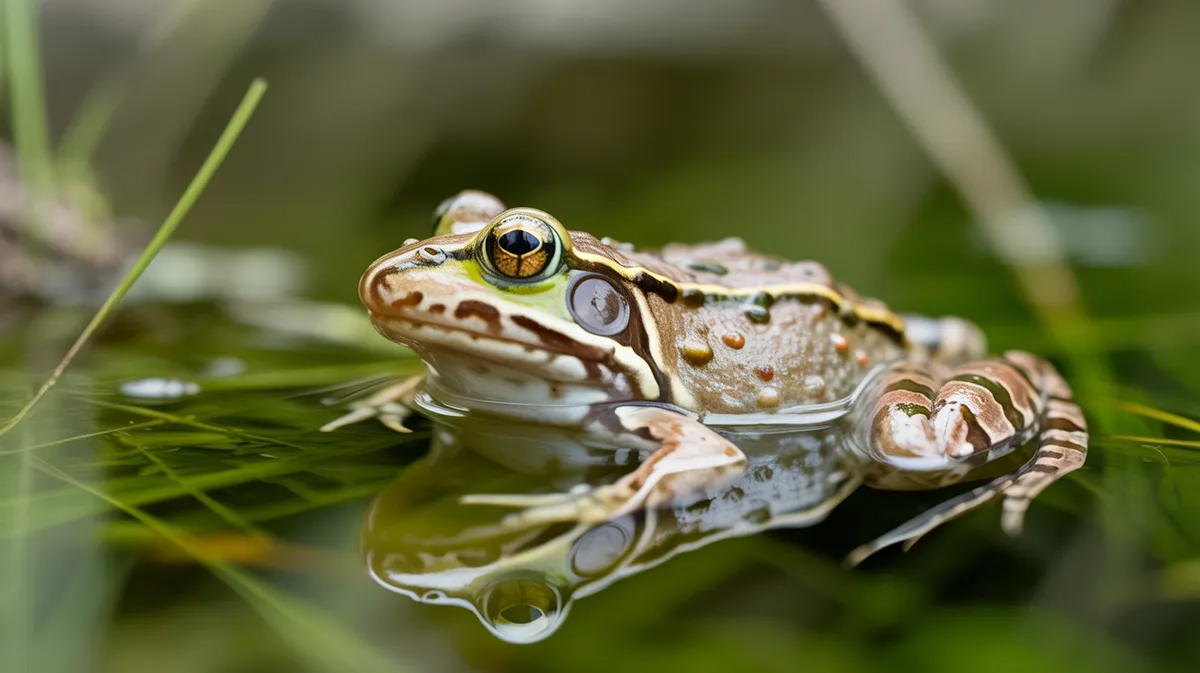
About the Budgett's Frog
Budgett's Frog, also known as the Paraguay horned frog, is a unique amphibian native to South America. It is renowned for its bizarre, flattened appearance, wide mouth, and aggressive temperament, especially when threatened. Adapted to a semi-aquatic lifestyle, this amphibian spends much of the year in burrows during dry periods, emerging during the rainy season to breed. Its unusual vocalizations and voracious appetite make it a fascinating species both in the wild and in the exotic pet trade.
Fascinating facts
Biting Defense
Budgett's Frog uses its powerful jaws to bite potential threats, a rare trait among frogs.
Unusual Appearance
Their flattened body and wide mouth give them a comical, grumpy expression that sets them apart from other frogs.
Rainy Season Breeder
They spend most of the year underground in a state of estivation, emerging only during heavy rains to breed.
Detailed description
Budgett's Frog (Lepidobatrachus laevis) is a robust, highly specialized amphibian belonging to the family Ceratophryidae. Adults typically measure 10–13 cm (4–5 in) in length, with females generally larger than males. The species is instantly recognizable by its dorsoventrally flattened body, broad, shovel-shaped head, and disproportionately wide mouth, which can span nearly the width of the head. Its skin is smooth to slightly granular, colored in mottled olive, gray, or brown, providing camouflage in muddy aquatic environments. The eyes are set high on the head, an adaptation for ambush predation while submerged. Budgett's Frogs possess short, powerful limbs with unwebbed fingers and partially webbed toes, aiding both in digging and aquatic locomotion. Their vocalizations are loud, harsh, and distinctive, especially during the breeding season. When threatened, they inflate their bodies, emit piercing distress calls, and may bite aggressively. This species is primarily nocturnal and exhibits a solitary lifestyle, except during the brief breeding period. Notably, Budgett's Frogs can survive prolonged droughts by burrowing underground and entering a state of estivation, encasing themselves in a cocoon of shed skin to prevent desiccation.
Did you know?
Unlike most frogs, Budgett's Frog can inflate its body and bite fiercely to deter predators.
Research & sources
Wikipedia summary
Lepidobatrachus is a genus of ceratophryidid frogs. They are commonly known as Paraguay horned frogs or Budgett's frogs, although the latter technically describes a specific species, Lepidobatrachus laevis.
Behaviour & social structure
Budgett's Frogs are predominantly sit-and-wait ambush predators, remaining motionless in shallow water or mud with only their eyes and nostrils exposed. They are opportunistic carnivores, preying on invertebrates, small fish, other amphibians, and even conspecifics (cannibalism is documented, especially among tadpoles). Their feeding behavior is characterized by rapid lunges and the use of strong jaws to subdue prey. They exhibit aggressive defensive behaviors, including inflating the body, emitting loud distress calls, and biting. Social interactions are minimal outside the breeding season, as individuals are highly territorial. Daily activity peaks at night, with most foraging and movement occurring after dusk. During dry periods, they remain inactive in self-dug burrows, reducing metabolic activity until rains return.
Reproduction & life cycle
Reproduction is closely tied to the seasonal rainfall of their native Chaco and Gran Chaco regions. Breeding occurs explosively at the onset of the rainy season (typically November–February), when adults emerge en masse to breed in temporary ponds and flooded grasslands. Males call from the water to attract females, producing a loud, duck-like squawk. Amplexus is axillary, and females lay several thousand eggs in shallow water. Eggs hatch rapidly, often within 2–3 days, and the tadpoles are highly carnivorous, equipped with keratinized beaks and strong jaws. Tadpoles may exhibit cannibalistic behavior, which is thought to be an adaptation to ephemeral habitats. Metamorphosis is rapid, typically completed within 2–4 weeks, allowing juveniles to disperse before ponds dry up. There is no parental care post-oviposition.
Adaptations & survival
Budgett's Frogs display several remarkable adaptations for survival in unpredictable, arid environments. Their flattened bodies and upward-facing eyes are ideal for ambush predation in shallow water. The ability to burrow and enter estivation enables survival during prolonged dry periods, with metabolic rates dropping significantly. Tadpoles possess specialized oral structures for carnivory and rapid growth, reducing vulnerability to desiccation. Adults have a highly elastic mouth and robust jaw musculature, allowing them to consume large or struggling prey. Their skin secretes mucous and toxins, deterring some predators. The aggressive defensive behaviors, including biting and loud vocalizations, further reduce predation risk.
Cultural significance
Budgett's Frog has limited direct significance in indigenous folklore or traditional medicine, but it has gained notoriety in the exotic pet trade due to its unusual appearance and behavior. Its distinctive look and aggressive temperament have made it a subject of fascination in popular culture and educational exhibits. The species is sometimes referenced in media and internet culture for its 'alien' appearance and comical vocalizations.
Recent research
Recent research has focused on the developmental biology of Budgett's Frog, particularly the rapid and carnivorous nature of its tadpoles, which serve as a model for studying vertebrate morphological evolution and developmental plasticity. Studies have examined the genetic and hormonal mechanisms underlying estivation and drought resistance. There is ongoing interest in the species' unique immune system adaptations, which may provide insights into amphibian disease resistance. Additionally, its aggressive feeding and cannibalistic behavior in larval stages are subjects of ecological and evolutionary investigation.
Videos
Habitat
Freshwater seasonal ponds and swamps


Conservation
The Budgett's Frog is currently classified as Least Concern on the IUCN Red List.
Threats & challenges
Currently classified as 'Least Concern' by the IUCN, Budgett's Frog faces localized threats from habitat loss due to agricultural expansion, wetland drainage, and pollution. Collection for the pet trade, while not currently a major threat, could impact populations if not managed sustainably. Climate change poses a potential long-term risk by altering rainfall patterns and reducing the availability of suitable breeding sites. Despite these challenges, the species' wide distribution and adaptability to temporary water bodies contribute to its stable population trend.
Taxonomy
Scientific name
Lepidobatrachus laevis
- Kingdom
- Animalia
- Phylum
- Chordata
- Class
- Amphibia
- Order
- Anura
- Family
- Ceratophryidae
- Genus
- Lepidobatrachus
- Species
- laevis
Community notes
Share your observations about the Budgett's Frog.
No community notes yet. Be the first!
Discover more wildlife
More fascinating animals from the encyclopedia.