
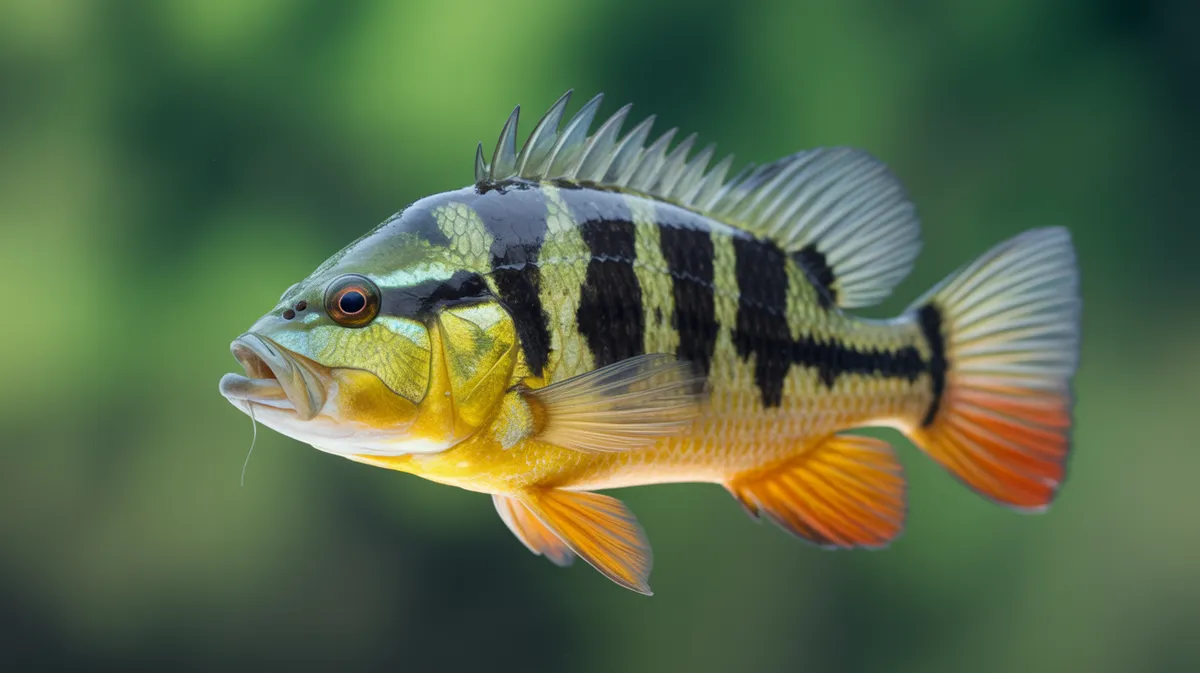
About the Butterfly peacock bass
The butterfly peacock bass is a vibrant freshwater fish native to the rivers and lakes of northern South America, particularly the Amazon Basin. Known for its striking yellow, green, and black coloration, this species is highly prized by anglers for its strength and aggressive feeding behavior. It was introduced to South Florida in the 1980s to help control populations of invasive fish and has since become an important part of the local ecosystem. The butterfly peacock bass is a predatory fish, feeding mainly on smaller fish and crustaceans.
Fascinating facts
Sport Fishing Favorite
Butterfly peacock bass are celebrated for their fighting ability and are a major draw for recreational anglers in South Florida and South America.
Name Origin
Their name comes from the eye-like 'ocelli' spots near the tail fin, resembling a butterfly's wing pattern.
Sensitive to Cold
These fish cannot survive in water temperatures below 16°C (60°F), which restricts their range to tropical and subtropical environments.
Detailed description
The butterfly peacock bass (Cichla ocellaris) is a robust, deep-bodied cichlid reaching up to 74 cm (29 in) in length and weighing as much as 12 kg (26 lbs) in its native range, though most individuals are smaller. Its body is laterally compressed, with a large, slightly oblique mouth and prominent lower jaw, adapted for engulfing prey. The species is renowned for its vivid coloration: a golden-yellow to olive-green body, with three distinct vertical black bars along the flanks and a characteristic ocellated (eye-like) spot at the base of the caudal fin, which gives the species its name. Fins are often tinged with orange or red, especially in breeding males. The dorsal fin is long and spiny, providing protection from predators. C. ocellaris exhibits acute vision and rapid acceleration, making it an effective ambush predator. Its lateral line system is highly developed, allowing it to detect vibrations and movements in the water. The species is diurnal, most active during daylight hours, and displays complex social behaviors, including territoriality and parental care. In its native South American habitats, it occupies a variety of freshwater environments, from slow-moving rivers and floodplain lakes to artificial reservoirs and canals.
Did you know?
Despite their name, butterfly peacock bass are not true bass—they belong to the cichlid family and are more closely related to angelfish than to largemouth bass.
Research & sources
Wikipedia summary
Cichla ocellaris, sometimes known as the butterfly peacock bass, is a very large species of cichlid from South America, and a prized game fish. It reaches 74 cm (29 in) in length. It is native to the Marowijne and Essequibo drainages in the Guianas, and the Branco River in Brazil. It has also been introduced to regions outside its natural range, but some uncertainty exists over the exact identity, and at least some of the introductions may involve another Cichla species or hybrids. It is frequently confused with C. monoculus. Studies conclude that the introduction of Cichla ocellaris does not negatively impact fish communities in Florida, making it an effective fisheries management tool.
Behaviour & social structure
Butterfly peacock bass are primarily solitary or found in small groups, except during the breeding season when pairs form strong bonds. They are aggressive, territorial fish, especially males defending nesting sites. Their hunting strategy is largely ambush-based: they use submerged structures or vegetation as cover, then lunge rapidly at passing prey, which consists mainly of smaller fish such as characins, cichlids, and occasionally crustaceans. Feeding peaks in the early morning and late afternoon. Juveniles may form loose schools for protection, but adults are more solitary. During non-breeding periods, individuals patrol well-defined territories and display threat postures—such as flaring fins and lateral displays—toward intruders. In introduced ranges like Florida, they have adapted to urban canals and altered habitats, maintaining similar behavioral patterns.
Reproduction & life cycle
Cichla ocellaris is a substrate spawner with a distinct breeding season, typically coinciding with the onset of the rainy season (December to March in its native range). Pairs form monogamous bonds and select flat, hard surfaces—such as rocks or submerged logs—for nest sites. Females lay between 3,000 and 10,000 adhesive eggs, which are then fertilized externally by the male. Both parents exhibit strong biparental care: they fan the eggs to provide oxygenation, guard against predators, and later, herd the free-swimming fry. Parental aggression is heightened during this period, with adults fiercely defending their brood. The eggs hatch in 3–5 days, and fry remain under parental protection for several weeks until they are large enough to disperse. In introduced populations, reproductive timing may shift slightly in response to local environmental cues.
Adaptations & survival
C. ocellaris displays several adaptations for predatory efficiency and survival. Its powerful jaws and conical teeth are specialized for grasping and swallowing whole prey. The ocellated spot on the tail fin is thought to confuse predators and rivals by mimicking an eye, potentially diverting attacks away from the head. The species’ coloration provides camouflage among submerged vegetation and dappled sunlight. Its lateral line system enhances detection of prey and predators in turbid waters. Behavioral plasticity allows it to exploit a range of habitats, including man-made canals and reservoirs. Rapid growth rates and high fecundity contribute to its success both in native and introduced environments.
Cultural significance
The butterfly peacock bass holds considerable value as a sport fish, renowned for its strength, acrobatic fights, and striking appearance. In South America, it is a sought-after target for recreational and subsistence anglers, contributing to local economies through ecotourism and fishing lodges. In Florida, its introduction was specifically intended to enhance recreational fisheries and control invasive tilapia and other non-native species. The fish features in local folklore and is sometimes depicted in indigenous art. Its popularity has also led to its inclusion in aquarium trade, though it requires large tanks and specialized care.
Recent research
Recent genetic studies have clarified the distinction between C. ocellaris and closely related species such as C. monoculus, which were previously confused due to morphological similarities. Ongoing research in Florida focuses on the species’ ecological integration, reproductive success, and interactions with native and introduced fish. Tagging and telemetry studies have provided insights into habitat use, movement patterns, and home range sizes. Investigations into parental care behaviors have revealed complex communication and coordination between breeding pairs. Additionally, research into the species’ potential as a biological control agent for invasive fish continues to inform fisheries management strategies.
Videos
Habitat
Freshwater rivers, lakes, and canals


Conservation
The Butterfly peacock bass is currently classified as Least Concern on the IUCN Red List.
Threats & challenges
Currently, Cichla ocellaris faces few significant threats in its native range and is classified as Least Concern by the IUCN. However, localized pressures include habitat modification (such as dam construction and deforestation), overfishing for sport and food, and potential competition or hybridization with other Cichla species. In introduced areas, the species has been carefully managed to avoid negative impacts on native fish communities, as seen in Florida, where studies indicate minimal ecological disruption. Nevertheless, ongoing monitoring is necessary to detect any long-term ecosystem changes. Climate change and water pollution represent emerging challenges that could affect population dynamics in the future.
Taxonomy
Scientific name
Cichla ocellaris
- Kingdom
- Animalia
- Phylum
- Chordata
- Class
- Actinopterygii
- Order
- Cichliformes
- Family
- Cichlidae
- Genus
- Cichla
- Species
- ocellaris
Community notes
Share your observations about the Butterfly peacock bass.
No community notes yet. Be the first!
Discover more wildlife
More fascinating animals from the encyclopedia.