
About the Capybara
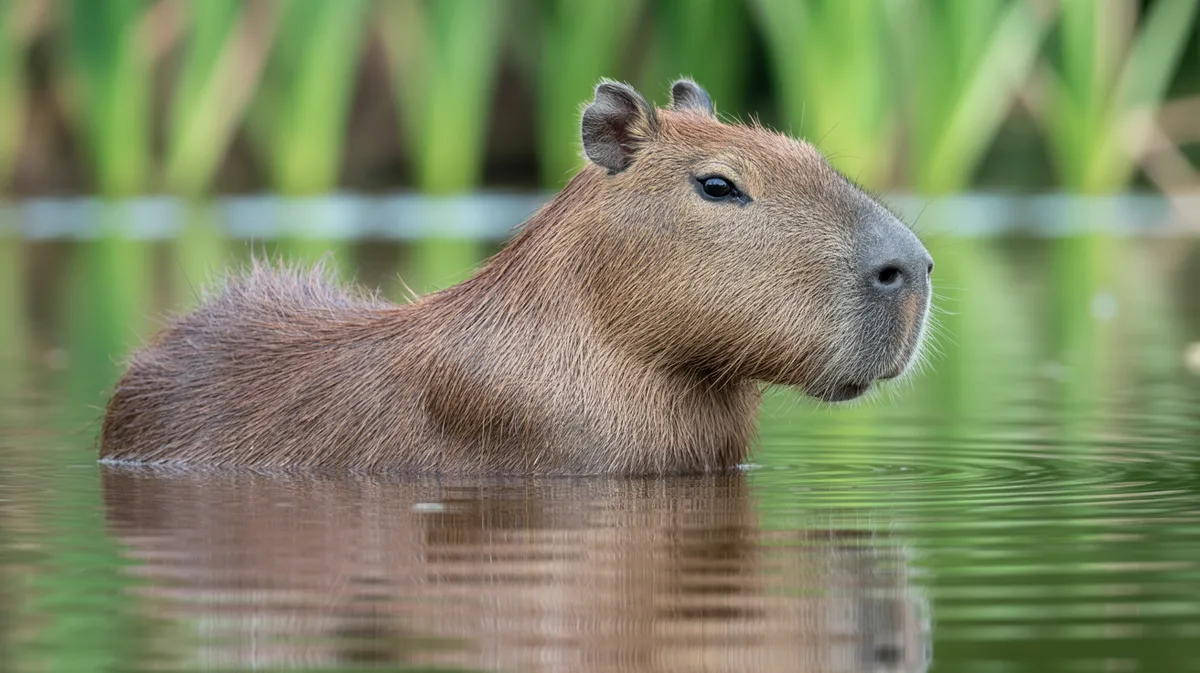
The capybara (Hydrochoerus hydrochaeris) is the largest rodent in the world, weighing between 35 to 66 kilograms and reaching lengths of up to 1.3 meters. Indigenous to South America, it is found in every country on the continent except Chile, thriving in a variety of habitats from the dense forests of the Amazon Basin to the grassy savannas of Venezuela. As a semiaquatic herbivore, the capybara is uniquely adapted to life near water. Its webbed feet and streamlined body facilitate swimming, while its eyes, ears, and nostrils are positioned on top of its head, allowing it to remain mostly submerged, a useful adaptation for avoiding predators. Capybaras primarily consume grasses and aquatic plants, but they also engage in coprophagy, re-ingesting their feces to maximize nutrient absorption, a common trait among rodents. Their social structure is notable, often forming groups of 10 to 20 individuals, which aids in predator detection and social bonding.
Fascinating facts
World’s Largest Rodent
Capybaras hold the title of the world’s largest rodent, reaching lengths up to 1.35 meters (4.4 feet).
Superb Swimmers
Capybaras are excellent swimmers and can stay submerged for up to five minutes to hide from predators.
Social Creatures
Capybaras are extremely social and live in groups, often displaying cooperative behaviors such as grooming and communal parenting.
Detailed description
The capybara (Hydrochoerus hydrochaeris) is a robust, barrel-shaped rodent reaching up to 134 cm (53 in) in length, standing 50–62 cm (20–24 in) at the shoulder, and weighing between 35–66 kg (77–146 lbs), with females typically slightly heavier than males. Its dense, coarse fur is reddish-brown above and yellowish-brown below, providing camouflage in aquatic vegetation. The head is blunt with small ears and eyes positioned high on the skull, an adaptation for semi-aquatic life, allowing the capybara to see and hear while mostly submerged. Limbs are short and sturdy, with partially webbed feet (four toes on the front, three on the hind), enhancing swimming ability and maneuverability in muddy terrain. Capybaras are highly social, forming stable groups of 10–20 individuals, though aggregations of up to 100 may occur during the dry season. They communicate through a complex repertoire of vocalizations, including barks, whistles, clicks, and purrs. Primarily crepuscular, they graze on grasses and aquatic plants, with a digestive system adapted for hindgut fermentation and coprophagy (re-ingestion of feces) to maximize nutrient extraction. Reproduction is polygynous, with dominant males monopolizing access to females. Females give birth to litters of 2–8 precocial young after a gestation of about 150 days. Capybaras are excellent swimmers, capable of remaining submerged for up to five minutes to evade predators, and their semi-aquatic lifestyle is central to their ecology and behavior.
Did you know?
Capybaras are so tolerant and friendly that many other animals, including birds and monkeys, are often seen sitting on their backs in the wild.
Research & sources
Wikipedia summary
The capybara or greater capybara is the largest living rodent, native to South America. It is a member of the genus Hydrochoerus. The only other extant member is the lesser capybara. Its close relatives include guinea pigs and rock cavies, and it is more distantly related to the agouti, the chinchilla, and the nutria. The capybara inhabits savannas and dense forests, and lives near bodies of water. It is a highly social species and can be found in groups as large as one hundred individuals, but usually live in groups of 10–20 individuals. The capybara is hunted for its meat and hide and also for grease from its thick fatty skin.
Behaviour & social structure
Capybaras are predominantly crepuscular, being most active at dawn and dusk, though activity patterns can shift in response to human disturbance or predation risk. They spend much of their time grazing on grasses, reeds, and aquatic plants, consuming up to 3–4 kg (6.6–8.8 lbs) of vegetation daily. Feeding is often communal, with individuals maintaining close proximity and coordinated movement. Social structure is hierarchical, with a dominant male leading the group, supported by subordinate males, females, and juveniles. Social bonds are reinforced through grooming, vocalizations, and scent-marking using specialized glands on the nose (morro) and anus. Capybaras are highly vigilant, posting sentinels while others feed or rest. When threatened, they emit alarm barks and retreat to water, where they can evade terrestrial predators. Daily routines include basking, wallowing in mud to regulate body temperature and deter parasites, and resting in shaded areas during the heat of the day.
Reproduction & life cycle
Capybaras breed year-round in equatorial regions, but reproduction is often synchronized with the rainy season in more seasonal habitats. Mating occurs in water, with dominant males pursuing receptive females. Gestation lasts approximately 150 days, after which females give birth to 2–8 precocial young, typically on land in dense vegetation. Neonates are well-developed, able to follow the mother and graze within a week, though they nurse for up to 16 weeks. Alloparental care is common, with multiple females in a group nursing and protecting the young. Juvenile survival is enhanced by group vigilance and the use of aquatic refuges. Sexual maturity is reached at 12–18 months, and females may produce up to two litters per year under favorable conditions.
Adaptations & survival
Capybaras possess several adaptations for a semi-aquatic lifestyle: their eyes, ears, and nostrils are positioned dorsally, allowing them to remain mostly submerged while monitoring their surroundings. The partially webbed feet facilitate efficient swimming and movement through marshy terrain. Dense, greasy fur resists water penetration, and a thick layer of subcutaneous fat provides buoyancy and insulation. Their digestive system is specialized for processing fibrous plant material, with an enlarged cecum and colon for microbial fermentation. Coprophagy enables them to extract maximum nutrients from their diet. Behavioral adaptations include group living for enhanced predator detection and the use of vocal and chemical communication to coordinate social interactions and territory defense.
Cultural significance
Capybaras hold cultural importance in several South American societies. In Venezuela, they are traditionally hunted during Lent, as the Catholic Church historically classified them as 'fish,' permitting their consumption when red meat was forbidden. Their hides are used for leather, and their fat is rendered for medicinal and cosmetic purposes. In popular culture, capybaras are celebrated for their docile nature and have become symbols of tranquility and sociability. They are increasingly featured in ecotourism and wildlife parks, and their image is used in folklore and children's literature across South America.
Recent research
Recent research has focused on capybara social dynamics, vocal communication, and their role as ecosystem engineers in wetland environments. Studies have elucidated the complexity of their vocal repertoire, revealing context-specific calls for alarm, mating, and social cohesion. Genetic analyses have clarified population structure and gene flow across fragmented habitats. Capybaras are also recognized as important hosts for ticks and other ectoparasites, with implications for the transmission of zoonotic diseases such as Brazilian spotted fever (Rickettsia rickettsii). Ongoing research explores their adaptability to human-altered landscapes and their potential as model organisms for studying social behavior and digestive physiology in large herbivorous rodents.
Videos
Habitat
Wetlands, riverbanks, marshes, and lakeshores in tropical and subtropical South America
Conservation
The Capybara is currently classified as Least Concern on the IUCN Red List.
Threats & challenges
While the capybara is listed as Least Concern by the IUCN due to its wide distribution and large populations, it faces localized threats from habitat loss, wetland drainage, and hunting for meat, hides, and grease. In some regions, capybaras are subject to intensive hunting pressure, especially during the dry season when they congregate near dwindling water sources. Agricultural expansion and water pollution also pose significant challenges. Despite these threats, capybara populations are resilient and can thrive in modified landscapes, including cattle ranches and agricultural fields, provided water bodies are present. Invasive populations have been reported in Florida and other non-native areas, raising concerns about ecosystem impacts.
Taxonomy
Scientific name
Hydrochoerus hydrochaeris
- Kingdom
- Animalia
- Phylum
- Chordata
- Class
- Mammalia
- Order
- Rodentia
- Family
- Caviidae
- Genus
- Hydrochoerus
- Species
- hydrochaeris
Where to see a capybara
30 zoos and aquariums in 9 countries are recorded as keeping this species.
 Belfast Zoo🇬🇧 Belfast, United Kingdom
 Dudley Zoo & Castle🇬🇧 Dudley, United Kingdom
 Newquay Zoo🇬🇧 Newquay, United Kingdom
 San Diego Zoo🇺🇸 San Diego, United States
 Tierpark Hellabrunn🇩🇪 München, Germany
Community notes
Share your observations about the Capybara.
No community notes yet. Be the first!
Discover more wildlife
More fascinating animals from the encyclopedia.