
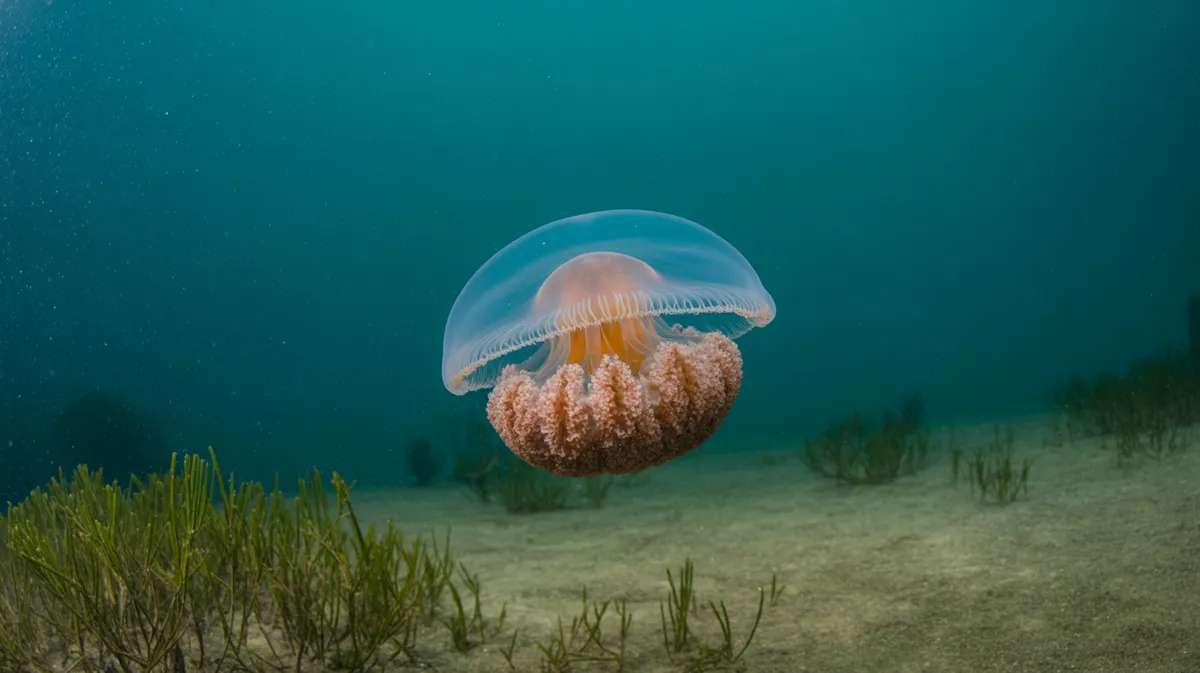
About the Cassiopea Jellyfish
Cassiopea lives upside down. It settles bell-down on the sediment of mangrove lagoons and seagrass flats and holds its frilled oral arms up toward the surface — and the reason is that it is farming. Its tissues are packed with symbiotic photosynthetic algae, and by lying on its back in shallow, sunlit water it turns itself into a living solar panel, deriving a large share of its energy from its own symbionts exactly as a coral does. It pulses gently to drive water past its arms and pick up plankton to supplement the sunlight. It is also responsible for a phenomenon swimmers have complained about for a century: "stinging water", the sensation of being stung in an area where no jellyfish are touching you. In 2020 researchers identified the cause — cassiosomes, tiny free-floating mucus grenades studded with living stinging cells that the jellyfish releases into the water column, where they drift and sting on contact.
Fascinating facts
Sun-powered jelly
Cassiopea jellyfish rely on sunlight for energy because of their symbiotic relationship with photosynthetic algae.
Upside-down lifestyle
They spend most of their time with their bell on the bottom and tentacles facing upward, unlike most other jellyfish.
Stinging mucus
Cassiopea jellyfish can release clouds of stinging mucus that contain nematocysts, affecting nearby organisms and swimmers.
Detailed description
The Cassiopea jellyfish, or upside-down jellyfish, comprises several species within the genus Cassiopea, most commonly found in warm, shallow marine environments such as lagoons, mangrove swamps, and seagrass beds across the Atlantic, Indo-Pacific, and Caribbean regions. Measuring typically between 10 and 30 centimeters in diameter, Cassiopea displays a flattened, saucer-shaped bell and a set of frilly oral arms that are rich in symbiotic dinoflagellate algae (zooxanthellae). Unlike most jellyfish, Cassiopea rests inverted on the substrate, with its bell against the sand and its oral arms and tentacles facing upward, maximizing sunlight exposure for photosynthesis by its symbionts. Its body is semi-translucent, often with greenish or brownish hues due to the algae. Cassiopea lacks a true centralized brain, instead relying on a diffuse nerve net to coordinate its rhythmic pulsing, which facilitates gas exchange and nutrient uptake. The jellyfish can form dense aggregations, sometimes numbering in the hundreds per square meter, and releases a mucous laden with nematocysts (stinging cells) into the water to immobilize planktonic prey. Cassiopea is an important ecological component, contributing to nutrient cycling and serving as prey for specialized predators like nudibranchs and some sea turtles. Its unique mode of life and symbiotic relationship with algae make it a model organism for studies on cnidarian-algal symbiosis and benthic-pelagic coupling.
Did you know?
Cassiopea jellyfish can release tiny, stinging, mucus-filled bubbles into the water, which can cause mild discomfort to swimmers even without direct contact.
Research & sources
Behaviour & social structure
Cassiopea jellyfish exhibit a largely sedentary lifestyle, spending most of their time resting upside-down on the seafloor. Their pulsing behavior, occurring at a rate of 1–2 contractions per second, serves multiple functions: it enhances water flow around the oral arms, facilitates photosynthetic gas exchange for the symbiotic algae, and aids in the capture of suspended prey. Cassiopea feeds primarily by absorbing dissolved organic matter and capturing zooplankton, small crustaceans, and detritus with its mucus and nematocyst-laden oral arms. Socially, Cassiopea can form large aggregations, likely driven by environmental factors such as light availability and substrate type, rather than complex social interactions. During daylight hours, individuals are most active, maximizing photosynthetic output, while at night, pulsing and feeding rates decrease. Cassiopea can also exhibit a defensive behavior known as 'stinging water,' where it releases clouds of mucus containing cassiosomes—specialized stinging cell clusters—to deter predators and immobilize prey.
Reproduction & life cycle
Cassiopea jellyfish display a complex life cycle typical of scyphozoans, alternating between sexual and asexual phases. Sexual reproduction occurs when mature medusae release eggs and sperm into the water column, resulting in external fertilization. The fertilized eggs develop into planula larvae, which settle onto the substrate and metamorphose into sessile polyps (scyphistomae). These polyps can reproduce asexually through budding or strobilation, releasing free-swimming ephyrae that eventually mature into adult medusae. Breeding is generally continuous in tropical climates but may peak during warmer months when food and light are abundant. Parental care is absent; once released, larvae are independent. Some studies suggest that Cassiopea can also reproduce via fragmentation, where damaged individuals regenerate into new polyps.
Adaptations & survival
Cassiopea's most notable adaptation is its upside-down orientation, which maximizes sunlight exposure for its endosymbiotic zooxanthellae, enabling efficient photosynthesis and nutrient exchange. The jellyfish's flattened bell and frilly oral arms increase surface area for light capture and gas exchange. Its ability to produce and release stinging mucous clouds (containing cassiosomes) provides both a feeding mechanism and a defense against predators. Cassiopea can tolerate low-oxygen (hypoxic) environments, a trait advantageous in stagnant lagoons and mangroves. Physiologically, it can endure wide fluctuations in salinity and temperature, making it resilient to environmental changes. The symbiotic relationship with algae allows Cassiopea to thrive in nutrient-poor waters where other jellyfish might not survive.
Cultural significance
Cassiopea jellyfish have limited direct cultural significance but are increasingly recognized in public aquaria and marine education for their unusual appearance and symbiotic lifestyle. In some Caribbean and Pacific Island cultures, jellyfish are featured in folklore as symbols of adaptability and resilience. There is ongoing interest in Cassiopea's unique stinging mucus for biomedical research, particularly in the study of venom delivery and potential pharmaceutical applications. In scientific circles, Cassiopea is a model organism for research on cnidarian-algal symbiosis, regeneration, and benthic-pelagic interactions.
Recent research
Recent research has focused on the structure and function of cassiosomes—specialized stinging cell aggregates in Cassiopea's mucus—which represent a novel mechanism of venom delivery among cnidarians. Studies have also examined the molecular basis of Cassiopea's symbiosis with dinoflagellates, revealing insights into nutrient exchange, stress tolerance, and bleaching responses similar to those seen in corals. Genomic and transcriptomic analyses are shedding light on Cassiopea's developmental biology and regenerative capabilities. Additionally, Cassiopea is being used as a bioindicator for coastal ecosystem health due to its sensitivity to environmental changes and its role in nutrient cycling. Ongoing research is exploring the ecological impacts of Cassiopea blooms in both native and invasive ranges.
Sources
The upside-down jellyfish Cassiopea: A model system for studying cnidarian-dinoflagellate symbiosis
Ohdera, A. H., Ames, C. L., et al. (2018)
scientificCassiosomes are stinging-cell structures in the mucus of the upside-down jellyfish Cassiopea xamachana
Ames, C. L., Klompen, A. M., et al. (2020)
scientificThe upside-down jellyfish Cassiopea: A model system for studying cnidarian-dinoflagellate symbiosis
Ohdera, A. H., Ames, C. L., et al. (2018)
scientificCassiosomes are stinging-cell structures in the mucus of the upside-down jellyfish Cassiopea xamachana
Ames, C. L., Klompen, A. M. L., et al. (2020)
scientificCassiopea Jellyfish: The upside-down jellyfish and its novel venom delivery mechanism
Ames, C.L., et al. (2021)
scientificVideos
Habitat
Shallow coastal lagoons, mangroves, and seagrass beds

Conservation
The Cassiopea Jellyfish is currently classified as Least Concern on the IUCN Red List.
Threats & challenges
Currently classified as Least Concern, Cassiopea populations are generally stable and may even be increasing in some areas due to coastal eutrophication and habitat modification. However, they face localized threats from habitat destruction (especially mangrove clearance), pollution, and climate change, which can alter water temperature and salinity regimes. Invasive populations have been reported in the Mediterranean and other non-native regions, likely due to ballast water transport. While Cassiopea is not heavily targeted by fisheries, it can be affected by human activities that degrade its preferred habitats. In some locations, dense aggregations can impact local fisheries and tourism by causing 'stinging water' incidents.
Taxonomy
Scientific name
Cassiopea spp.
- Kingdom
- Animalia
- Phylum
- Cnidaria
- Class
- Scyphozoa
- Order
- Rhizostomeae
- Family
- Cassiopeidae
- Genus
- Cassiopea
- Species
- spp.
Community notes
Share your observations about the Cassiopea Jellyfish.
No community notes yet. Be the first!
Discover more wildlife
More fascinating animals from the encyclopedia.