
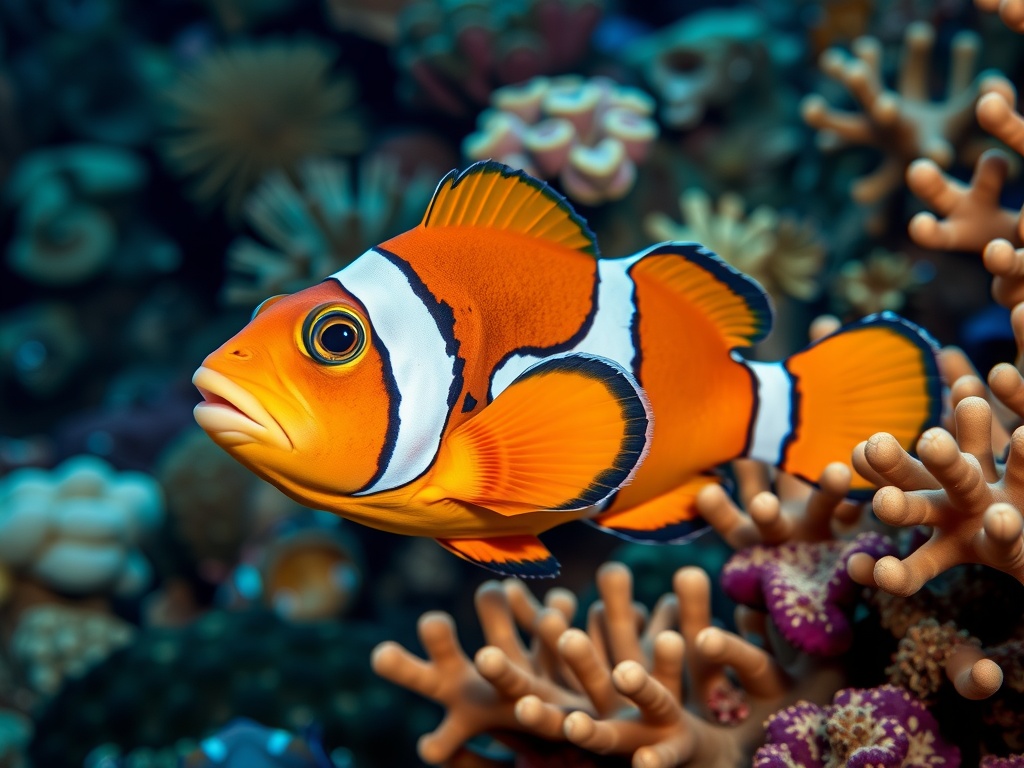
About the Clown triggerfish
The clown triggerfish is a strikingly colorful marine fish recognized for its bold patterns of white spots and yellow markings on a black body, complemented by a yellow snout. Native to the tropical Indo-Pacific reefs, it is a solitary and territorial species that spends much of its time near drop-offs and steep reef slopes. The clown triggerfish is known for its strong jaws, which allow it to feed on hard-shelled prey, and its distinctive ability to lock itself into crevices with its dorsal spine for protection. This fish is popular in the aquarium trade due to its appearance, but it requires experienced care because of its aggressive nature.
Fascinating facts
Vivid Patterns
The clown triggerfish's body is covered with large white spots on its lower half and a network of yellow patterns on its upper body, making it one of the most visually distinctive reef fish.
Powerful Jaws
Its strong, sharp teeth allow it to eat hard-shelled animals like sea urchins, mollusks, and crustaceans, which many other reef fish cannot consume.
Locking Mechanism
The fish can erect and lock its first dorsal spine as a defensive measure, anchoring itself tightly in rocks or crevices to avoid being removed by predators.
Detailed description
The clown triggerfish (Balistoides conspicillum) is a medium to large-sized marine fish, typically reaching lengths of 35–50 cm, with some individuals recorded up to 50 cm in the wild. Its body is laterally compressed and robust, covered in tough, sandpaper-like skin with small scales, a characteristic of the Balistidae family. The species is instantly recognizable by its dramatic coloration: the lower half of the body is jet-black adorned with large, round white spots, while the upper half features a yellow or golden network pattern on a dark background. The snout is bright yellow, and a white band runs across the mouth, giving the appearance of a 'clown face.' The dorsal and anal fins are elongated and set far back, aiding in precise maneuvering. Clown triggerfish possess a unique dorsal spine mechanism: the first spine can be locked upright by the second, providing defense against predators and allowing the fish to wedge itself securely into crevices. Their strong, beak-like teeth and powerful jaws are adapted for crushing hard-shelled prey. This species is solitary and highly territorial, often patrolling a defined area of the reef, especially near drop-offs and steep slopes. It is diurnal, spending daylight hours actively foraging and retreating to shelter at night. The clown triggerfish is known for its bold, inquisitive behavior and can be aggressive, especially during breeding or when defending its territory.
Did you know?
Clown triggerfish can wedge themselves into reef crevices and lock their dorsal spine, making it extremely difficult for predators to pull them out.
Research & sources
Wikipedia summary
The clown triggerfish, also known as the bigspotted triggerfish, is a demersal marine fish.
Behaviour & social structure
Clown triggerfish are primarily solitary and display pronounced territoriality, vigorously defending their chosen area against intruders, including other triggerfish and similarly sized reef fish. They are diurnal hunters, foraging during the day and seeking shelter in reef crevices at night. Their diet consists mainly of benthic invertebrates such as sea urchins, crustaceans, mollusks, and occasionally small fish. They use their strong jaws and specialized teeth to crush the hard exoskeletons of prey. Foraging behavior includes overturning rocks and blowing jets of water to expose hidden prey. Social interactions are limited outside of breeding, with individuals communicating through body postures, fin displays, and rapid color changes. When threatened, clown triggerfish may produce audible grunting sounds and will erect their dorsal spine to deter predators or wedge themselves into tight spaces for protection.
Reproduction & life cycle
Reproduction in clown triggerfish is oviparous, with external fertilization. Spawning typically occurs during the warmer months, often synchronized with lunar cycles. Males establish and defend territories that include suitable nesting sites, usually sandy patches or depressions near coral rubble. Courtship involves elaborate displays, including circling, fin spreading, and color intensification. Females lay adhesive eggs in a prepared nest, which are then fertilized by the male. Parental care is primarily provided by the female, who vigorously fans and guards the eggs until they hatch, usually within several days (3–6 days depending on water temperature). After hatching, the pelagic larvae drift with planktonic currents before settling onto the reef as juveniles. Breeding success is highly dependent on environmental conditions and the availability of suitable nesting sites.
Adaptations & survival
The clown triggerfish exhibits several notable adaptations for survival in complex reef environments. Its powerful jaws and fused teeth are specialized for crushing the hard shells of sea urchins, crustaceans, and mollusks, allowing it to exploit food resources inaccessible to many other reef fish. The unique trigger mechanism of the dorsal fin provides effective defense, enabling the fish to lock itself into crevices and resist extraction by predators. Its bold coloration serves as both camouflage among the reef's shadows and a warning (aposematism) to potential predators of its aggressive nature and formidable defenses. The tough, leathery skin offers additional protection against bites and abrasions. Behavioral adaptations include the use of water jets to uncover prey and the ability to produce sounds for communication and deterrence. The species' territoriality ensures access to food resources and breeding sites.
Cultural significance
The clown triggerfish is a popular species in the marine aquarium trade, prized for its vivid coloration and distinctive patterns. In some Indo-Pacific cultures, triggerfish are featured in folklore and traditional art, symbolizing strength and resilience due to their aggressive nature and defensive adaptations. However, there are no widespread traditional uses or significant roles in mythology specifically attributed to this species. Its striking appearance has made it a favorite subject for underwater photographers and marine enthusiasts, contributing to its prominence in ecotourism and public aquaria.
Recent research
Recent research on Balistoides conspicillum has focused on its ecological role in coral reef systems, particularly its impact on benthic invertebrate populations and reef health. Studies have examined its feeding mechanics, revealing specialized jaw musculature and tooth structure adapted for durophagy (eating hard-shelled prey). Genetic analyses are ongoing to clarify population structure and connectivity across its wide Indo-Pacific range, with implications for conservation management. Behavioral studies have documented complex social interactions, including acoustic communication and territorial displays. There is growing interest in the species' response to environmental stressors, such as rising sea temperatures and ocean acidification, which may affect reproductive success and larval dispersal.
Videos
Habitat
Coral reefs

Conservation
The Clown triggerfish is currently classified as Least Concern on the IUCN Red List.
Threats & challenges
Currently assessed as Least Concern by the IUCN, the clown triggerfish faces localized threats from habitat degradation, particularly coral reef destruction due to climate change, ocean acidification, and destructive fishing practices. Overcollection for the marine aquarium trade poses additional pressure in some regions, as the species is highly sought after for its striking appearance. While populations are generally stable, ongoing habitat loss and unsustainable collection could pose future risks. The species is not targeted by major commercial fisheries but may be caught incidentally. Conservation challenges include the enforcement of sustainable collection practices and the protection of critical reef habitats.
Taxonomy
Scientific name
Balistoides conspicillum
- Kingdom
- Animalia
- Phylum
- Chordata
- Class
- Actinopterygii
- Order
- Tetraodontiformes
- Family
- Balistidae
- Genus
- Balistoides
- Species
- conspicillum
Where to see a clown triggerfish
1 zoo and aquarium in 1 country are recorded as keeping this species.

Community notes
Share your observations about the Clown triggerfish.
No community notes yet. Be the first!
Discover more wildlife
More fascinating animals from the encyclopedia.