
About the Coelacanth
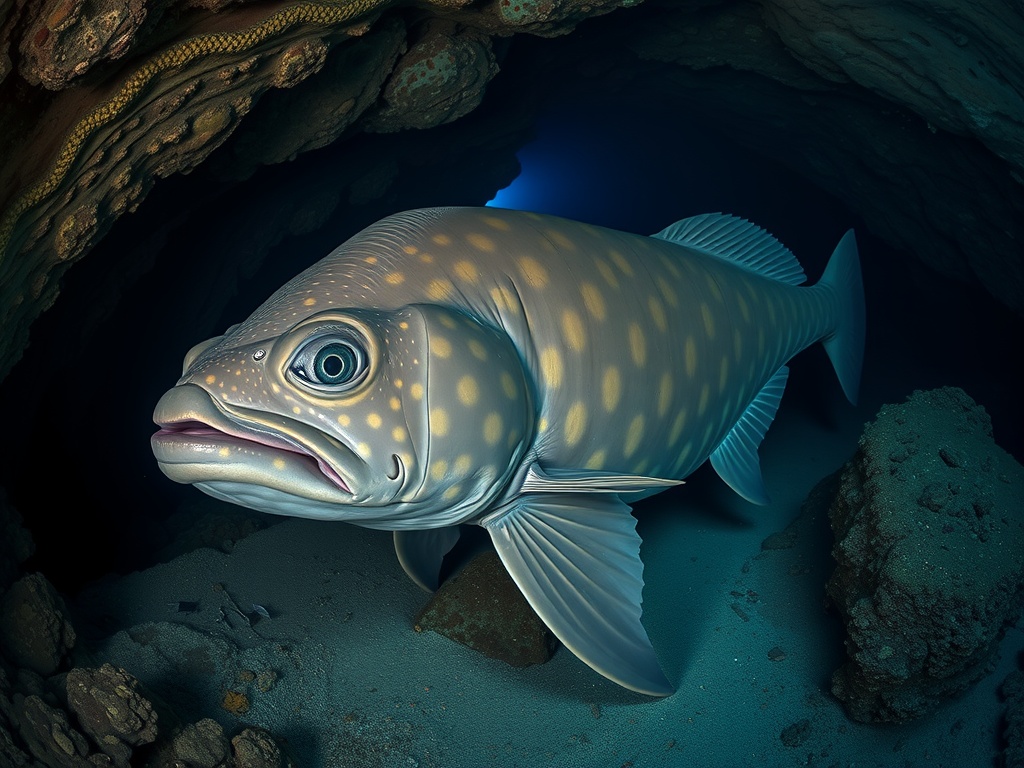
The coelacanth was known only from fossils and assumed to have died out with the dinosaurs, roughly sixty-six million years ago — until 1938, when one turned up in a South African trawler's catch and a museum curator recognised what she was looking at. It is more closely related to us than it is to a tuna. Its lobed, limb-like fins move in the alternating pattern of a walking tetrapod, a ghost of the anatomy that eventually carried vertebrates onto land. It has an intracranial joint, a hinge running across the skull that no other living vertebrate possesses, allowing it to swing the front of its head upward and widen its gape. It has no true backbone — a fluid-filled notochord runs the length of the body — and a rostral organ in the snout that detects the weak electric fields of prey. It drifts in deep volcanic caves by day, hunts slowly at night, gives birth to live young after a gestation that may exceed three years, and is now critically endangered.
Fascinating facts
Living Fossil
Coelacanths are one of the oldest living lineages of jawed fish, virtually unchanged for hundreds of millions of years.
Unique Fins
Their lobed fins are jointed and resemble the limbs of land vertebrates, providing insight into the evolution of walking animals.
Rare Discovery
The species was presumed extinct until a live specimen was found in 1938, making it one of the most significant zoological discoveries of the 20th century.
Detailed description
The coelacanth (Latimeria chalumnae) is a large, lobe-finned fish reaching lengths of up to 2 meters and weights of 80 kg. Its most distinctive anatomical feature is its paired, fleshy pectoral and pelvic fins, which are supported by robust bones and muscles, resembling the limb structure of early tetrapods. The body is covered in thick, cosmoid scales providing protection from predators and abrasive rocky habitats. Coelacanths possess a unique intracranial joint—a hinge in the skull that allows the anterior portion of the head to lift, increasing gape and suction during feeding. Their eyes are large and highly adapted for low-light vision, containing a reflective tapetum lucidum to enhance sensitivity in the deep-sea environment. The coelacanth's notochord, a fluid-filled tube, persists into adulthood instead of being replaced by a vertebral column, providing both flexibility and support. Behaviorally, they are nocturnal and solitary, seeking refuge in underwater caves during the day and emerging at night to hunt. Coelacanths are slow-growing and can live for several decades, with some individuals estimated to be over 60 years old. Their reproductive biology is unusual among fishes, as they are ovoviviparous, giving birth to live young after an extended gestation period.
Did you know?
Coelacanths give birth to live young after an unusually long gestation period of up to 3 years.
Research & sources
Wikipedia summary
Coelacanths are an ancient group of lobe-finned fish (Sarcopterygii) in the class Actinistia. As sarcopterygians, they are more closely related to lungfish and tetrapods than to ray-finned fish.
Behaviour & social structure
Coelacanths exhibit a largely solitary lifestyle, with individuals typically occupying separate caves or crevices during daylight hours. They display minimal social interaction outside of the breeding season. Nocturnally active, they leave their shelters at dusk to forage along steep volcanic slopes and submarine canyons. Their hunting strategy involves slow, energy-efficient swimming using their lobed fins for precise maneuvering and hovering, often employing a headstand posture to probe crevices for prey. Diet consists mainly of benthic fishes, cephalopods, and occasionally crustaceans. Coelacanths use a passive drift-and-wait approach, ambushing prey with rapid mouth expansion enabled by their intracranial joint. Daily routines are characterized by long periods of inactivity interspersed with brief, targeted foraging bouts.
Reproduction & life cycle
Coelacanths are ovoviviparous, with internal fertilization and embryos developing within the female's oviducts. Mating behavior is poorly documented due to their deep-sea habitat, but genetic studies suggest low reproductive rates and limited gene flow between populations. Gestation is exceptionally long, estimated at 3 years—the longest known for any fish. Females give birth to live young, typically producing litters of 5–26 pups, each measuring about 35 cm at birth. There is no evidence of parental care post-birth; juveniles are fully developed and independent upon parturition. Breeding appears to be infrequent, with long intervals between reproductive events, contributing to the species' vulnerability.
Adaptations & survival
Coelacanths possess numerous adaptations for deep-sea survival. Their lobed fins, articulated with a unique ball-and-socket joint, allow for precise movement and hovering in complex rocky habitats. The intracranial joint increases feeding efficiency by expanding mouth gape. A specialized rostral organ in the snout, part of the electrosensory system, detects weak electrical signals from prey. The tapetum lucidum in the retina enhances low-light vision. Their metabolism is slow, reducing oxygen and energy requirements in the nutrient-scarce deep sea. The persistent notochord provides flexibility for navigating narrow crevices. They also exhibit physiological adaptations for pressure tolerance and buoyancy control, such as a fatty organ in place of a swim bladder.
Cultural significance
The coelacanth has achieved iconic status as a 'living fossil' and symbol of evolutionary history. Its rediscovery in 1938 was a major scientific event, challenging assumptions about extinction and the resilience of ancient lineages. In local cultures of the Comoros, the fish is known as 'gombessa' and has featured in folklore, though it is rarely consumed due to its oily, unpalatable flesh. The coelacanth is a powerful symbol in paleontology and evolutionary biology, representing the transition from aquatic to terrestrial vertebrates. It has inspired art, literature, and conservation campaigns worldwide.
Recent research
Recent research has focused on the coelacanth genome, revealing that its genes are remarkably conserved and provide insights into the evolution of tetrapods. Studies using remotely operated vehicles (ROVs) and submersibles have documented their behavior, habitat preferences, and population structure. Genetic analyses have identified two extant species: Latimeria chalumnae (West Indian Ocean) and Latimeria menadoensis (Indonesian coelacanth), with significant genetic divergence. Ongoing research aims to clarify their reproductive biology, population dynamics, and responses to environmental change. Conservation efforts include habitat protection, fisheries management, and international collaboration to monitor populations.
Videos
Habitat
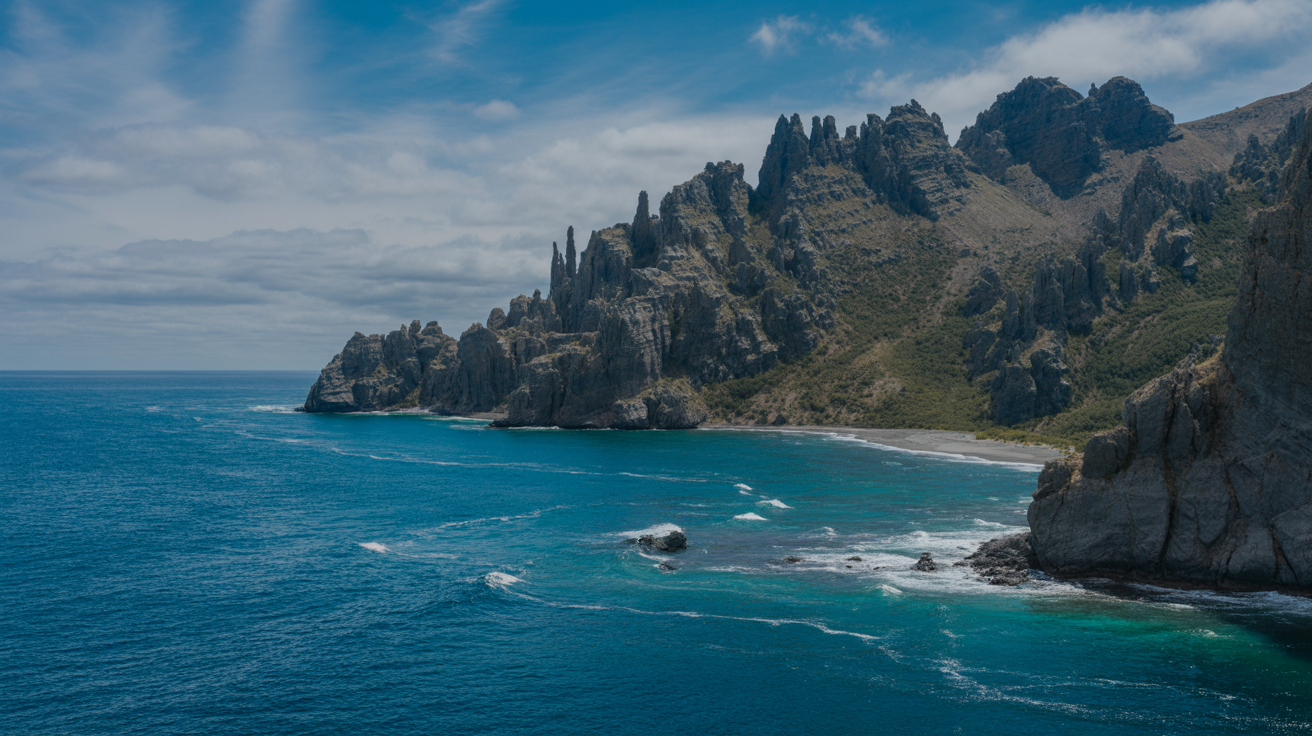
Deep marine caves and volcanic slopes
Conservation
The Coelacanth is currently classified as Critically Endangered on the IUCN Red List.
Threats & challenges
Coelacanths face significant threats due to their restricted range, small population size, and specialized habitat requirements. Bycatch in deep-sea trawl and gillnet fisheries is a primary threat, particularly off the coasts of South Africa, the Comoros, Madagascar, and Indonesia. Habitat disturbance from deep-sea mining and coastal development poses additional risks. Their slow growth, late maturity (estimated at 20 years), and low reproductive output make population recovery difficult. Climate change and ocean warming may also impact their deep-water habitats. Population estimates suggest fewer than 500 mature individuals remain in some regions, and the IUCN lists Latimeria chalumnae as Critically Endangered.
Taxonomy
Scientific name
Latimeria chalumnae
- Kingdom
- Animalia
- Phylum
- Chordata
- Class
- Sarcopterygii
- Order
- Coelacanthiformes
- Family
- Latimeriidae
- Genus
- Latimeria
- Species
- chalumnae
Community notes
Share your observations about the Coelacanth.
No community notes yet. Be the first!
Discover more wildlife
More fascinating animals from the encyclopedia.