
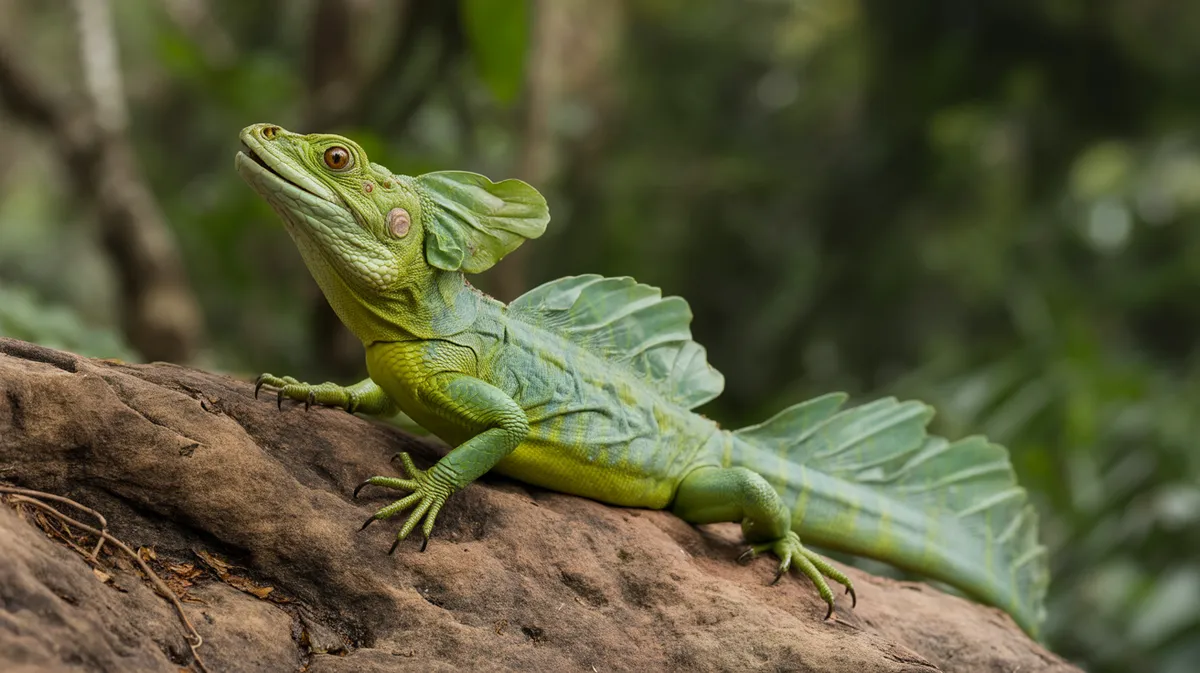
About the Common Basilisk
Basiliscus basiliscus of Central American streamsides is the original "Jesus Christ lizard," and the physics of its water-running is better understood than most people assume. Each hind foot carries a fringe of scales that unfurls on the downstroke, widening the foot and driving it into the surface hard enough to create a pocket of air. The lizard then strokes backward inside that cavity and — critically — pulls the foot out again before the water can collapse in on it, which is why the stride is a blur of about 20 steps per second. That trick has a strict weight limit: hatchlings can cross several metres of open water with ease, while a heavy adult male breaks through after a short sprint and finishes the escape by swimming. The whole behaviour exists for one reason, which is to put a stretch of water between the lizard and a snake or a bird, so it is fired off almost exclusively as a startle response. Basilisks are semi-aquatic omnivores that eat insects, small vertebrates, flowers and fruit, and they can stay submerged and motionless on the stream bottom for many minutes when pressed. Males grow a tall head crest and a serrated dorsal ridge; females are drabber and crestless.
Fascinating facts
Water Runner
The Common Basilisk can run on water at speeds up to 8.4 km/h (5.2 mph) to escape predators, thanks to its specialized feet.
Arboreal Lifestyle
This lizard spends much of its time in trees and shrubs near water, ready to drop into the river below if threatened.
Prolific Breeder
Females lay multiple clutches of eggs per year, each containing 5-15 eggs, which hatch after about 8-10 weeks.
Detailed description
The Common Basilisk (Basiliscus basiliscus) is a medium-to-large lizard, with adult males reaching up to 80 cm (31 in) in total length, including the tail, while females are generally smaller. Its body is laterally compressed, aiding in swift movement through dense vegetation and water. The species is easily recognized by its prominent cranial crest, which is more developed in males and used in sexual display and territorial disputes. The dorsal coloration varies from bright green to olive-brown, often with lighter stripes along the flanks and limbs, providing effective camouflage among riverbank foliage. The long, muscular tail, accounting for up to 70% of total length, is flattened laterally to facilitate swimming. The toes, especially the third, are elongated and fringed with specialized scales, enabling the basilisk's remarkable ability to run bipedally across water surfaces—a feat possible due to rapid slapping and lifting of the feet, creating air pockets. The eyes are large and positioned laterally, granting a wide field of vision to detect predators and prey. The skin is covered in fine granular scales, and the species is capable of rapid color changes in response to temperature, stress, or social interactions. Common Basilisks are diurnal, highly alert, and exhibit both arboreal and terrestrial behaviors, often basking on branches overhanging water for quick escape.
Did you know?
The Common Basilisk's unique water-running ability is due to its rapid movement and specialized toe fringes that slap the water, creating enough lift to keep the lizard above the surface for several seconds.
Research & sources
Wikipedia summary
The common basilisk is a species of lizard in the family Corytophanidae. The species is endemic to Central America and South America, where it is found near rivers and streams in rainforests. It is also known as the Jesus Christ lizard, Jesus lizard, South American Jesus lizard, or lagarto de Jesus Cristo for its ability to run on the surface of water.
Behaviour & social structure
Common Basilisks are primarily solitary, with males establishing and defending territories that may overlap with several females. They are highly territorial, using visual displays—such as head-bobbing, dewlap extension, and crest erection—to communicate dominance or deter rivals. Their daily routine involves basking in the morning to regulate body temperature, followed by active foraging along riverbanks and in the understory. Their omnivorous diet includes insects, spiders, small vertebrates (such as fish, frogs, and other lizards), fruits, seeds, and flowers. Hunting is opportunistic; they employ a sit-and-wait strategy or actively pursue prey, especially near water. When threatened, basilisks escape by sprinting bipedally across the water surface for up to 20 meters, then swimming or diving to evade capture. They are adept climbers, often sleeping on branches several meters above ground or water at night to avoid nocturnal predators.
Reproduction & life cycle
Breeding occurs during the rainy season, typically from March to September, although timing may vary with local climate. Males court females through elaborate displays and may mate with multiple partners. Females lay clutches of 10–20 eggs in shallow nests excavated in moist soil near water. Incubation lasts approximately 8–10 weeks, depending on temperature and humidity. Hatchlings are fully independent at birth, measuring about 9–10 cm (3.5–4 in) in length, and exhibit the water-running ability immediately. There is no parental care post-oviposition. Females may produce several clutches per season if conditions allow, contributing to the species' resilience and widespread distribution.
Adaptations & survival
The Common Basilisk's most distinctive adaptation is its ability to run on water, facilitated by elongated toes with fringed scales that increase surface area and reduce sinking. This adaptation allows rapid escape from terrestrial and aquatic predators, including birds, snakes, and mammals. Its cryptic coloration and ability to remain motionless enhance camouflage. The laterally compressed body and long tail improve maneuverability in dense vegetation and water. Arboreal and aquatic proficiency allows exploitation of diverse microhabitats and food sources. Physiologically, basilisks can remain submerged for up to 30 minutes, reducing predation risk. Their omnivorous diet and flexible foraging strategies further enhance survival in fluctuating environments.
Cultural significance
The Common Basilisk is renowned in local folklore and popular culture for its 'Jesus lizard' moniker, stemming from its ability to run on water, which evokes the biblical story of Jesus walking on water. This unique trait has made the species a subject of fascination in documentaries, ecotourism, and educational programs throughout Central and South America. In indigenous traditions, the basilisk may be associated with agility, escape, or supernatural abilities, though it is not typically hunted or used in traditional medicine. Its striking appearance and behaviors have also inspired artistic representations and scientific curiosity worldwide.
Recent research
Recent research has focused on the biomechanics of the basilisk's water-running ability, revealing that the lizard generates sufficient upward force by slapping and stroking its feet at high speed, creating air pockets that prevent sinking. Studies using high-speed videography and force measurements have provided insights into the evolutionary convergence of locomotor adaptations among semi-aquatic lizards. Genetic analyses have clarified phylogenetic relationships within the Corytophanidae family, supporting the distinctiveness of B. basiliscus from related species. Ongoing ecological studies are examining the impact of habitat fragmentation and climate variability on population dynamics, while behavioral research continues to explore social structure, communication, and reproductive strategies.
Videos
Habitat
Tropical rainforest near freshwater rivers and streams
 Tropical Regions
Rainforest
Dense, wet forests with the highest biodiversity on Earth, containing more than half of the world's plant and animal species.
 Global
Forest
Wooded areas with significant tree cover and diverse plant and animal communities.
 Global
Freshwater
Lakes, rivers, and wetlands with diverse aquatic ecosystems.
Conservation
The Common Basilisk is currently classified as Least Concern on the IUCN Red List.
Threats & challenges
Currently classified as Least Concern by the IUCN, the Common Basilisk faces localized threats from habitat loss due to deforestation, agricultural expansion, and urbanization. Water pollution and alteration of riverine habitats can impact populations. In some areas, they are collected for the pet trade, but this is not considered a major threat at present. Natural predators include birds of prey, snakes, and mammals. Despite these pressures, the species remains widespread and adaptable, with stable populations in many protected areas. Continued habitat degradation and climate change could pose future challenges, emphasizing the need for habitat conservation.
Taxonomy
Scientific name
Basiliscus basiliscus
- Kingdom
- Animalia
- Phylum
- Chordata
- Class
- Reptilia
- Order
- Squamata
- Family
- Corytophanidae
- Genus
- Basiliscus
- Species
- basiliscus
Community notes
Share your observations about the Common Basilisk.
No community notes yet. Be the first!
Discover more wildlife
More fascinating animals from the encyclopedia.