
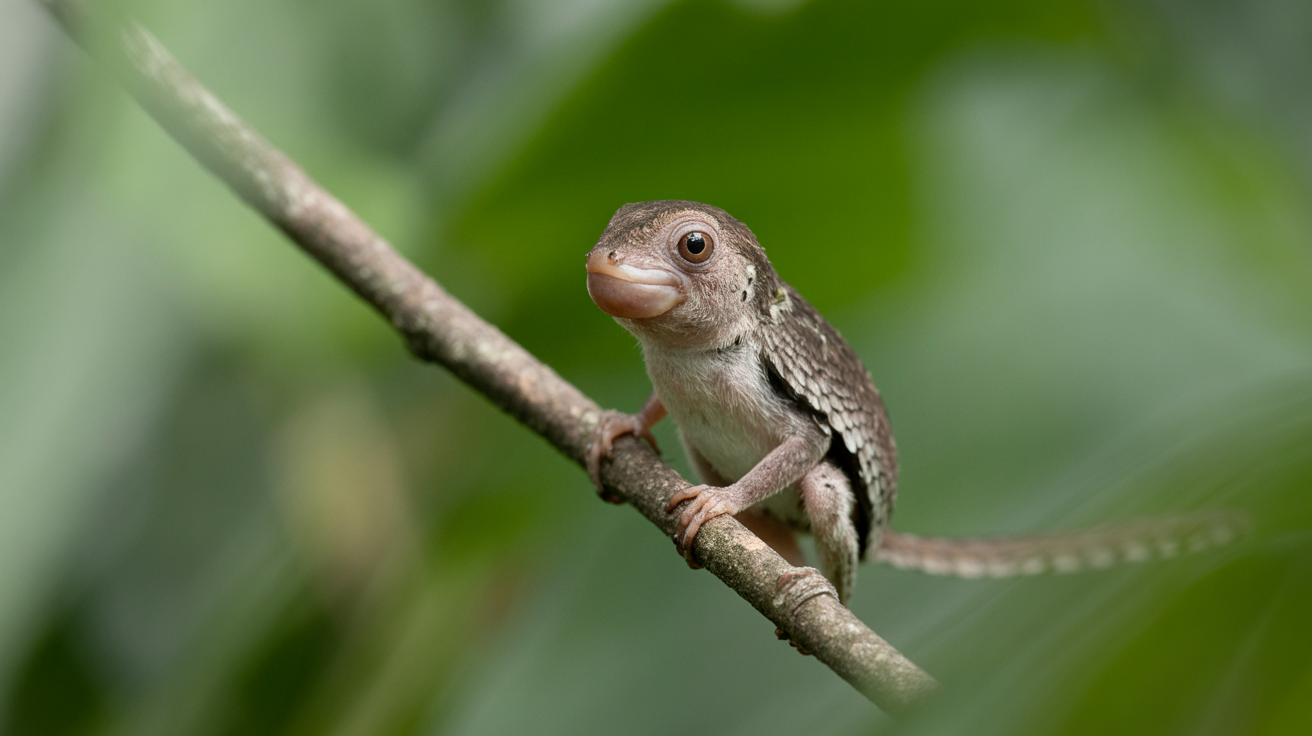
About the Common Coquí
The Common Coquí is a small, nocturnal frog native to Puerto Rico and recognized for its iconic 'co-kee' call, which is used by males to attract mates and defend territory. Adapted to a variety of moist habitats, this species is arboreal and can often be found perched on leaves and branches. It is highly adaptable and has established populations outside its native range, notably in Hawaii, where it is considered invasive. The Common Coquí is celebrated in Puerto Rican culture and plays a vital ecological role as both predator and prey. Despite habitat changes, the species remains abundant within its native range.
Fascinating facts
Loud Singer
Male coquí frogs have an exceptionally loud call relative to their size, reaching up to 100 decibels to attract females and mark territory.
Direct Development
The Common Coquí does not have a typical tadpole stage; instead, its eggs hatch directly into miniature froglets.
Cultural Icon
The coquí is a cherished symbol in Puerto Rico, featured in art, music, and local legends.
Detailed description
The Common Coquí (Eleutherodactylus coqui) is a small, robust frog, typically measuring 30–50 mm (1.2–2.0 in) in snout-vent length, with females generally larger than males. Its coloration is highly variable, ranging from gray, brown, and yellowish to greenish hues, often with mottled or patterned dorsal surfaces that provide camouflage among leaf litter and vegetation. The skin is smooth with a slightly granular texture on the back. Unlike many frogs, the coquí lacks webbing between its toes, an adaptation for its predominantly arboreal lifestyle. The head is broad with large, protruding eyes and a rounded snout. The species is nocturnal, emerging at dusk to forage and vocalize. Males are territorial and produce the characteristic 'co-kee' call, which is both a mating and territorial signal. The Common Coquí is a direct-developing frog, meaning it bypasses the free-living tadpole stage; eggs hatch directly into miniature froglets. This reproductive strategy, combined with its tolerance for a range of microhabitats, has contributed to its success both in its native and introduced ranges. The species is an opportunistic insectivore, feeding on a wide variety of arthropods. Its ecological role is significant, as it helps regulate insect populations and serves as prey for birds, snakes, and mammals.
Did you know?
The Common Coquí lays its eggs on land, and the young emerge as fully formed froglets, bypassing the aquatic tadpole stage entirely.
Research & sources
Wikipedia summary
The common coquí, widely known as the coquí, is a species of frog native to Puerto Rico belonging to the family Eleutherodactylidae. The species is named for the loud call the males make at night, which serves two purposes; the "co" serves to repel other males and establish territory while the "quí" serves to attract females. The auditory systems of males and females respond preferentially to different notes of the male call, displaying sex difference in a sensory system. The common coquí is a very important aspect of Puerto Rican culture, and it has become an unofficial territorial symbol of Puerto Rico.
Behaviour & social structure
The Common Coquí is primarily nocturnal, seeking shelter under leaves, bark, or debris during the day to avoid desiccation and predation. At night, males establish and defend territories, typically occupying perches on leaves or branches 1–3 meters above ground. Territorial males call loudly, with call rates and intensity peaking after dusk and before dawn, especially during the wet season. The 'co' note deters rival males, while the 'quí' attracts females. Aggressive interactions between males may include physical combat, chasing, and call suppression. Feeding occurs throughout the night, with individuals actively hunting small insects, spiders, and other invertebrates using a sit-and-wait or active foraging strategy. Social structure is loosely defined, with high densities leading to overlapping territories and frequent acoustic competition. During dry periods, coquí may reduce activity and seek microhabitats with higher humidity.
Reproduction & life cycle
Breeding in Eleutherodactylus coqui occurs year-round in Puerto Rico, with peaks during the rainy season (April–October). Males call to attract females, and successful courtship leads to amplexus (mating embrace) on vegetation or ground sites. Females lay clutches of 16–40 eggs in moist, concealed locations such as leaf axils, under logs, or in bromeliads. Unique among many amphibians, the species exhibits direct development: embryos develop within the egg and hatch as fully formed froglets after an incubation period of 17–26 days, depending on temperature and humidity. Males often guard the eggs, moistening them with their bodies and defending the clutch from predators and fungal infection. This parental care increases offspring survival in the absence of standing water.
Adaptations & survival
The Common Coquí's most notable adaptation is its reproductive strategy of direct development, eliminating the need for aquatic habitats for larval development and allowing colonization of diverse terrestrial environments. Its adhesive toe pads facilitate climbing and adherence to smooth surfaces, supporting an arboreal lifestyle. The species' highly variable coloration provides effective camouflage in different microhabitats. The loud, frequency-modulated call is adapted for long-distance transmission in dense vegetation and is finely tuned to the auditory sensitivities of conspecifics, with sexual dimorphism in auditory processing. Physiologically, the coquí can tolerate a range of humidity and temperature conditions, and its skin secretes antimicrobial peptides that help prevent infection.
Cultural significance
The coquí is deeply embedded in Puerto Rican culture, serving as an unofficial national symbol and a source of national pride. Its nightly chorus is celebrated in folklore, music, and art, and the frog is featured in traditional stories and legends as a guardian of the island. The word 'coquí' itself is onomatopoeic, reflecting the distinctive call that is emblematic of Puerto Rican identity. The frog appears on coins, stamps, and souvenirs, and is invoked in poetry and songs. In diaspora communities, the sound of the coquí is a powerful symbol of cultural connection and nostalgia.
Recent research
Recent research has focused on the neurobiology of the coquí's vocal communication, revealing sex-specific auditory processing and neural mechanisms underlying call recognition. Studies have also examined the ecological impacts of coquí invasions in Hawaii, documenting changes in arthropod abundance and ecosystem processes. Genetic analyses have explored population structure and adaptive divergence between native and introduced populations. Ongoing research investigates the species' resistance to chytrid fungus, with some evidence suggesting innate immune defenses. The coquí's direct development and parental care continue to be model systems for studying amphibian life history evolution.
Videos
Habitat
Tropical and subtropical forests


Conservation
The Common Coquí is currently classified as Least Concern on the IUCN Red List.
Threats & challenges
In its native range, the Common Coquí faces relatively few natural threats and remains abundant, but localized declines have been observed due to habitat loss, pesticide use, and the spread of chytrid fungus (Batrachochytrium dendrobatidis). Invasive predators and competition with other Eleutherodactylus species may also pose risks. In introduced areas such as Hawaii, the species is considered invasive, with high population densities impacting local ecosystems by altering invertebrate communities and nutrient cycling. Climate change poses a potential long-term threat by altering precipitation patterns and habitat suitability. Despite these challenges, the species is listed as Least Concern by the IUCN due to its wide distribution, adaptability, and large population size.
Taxonomy
Scientific name
Eleutherodactylus coqui
- Kingdom
- Animalia
- Phylum
- Chordata
- Class
- Amphibia
- Order
- Anura
- Family
- Eleutherodactylidae
- Genus
- Eleutherodactylus
- Species
- coqui
Community notes
Share your observations about the Common Coquí.
No community notes yet. Be the first!
Discover more wildlife
More fascinating animals from the encyclopedia.