
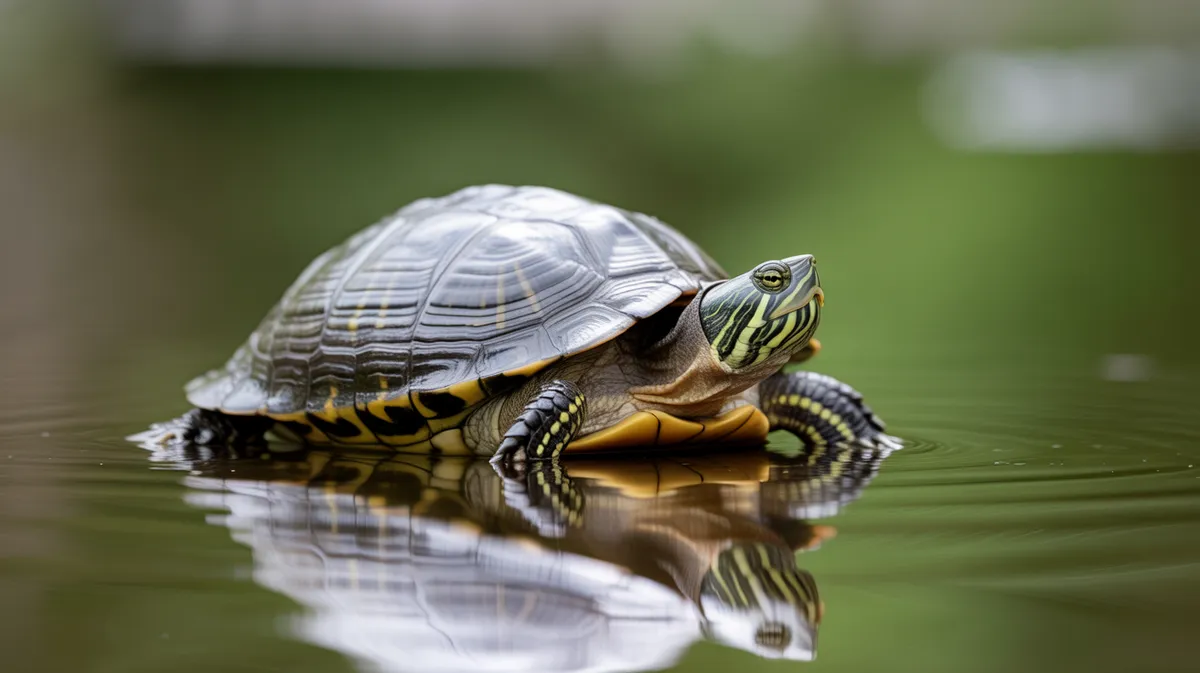
About the Common Map Turtle
The Common Map Turtle is a medium-sized freshwater turtle native to North America, easily recognized by the intricate, map-like yellow lines on its olive to brown carapace. Females are significantly larger than males, often doubling them in size, which is an adaptation to their differing diets. These turtles are highly aquatic and spend much of their time basking on logs or rocks along rivers and large lakes. Their shy nature means they quickly dive into the water at the slightest disturbance, making them more often heard than seen.
Fascinating facts
Map-like Carapace
The Common Map Turtle's shell features intricate yellow lines that resemble contour lines on a map, giving the species its name.
Sexual Dimorphism
Females are much larger than males, often reaching twice their size and possessing stronger jaws for consuming hard-shelled prey.
Aquatic Lifestyle
This species rarely ventures far from water, spending most of its life swimming, foraging, and basking along riverbanks and lakeshores.
Detailed description
The Common Map Turtle (Graptemys geographica) is a medium-sized freshwater turtle, with adult females typically reaching 18–27 cm (7–10.5 in) in carapace length, while males are much smaller, averaging 9–16 cm (3.5–6.3 in). The carapace is olive to brown, adorned with intricate yellow or greenish lines that resemble the contour lines of a map, giving the species its common name. The plastron is pale yellow, often with dark markings along the seams. The head is relatively small in males but robust in females, especially in older individuals, reflecting dietary differences. Both sexes have a prominent keel running down the center of the carapace, which is more pronounced in juveniles. Their skin is dark with thin yellow stripes, and a characteristic postorbital spot is usually present behind each eye. Highly aquatic, these turtles are rarely found far from water and are adept swimmers, using their webbed feet for propulsion. They are diurnal, spending daylight hours basking on logs or rocks and foraging underwater. The species exhibits pronounced sexual dimorphism, not only in size but also in cranial morphology, with females possessing broader heads adapted for crushing hard-shelled prey. Lifespans in the wild can exceed 20 years, with some individuals documented at over 30 years.
Did you know?
Unlike many turtles, Common Map Turtles seldom travel far from water and are almost exclusively aquatic, only coming ashore to bask or nest.
Research & sources
Wikipedia summary
The northern map turtle, also known as the common map turtle, is an aquatic turtle in the family Emydidae. It is endemic to North America.
Behaviour & social structure
Common Map Turtles are primarily solitary but may aggregate in favorable basking sites, especially during cooler months. They are extremely wary and will quickly slide into the water at the slightest disturbance. Their daily routine involves basking in the morning to regulate body temperature, followed by periods of foraging. Diet is omnivorous but highly sexually dimorphic: females consume more mollusks (snails, clams, freshwater mussels) due to their powerful jaws, while males and juveniles feed on aquatic insects, small crustaceans, and carrion. They use both visual and tactile cues to locate prey, often probing crevices or sifting through substrate. Social interactions are limited outside of the breeding season, with little evidence of territoriality. During winter, they hibernate underwater, often buried in mud or under submerged logs, relying on cutaneous respiration to survive extended periods without surfacing.
Reproduction & life cycle
Breeding occurs from late spring to early summer (April–June), with courtship and mating taking place in the water. Males approach females and use elongated foreclaws to stimulate them. Females lay 6–20 eggs per clutch, usually in sandy or soft soil near the water's edge, and may produce up to three clutches per season. Incubation lasts 50–80 days, depending on temperature, with hatchlings emerging from late summer to early fall. Temperature-dependent sex determination is observed: warmer nest temperatures generally produce females, while cooler temperatures yield males. There is no parental care after egg-laying; hatchlings are independent upon emergence and immediately seek water. Juvenile survival rates are low due to predation by raccoons, birds, and fish.
Adaptations & survival
Graptemys geographica exhibits several adaptations for an aquatic lifestyle, including a streamlined, hydrodynamic shell and fully webbed feet for efficient swimming. The pronounced sexual dimorphism in head size is an evolutionary adaptation to reduce intraspecific competition for food: females' robust jaws allow them to exploit hard-shelled mollusks, while males focus on softer prey. Their cryptic coloration and map-like carapace patterns provide camouflage among submerged logs and aquatic vegetation. The species is capable of cutaneous and cloacal respiration, enabling extended underwater hibernation in oxygen-poor environments. Their heightened wariness and rapid escape responses are behavioral adaptations to avoid predation.
Cultural significance
The Common Map Turtle holds modest cultural significance, primarily as a subject of natural history and ecological studies. Its distinctive carapace pattern has inspired local folklore and is sometimes referenced in educational programs about freshwater biodiversity. In some Indigenous North American traditions, turtles are symbolic of longevity and the earth, though Graptemys geographica itself is not a major figure in mythology. The species is occasionally kept as a pet, but its shy nature and specific habitat needs limit its popularity.
Recent research
Recent research has focused on the effects of environmental contaminants, such as PCBs and heavy metals, on reproductive health and hatchling development. Studies using radio telemetry have provided insights into home range size, habitat preferences, and seasonal movements. Genetic analyses have clarified the species' phylogenetic relationships within the genus Graptemys and highlighted the importance of river connectivity for maintaining genetic diversity. Ongoing research is examining the impacts of climate change on nesting phenology and sex ratios, as well as the role of map turtles in controlling invasive mollusk populations.
Videos
Habitat
Freshwater rivers and lakes


Conservation
The Common Map Turtle is currently classified as Least Concern on the IUCN Red List.
Threats & challenges
While currently listed as Least Concern, Common Map Turtles face several localized threats. Habitat degradation from dam construction, shoreline development, and pollution can reduce suitable basking and nesting sites. Water pollution, especially from agricultural runoff and heavy metals, can impact prey availability and turtle health. Collection for the pet trade and unintentional capture in fishing gear also pose risks. Nest predation by raccoons and other mammals is significant, particularly in areas altered by human activity. Climate change may affect sex ratios and hibernation patterns. Despite these challenges, populations remain stable in many areas, but continued monitoring is recommended.
Taxonomy
Scientific name
Graptemys geographica
- Kingdom
- Animalia
- Phylum
- Chordata
- Class
- Reptilia
- Order
- Testudines
- Family
- Emydidae
- Genus
- Graptemys
- Species
- geographica
Community notes
Share your observations about the Common Map Turtle.
No community notes yet. Be the first!
Discover more wildlife
More fascinating animals from the encyclopedia.