
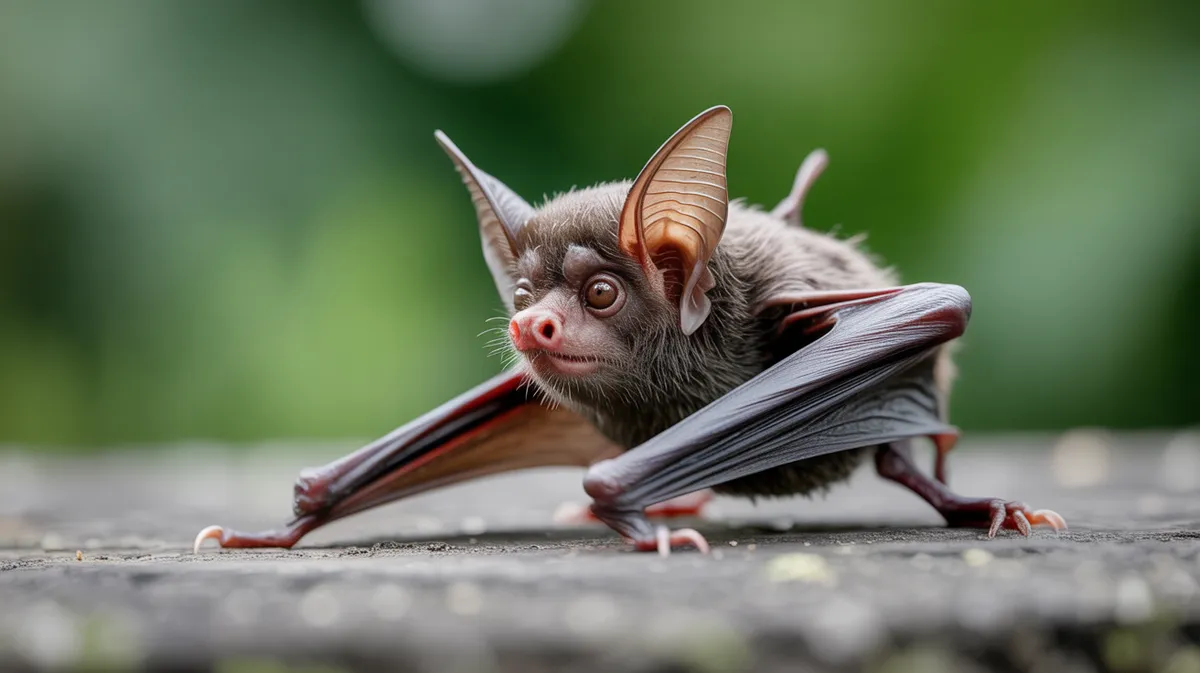
About the Common Vampire Bat
The common vampire bat is a small, nocturnal mammal native to the tropical and subtropical regions of the Americas. Recognized for its unique feeding habit, this bat consumes the blood of mammals and birds, making it the only mammal with a diet exclusively of blood. It has a short, cone-shaped muzzle, large ears, and a specialized heat-sensing nose that helps locate blood vessels in its prey. Highly social, these bats live in colonies and often share food with roost mates through regurgitation. Their ecological role includes controlling livestock populations and serving as a subject for studies in cooperative behavior.
Fascinating facts
Blood Drinker
The common vampire bat feeds solely on the blood of other animals, primarily livestock like cattle and horses.
Heat Detection
They possess heat-sensitive pits on their noses, allowing them to precisely locate blood vessels beneath the skin of their prey.
Social Sharing
Vampire bats are highly social and will regurgitate blood meals to feed hungry roost mates, even those not closely related.
Detailed description
The common vampire bat (Desmodus rotundus) is a small, robust bat with a body length of 7–9 cm (2.8–3.5 in), a wingspan of 35–40 cm (14–16 in), and a weight typically ranging from 25 to 40 grams (0.9–1.4 oz). Its fur is short and velvety, colored grayish-brown dorsally and paler ventrally. The bat's face is distinguished by a leaf-shaped nose and a pronounced, heat-sensitive pit on the snout, which aids in detecting blood vessels beneath the skin of its prey. Unlike most bats, it has a reduced, thumb-like digit on its wings and strong, agile hind limbs that allow it to walk, hop, and even run on the ground—a rare trait among bats. The dental formula is highly specialized, with razor-sharp upper incisors and canines designed for slicing skin, and grooved tongues that facilitate blood lapping. Colonies can range from a few individuals to over a hundred, typically roosting in caves, hollow trees, abandoned buildings, or wells. Social bonds are strong, with frequent grooming and reciprocal food sharing among kin and non-kin. The species is nocturnal, emerging at dusk to forage, and displays remarkable spatial memory to locate hosts and return to roosts. Reproduction is non-seasonal in much of its range, with females typically giving birth to a single pup after a gestation of about 205–214 days. The common vampire bat plays a complex ecological role, both as a parasite and as a subject of research into social cooperation and disease transmission.
Did you know?
Vampire bats can detect their prey's blood vessels using special heat sensors on their noses.
Research & sources
Wikipedia summary
The common vampire bat is a small, leaf-nosed bat native to the Americas. It is one of three extant species of vampire bats, the other two being the hairy-legged and the white-winged vampire bats.
Behaviour & social structure
Common vampire bats exhibit highly social and cooperative behaviors. They live in stable, mixed-sex colonies where females outnumber males, and maintain intricate social networks through mutual grooming and food sharing. When a bat fails to feed, it solicits regurgitated blood from roost-mates, a behavior underpinned by reciprocal altruism and kin selection. Foraging occurs exclusively at night; bats leave the roost individually or in small groups and use echolocation, olfaction, and thermal cues to locate sleeping mammals or birds. They approach prey stealthily, often landing near the animal and walking on all fours to an exposed area, typically the legs or neck. Using their sharp incisors, they make a small incision and lap up the blood, aided by anticoagulant compounds in their saliva (notably the enzyme 'draculin'). Feeding bouts last 20–30 minutes, but the blood loss to the host is usually minimal. After feeding, bats return to the roost, where social interactions, grooming, and food sharing are common. Daytime is spent resting, grooming, and engaging in social behaviors within the colony.
Reproduction & life cycle
Desmodus rotundus exhibits a polygynous mating system, with dominant males defending harems of females within the colony. Breeding is not strictly seasonal, though peaks may occur in some regions during the wet season when food is more abundant. Females reach sexual maturity at about 9–10 months, while males mature slightly later. Gestation lasts approximately 205–214 days, after which a single pup is born, weighing about 5–7 grams. Females typically give birth once per year, though some may have two litters under optimal conditions. Pups are altricial and remain attached to the mother for several weeks, clinging to her body or being left in nursery clusters within the roost. Mothers nurse their young for up to three months, and alloparental care (care by other females) is occasionally observed. Juveniles begin to accompany mothers on foraging trips at around 2–3 months of age and are weaned by 3–4 months.
Adaptations & survival
The common vampire bat possesses several unique adaptations for sanguivory (blood feeding). Its heat-sensitive nose-leaf detects infrared radiation, allowing precise targeting of blood vessels. The bat's saliva contains potent anticoagulants, vasodilators, and anesthetics, preventing blood clotting and minimizing host discomfort. Its grooved tongue and specialized stomach rapidly absorb plasma, allowing the bat to process large volumes of liquid meals. The bat's limbs are highly modified for terrestrial locomotion, with strong thumbs and hind limbs enabling agile movement on the ground. Socially, the species has evolved complex cooperative behaviors, including reciprocal food sharing and kin recognition, which buffer individuals against the high risk of starvation. Its kidneys are adapted to excrete excess water quickly, concentrating nutrients and minimizing weight gain after feeding.
Cultural significance
The common vampire bat has a prominent place in folklore and popular culture, often symbolizing fear, death, or supernatural evil due to its blood-feeding habits. In Latin America, it features in indigenous myths and colonial-era legends, sometimes associated with witchcraft or omens. However, it has also contributed to biomedical research: the anticoagulant 'draculin' in its saliva has inspired new treatments for blood-clotting disorders and stroke. The species' unique social behaviors have made it a model organism for studies of cooperation, altruism, and disease transmission, further embedding it in scientific and medical discourse.
Recent research
Recent research has focused on the molecular biology of vampire bat saliva, leading to the identification of novel anticoagulant and anesthetic compounds with potential medical applications. Studies using radio telemetry and stable isotope analysis have shed light on foraging ranges, host preferences, and the impact of environmental changes on feeding ecology. Social network analysis has revealed the complexity of food-sharing relationships and their evolutionary stability. Ongoing research addresses the bat's role as a rabies reservoir, with efforts to develop targeted vaccination strategies for both bats and livestock. Genomic studies have provided insights into the evolution of sanguivory, revealing gene losses and gains related to immunity, digestion, and sensory perception.
Videos
Habitat
Tropical and subtropical forests, open grasslands, and agricultural areas
 Various Continental Regions
Grassland
Open areas dominated by grasses rather than trees, supporting numerous herbivores and their predators.
 Global
Forest
Wooded areas with significant tree cover and diverse plant and animal communities.
 Africa
Savanna
Grasslands with scattered trees, characterized by seasonal rainfall and home to diverse grazing animals and predators.
Conservation
The Common Vampire Bat is currently classified as Least Concern on the IUCN Red List.
Threats & challenges
While currently listed as Least Concern by the IUCN, the common vampire bat faces several threats. Habitat loss due to deforestation and agricultural expansion can reduce roosting sites and prey availability. In some regions, culling campaigns target vampire bats to control rabies transmission to livestock and humans, sometimes resulting in non-selective killing of other bat species. The species is a known reservoir for rabies and other zoonotic pathogens, leading to conflict with humans and livestock producers. Despite these challenges, the bat's adaptability to human-altered landscapes and generalist roosting habits have allowed populations to remain stable or even expand in some areas. Climate change may alter prey distributions and roost availability, posing future risks.
Taxonomy
Scientific name
Desmodus rotundus
- Kingdom
- Animalia
- Phylum
- Chordata
- Class
- Mammalia
- Order
- Chiroptera
- Family
- Phyllostomidae
- Genus
- Desmodus
- Species
- rotundus
Community notes
Share your observations about the Common Vampire Bat.
No community notes yet. Be the first!
Discover more wildlife
More fascinating animals from the encyclopedia.