
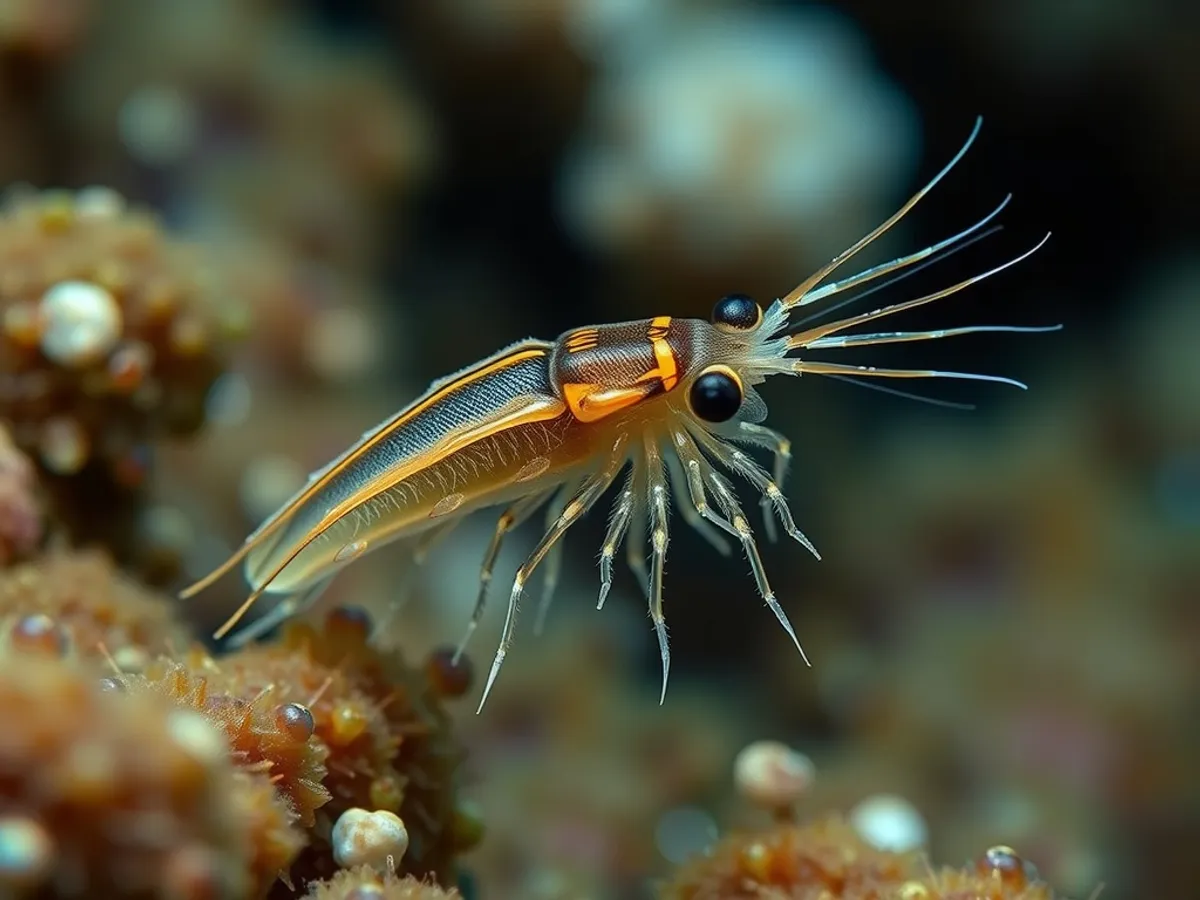
About the Copepod
Copepods are tiny crustaceans found in nearly every aquatic environment, from the deepest oceans to freshwater lakes and ponds. Despite their small size, typically less than 2 millimeters long, they are among the most abundant animals on Earth and play a crucial role in aquatic food webs. Copepods serve as a key food source for many fish, whales, and seabirds, and they contribute significantly to global carbon cycling. Their bodies are generally transparent or translucent, and they move through the water with quick, jerky motions using their antennae and legs.
Fascinating facts
Oceanic Dominance
Copepods are found in virtually every aquatic habitat, from the surface waters of the open ocean to freshwater lakes and even underground caves.
Vital Food Source
They are a major link in the aquatic food chain, feeding on microscopic algae and in turn being eaten by fish, whales, and seabirds.
Bioluminescent Abilities
Some copepod species are capable of bioluminescence, emitting light to confuse predators or communicate with others.
Detailed description
Copepods are a diverse subclass of small crustaceans, typically ranging from 0.2 to 5 millimeters in length, though some parasitic species can reach up to 17 mm. Their bodies are generally cylindrical or teardrop-shaped, with a distinct separation between the head, thorax, and abdomen. The head bears a single median compound eye, which is often red and highly sensitive to light, aiding in predator avoidance and navigation. Copepods possess two pairs of antennae, with the first pair often elongated and used for locomotion, resulting in their characteristic jerky swimming motion. The thorax is equipped with five pairs of swimming legs, while the abdomen lacks appendages. Most copepods are transparent or translucent, which provides camouflage in the water column. They exhibit a variety of feeding strategies, including filter feeding, grazing on phytoplankton, detritivory, and predation on smaller zooplankton or even other copepods. Some species are highly specialized parasites, attaching to fish or invertebrates. Copepods play a foundational role in aquatic food webs, serving as a primary food source for many commercially important fish species, baleen whales, and seabirds. Their sheer abundance—estimated at over 1,000,000 individuals per cubic meter in productive waters—makes them one of the most numerous multicellular animals on Earth. Additionally, copepods contribute significantly to biogeochemical cycles, particularly the oceanic carbon pump, by transporting organic carbon to deeper waters through their fecal pellets and diel vertical migrations.
Did you know?
A single liter of seawater can contain thousands of copepods, making them one of the most numerous multicellular organisms on the planet.
Research & sources
Wikipedia summary
Copepods are a group of small crustaceans found in nearly every freshwater and saltwater habitat. Some species are planktonic, some are benthic, several species have parasitic phases, and some continental species may live in limnoterrestrial habitats and other wet terrestrial places, such as swamps, under leaf fall in wet forests, bogs, springs, ephemeral ponds, puddles, damp moss, or water-filled recesses of plants (phytotelmata) such as bromeliads and pitcher plants. Many live underground in marine and freshwater caves, sinkholes, or stream beds. Copepods are sometimes used as biodiversity indicators.
Behaviour & social structure
Copepods exhibit complex behavioral patterns that vary by species and habitat. Planktonic copepods, such as Calanus finmarchicus, perform diel vertical migrations, ascending to surface waters at night to feed on phytoplankton and descending to deeper, darker layers during the day to avoid visual predators. Their feeding behavior is highly selective; they can detect and capture individual phytoplankton cells using mechanoreceptors on their antennae and mouthparts. Some copepods are ambush predators, remaining motionless until prey approaches, while others are active filter feeders. Social interactions are generally limited, though some species aggregate in swarms, which may enhance mating opportunities or reduce predation risk. Parasitic copepods exhibit host-seeking behaviors, using chemical and tactile cues to locate suitable hosts. Daily routines are strongly influenced by environmental factors such as light, temperature, and food availability, with many species capable of entering diapause or dormancy during unfavorable conditions.
Reproduction & life cycle
Copepod reproduction is typically sexual, with males locating females using chemical cues and transferring spermatophores (sperm packets) during brief copulatory encounters. Females carry fertilized eggs in one or two external sacs attached to the abdomen until hatching, though some species release eggs directly into the water. The number of eggs per clutch varies widely, from a few dozen to several hundred, depending on species and environmental conditions. Embryonic development is rapid, often taking just a few days, and the larvae (nauplii) undergo multiple molts before reaching the copepodite stage and eventually adulthood. There is little to no parental care beyond egg carrying. Breeding seasons are often synchronized with phytoplankton blooms to maximize offspring survival, especially in temperate and polar regions. Some copepods can produce resting eggs capable of surviving desiccation or extreme cold, ensuring population persistence through adverse periods.
Adaptations & survival
Copepods possess a suite of adaptations for survival in diverse environments. Their small, transparent bodies reduce visibility to predators, while rapid, erratic swimming enabled by powerful antennae enhances escape responses. Many species can detect minute water vibrations, allowing them to sense approaching threats or prey. Diel vertical migration is a key behavioral adaptation that balances feeding efficiency with predator avoidance. Some copepods produce bioluminescent chemicals as a defense mechanism, startling predators or attracting secondary predators to their attackers. Parasitic copepods have evolved specialized mouthparts and attachment structures for feeding on host tissues or fluids. Physiologically, copepods can regulate their buoyancy and tolerate wide ranges of salinity and temperature, facilitating colonization of both marine and freshwater habitats, as well as extreme environments like caves and ephemeral pools.
Cultural significance
Copepods, while not widely recognized in popular culture, have significant indirect importance to humans. They are essential to global fisheries, as the primary food source for many larval and adult fish species. In aquaculture, copepods are cultivated as live feed for fish and shrimp larvae. In some cultures, copepods are used as biological indicators of water quality and ecosystem health. Their role in controlling mosquito larvae in drinking water supplies has been harnessed in public health initiatives, notably in Vietnam, to combat mosquito-borne diseases. Copepods also feature in scientific art and educational materials, symbolizing the hidden complexity and interconnectedness of aquatic ecosystems.
Recent research
Recent research on copepods has focused on their role in the biological carbon pump, with studies showing that their vertical migrations and fecal pellet production contribute significantly to carbon sequestration in the deep ocean. Genomic and transcriptomic analyses have revealed remarkable genetic diversity and adaptations to environmental stressors, such as hypoxia and salinity fluctuations. Ongoing studies are investigating copepod responses to ocean acidification and warming, with implications for future marine food webs. Advances in imaging and molecular techniques have improved species identification and understanding of copepod microbiomes. There is also growing interest in the use of copepods as model organisms for studying developmental biology, sensory ecology, and the impacts of microplastics.
Videos
Habitat
Ocean


Conservation
The Copepod is currently classified as Least Concern on the IUCN Red List.
Threats & challenges
While copepods are generally resilient and abundant, they face several threats. Climate change is altering ocean temperatures, stratification, and primary productivity, which can disrupt copepod population dynamics and distribution. Ocean acidification may impact their exoskeleton formation and reproductive success. Pollution, particularly microplastics and chemical contaminants, can accumulate in copepod tissues, affecting their health and the species that feed on them. Overfishing of copepod predators can lead to trophic imbalances, while ballast water transport has introduced invasive copepod species to new regions, sometimes outcompeting native fauna. Despite these challenges, most copepod populations remain robust, though localized declines have been observed in some ecosystems.
Taxonomy
Scientific name
Calanus finmarchicus
- Kingdom
- Animalia
- Phylum
- Arthropoda
- Class
- Hexanauplia
- Order
- various (e.g., Calanoida, Cyclopoida, Harpacticoida)
- Family
- various (e.g., Calanidae, Cyclopidae, Harpacticidae)
- Genus
- various (e.g., Calanus)
- Species
- finmarchicus
Community notes
Share your observations about the Copepod.
No community notes yet. Be the first!
Discover more wildlife
More fascinating animals from the encyclopedia.