
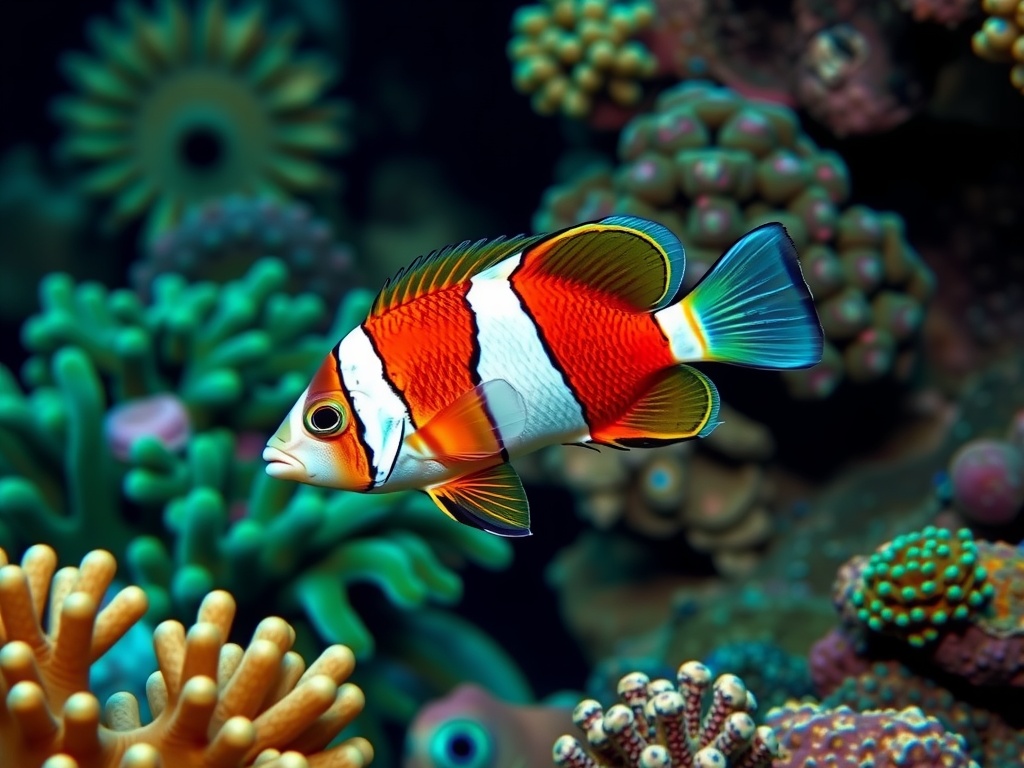
About the Copperband Butterflyfish
The Copperband Butterflyfish is a striking marine fish known for its elongated snout and distinctive yellow-orange vertical bands across its white body. Native to the Indo-Pacific region, it inhabits coral reefs where it uses its long snout to hunt for small invertebrates and worms in crevices. The species is admired for its graceful swimming and is a popular, though delicate, addition to marine aquariums. Despite its beauty, it can be challenging to keep in captivity due to its specialized diet and sensitivity to water conditions.
Fascinating facts
Specialized Snout
The Copperband Butterflyfish's long, tubular snout allows it to reach prey hiding in narrow reef crevices that most other fish can't access.
Reef Dweller
This species is strictly associated with coral reef habitats, where it finds both food and shelter among branching corals and rocky outcrops.
Vivid Markings
Its bright copper bands and distinctive eye-spot near the tail serve as both camouflage among corals and as a distraction for would-be predators.
Detailed description
The Copperband Butterflyfish (Chelmon rostratus) is a medium-sized marine fish, typically reaching lengths of 15–20 cm (6–8 inches) as adults. Its laterally compressed body is adorned with alternating vertical bands of bright yellow-orange and silvery white, with a distinctive black eyespot on the rear of the dorsal fin and a narrow, elongated snout adapted for probing into narrow crevices. The dorsal fin is continuous, with 8–9 spines and 21–23 soft rays, while the anal fin has 3 spines and 18–19 soft rays. The pectoral and pelvic fins are translucent. This species exhibits remarkable maneuverability, allowing it to navigate complex reef structures with ease. The eyes are positioned high on the head, aiding in predator awareness. Copperband Butterflyfish are diurnal, actively foraging during daylight hours and seeking shelter in reef crevices at night. Their coloration provides camouflage among coral branches and sponges, while the eyespot may confuse predators about the fish's true orientation. They are generally solitary or found in pairs, especially during the breeding season. The species is noted for its delicate feeding habits, which make it challenging to maintain in captivity.
Did you know?
Despite being widespread in the wild, the Copperband Butterflyfish is notoriously difficult to acclimate and feed in home aquariums due to its selective eating habits.
Research & sources
Wikipedia summary
The copperband butterflyfish, also known as the beaked coral fish, is found in reefs in both the Pacific and Indian Oceans. This butterflyfish is one of the three species that make up the genus Chelmon and all have long beaks.
Behaviour & social structure
Copperband Butterflyfish are primarily solitary, though pairs are sometimes observed, particularly during the breeding season. They establish and defend small territories within coral reefs, often returning to the same shelter sites each night. Their feeding behavior is highly specialized; using their long, narrow snouts and protractile mouths, they probe into crevices and holes to extract small invertebrates, polychaete worms, crustaceans, and occasionally coral polyps. They are methodical foragers, moving slowly and deliberately across the reef. Social interactions are generally limited to brief displays of aggression when defending territory, involving lateral displays and fin spreading. Juveniles are rarely seen and are thought to be more reclusive, hiding among branching corals or rubble. The species is known for its shy and cautious nature, quickly retreating into shelter when threatened.
Reproduction & life cycle
Copperband Butterflyfish are oviparous, forming monogamous pairs during the breeding season, which typically coincides with warmer months (spring to early summer) in most of their range. Courtship involves synchronized swimming and circling displays. Spawning occurs at dusk, with both partners ascending into the water column to release eggs and sperm simultaneously. The eggs are pelagic, floating freely in the water and hatching after approximately 24–48 hours, depending on temperature. Larvae are planktonic and undergo several developmental stages before settling onto the reef as juveniles. There is no parental care after spawning; survival of the offspring depends on dispersal and finding suitable habitat for settlement.
Adaptations & survival
Chelmon rostratus exhibits several key adaptations for survival in complex reef environments. The elongated, beak-like snout and small, protrusible mouth allow it to access prey hidden deep within coral crevices, giving it a feeding niche with less competition. Its laterally compressed body enables agile maneuvering among tight spaces. The bold vertical stripes and eyespot serve as disruptive coloration, confusing predators and providing camouflage among corals and sponges. The species also has a high degree of site fidelity, often returning to the same sheltering spots, which may reduce predation risk. Physiologically, it is adapted to tolerate a range of salinities and temperatures typical of shallow reef environments, though it is sensitive to rapid environmental changes.
Cultural significance
The Copperband Butterflyfish is highly prized in the marine aquarium trade for its striking appearance and graceful swimming. In some cultures, butterflyfish are considered symbols of beauty and harmony, and their presence in aquaria is believed to bring good fortune. The species does not have significant roles in traditional medicine or mythology, but its image is frequently used in marine-themed art and educational materials. Its popularity has also made it an ambassador species for coral reef conservation efforts.
Recent research
Recent research on Chelmon rostratus has focused on its feeding ecology, revealing its role in controlling populations of certain coral pests, such as polychaete worms and small crustaceans. Studies on its reproductive biology have improved understanding of larval dispersal and recruitment patterns, which are important for reef resilience. Genetic analyses have clarified its relationships within the Chaetodontidae family, confirming its distinctiveness from closely related species. Ongoing research is examining the impacts of climate change on its distribution and the effects of the aquarium trade on wild populations. There is also interest in developing improved husbandry techniques to increase survival rates in captivity, which could reduce pressure on wild stocks.
Videos
Habitat
Coral reefs

Conservation
The Copperband Butterflyfish is currently classified as Least Concern on the IUCN Red List.
Threats & challenges
While the Copperband Butterflyfish is currently listed as Least Concern by the IUCN, it faces several localized threats. Habitat degradation due to coral reef destruction, pollution, and climate change-induced coral bleaching poses significant risks to its populations. Overcollection for the aquarium trade is another concern, as the species is highly sought after but has a poor survival rate in captivity due to its specialized diet and sensitivity to stress. There is evidence of population declines in areas with heavy reef damage or intense collection pressure. However, the species' wide distribution and adaptability to various reef habitats have so far buffered it from major global declines.
Taxonomy
Scientific name
Chelmon rostratus
- Kingdom
- Animalia
- Phylum
- Chordata
- Class
- Actinopterygii
- Order
- Perciformes
- Family
- Chaetodontidae
- Genus
- Chelmon
- Species
- rostratus
Where to see a copperband butterflyfish
1 zoo and aquarium in 1 country are recorded as keeping this species.

Community notes
Share your observations about the Copperband Butterflyfish.
No community notes yet. Be the first!
Discover more wildlife
More fascinating animals from the encyclopedia.