
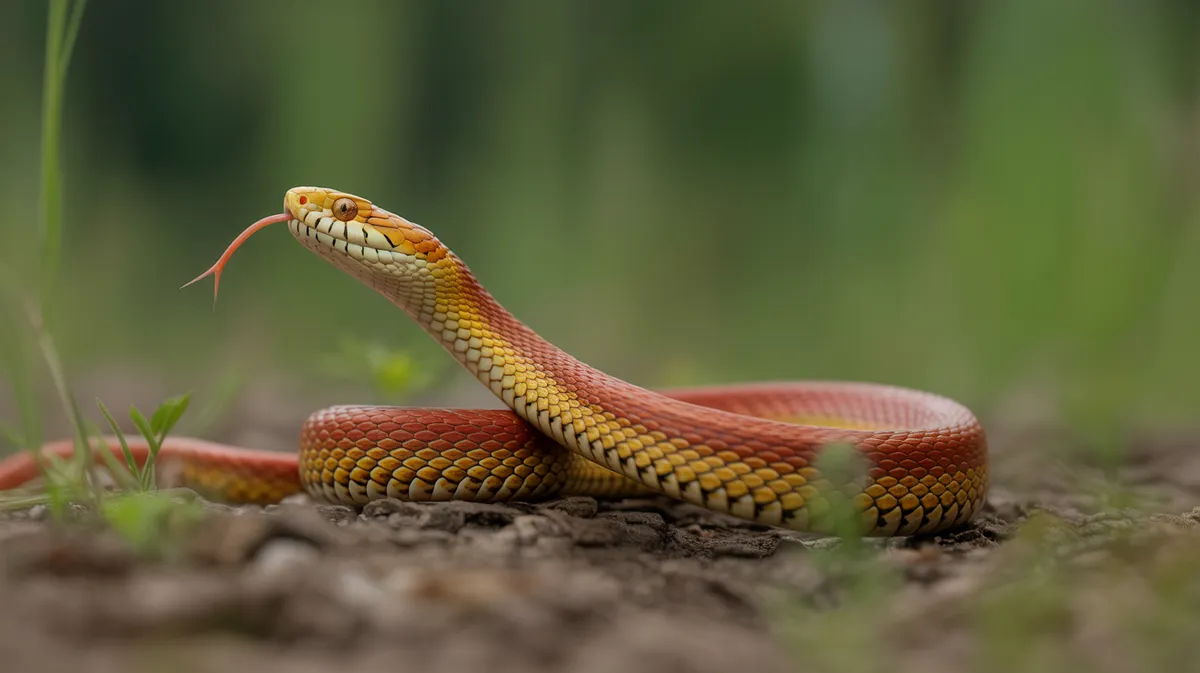
About the Corn Snake
Pantherophis guttatus is a slender, non-venomous constrictor of the southeastern United States, and its name almost certainly comes from the bold black-and-white checkerboard on its belly, which looks like Indian corn — with a secondary nod to the fact that it was so often found in corn cribs hunting the rats that came for the grain. It kills by constriction, and studies of the group have shown constrictors do not suffocate their prey so much as shut down its circulation, tightening in response to the victim's own heartbeat and releasing when it stops. Corn snakes climb far better than their build suggests, using a concertina grip on rough bark to reach bird nests and roosting rodents. When threatened they will rear, flatten the head into a rough triangle and vibrate the tail rapidly in dry leaves, producing a buzz convincing enough that they are frequently killed as copperheads or rattlesnakes — a mistake that costs farmers a genuinely useful rodent predator. In captivity the species has become the laboratory of reptile genetics: amelanistic, anerythristic, snow, lavender and scaleless morphs have all been fixed by breeders, and corn snakes are now one of the most heavily line-bred reptiles on earth. Wild ones are orange-red with black-bordered blotches.
Fascinating facts
Colorful Morphs
Corn snakes come in a wide variety of color morphs and patterns in captivity, thanks to selective breeding.
Rodent Control
In the wild, corn snakes play an important role by keeping rodent populations in check.
Arboreal Skills
Though mainly terrestrial, corn snakes are strong climbers and can be found in trees and on elevated surfaces.
Detailed description
The corn snake (Pantherophis guttatus) is a medium-sized, slender colubrid, typically reaching adult lengths of 61–182 cm (2–6 ft), with an average mass of 500–900 grams. Its dorsal coloration is highly variable but most commonly features vibrant orange, brown, or gray backgrounds with large, black-bordered red blotches along the back and a distinctive checkerboard pattern of black and white on the ventral scales. The head is slightly wider than the neck, with a spear-shaped marking between the eyes and a pronounced stripe running from the eye to the jaw. Corn snakes possess smooth scales and round pupils, distinguishing them from many venomous species. They are primarily terrestrial but are adept climbers, often found in trees or abandoned buildings. Their cryptic coloration provides camouflage among leaf litter and forest debris. Corn snakes are primarily crepuscular, being most active during dawn and dusk. They are solitary outside of the breeding season and exhibit secretive behaviors, often hiding under logs, rocks, or within rodent burrows. In the wild, their lifespan is typically 6–8 years, but in captivity, they can live over 20 years with proper care.
Did you know?
Corn snakes can vibrate their tails rapidly against dry leaves to mimic the sound of a rattlesnake, deterring potential predators.
Research & sources
Wikipedia summary
The corn snake, sometimes called red rat snake is a species of North American rat snake in the family Colubridae. The species subdues its small prey by constriction. It is found throughout the southeastern and central United States. Though superficially resembling the venomous copperhead and often killed as a result of this mistaken identity, the corn snake lacks functional venom and is harmless. The corn snake is beneficial to humans because it helps to control populations of wild rodent pests that damage crops and spread disease.
Behaviour & social structure
Corn snakes are solitary and secretive, spending much of their time concealed to avoid predators. They are primarily crepuscular, hunting at dawn and dusk, though activity patterns can shift with temperature and season. Their primary hunting strategy involves active foraging, using their keen sense of smell (via the Jacobson's organ) and heat-sensitive pits to locate prey, which consists mainly of small mammals, birds, and occasionally amphibians and reptiles. Upon encountering prey, corn snakes employ constriction, rapidly coiling around the animal and suffocating it before ingestion. They are excellent climbers and swimmers, allowing them to exploit a variety of microhabitats. Defensive behaviors include tail vibration (mimicking rattlesnakes), musking, and rapid escape. Social interactions are minimal outside of breeding, with occasional tolerance of conspecifics in favorable hibernacula during winter.
Reproduction & life cycle
Corn snakes are oviparous, with breeding typically occurring in spring (March to May) after emergence from winter brumation. Courtship involves males following pheromone trails left by receptive females, with copulation lasting several hours. Females lay 10–30 elongated, leathery eggs in concealed, humid locations such as rotting logs, leaf litter, or abandoned burrows. Incubation lasts 55–70 days at optimal temperatures (24–30°C/75–86°F). There is no parental care; hatchlings are independent immediately upon emergence, measuring 25–38 cm (10–15 in) in length. Sexual maturity is reached at 18–36 months, depending on food availability and environmental conditions. In the wild, females may breed annually or biennially, depending on resource abundance.
Adaptations & survival
Corn snakes exhibit several adaptations for survival. Their cryptic coloration and patterning provide effective camouflage against predators and prey. Smooth, flexible scales facilitate movement through tight spaces and leaf litter. They possess a highly kinetic skull and loosely attached jaws, enabling them to consume prey much larger than their head. The Jacobson's organ enhances chemosensory perception, crucial for tracking prey and mates. Behavioral adaptations include brumation during colder months, allowing survival in temperate climates. Tail vibration is a defensive mimicry tactic, deterring predators by imitating rattlesnakes. Their ability to exploit both arboreal and terrestrial habitats increases their ecological versatility.
Cultural significance
Corn snakes have played a positive role in human culture, particularly in the southeastern United States, where they are valued for their role in controlling rodent populations in agricultural settings. The name 'corn snake' is believed to originate from their frequent presence in corn cribs and fields, where they hunt rodents attracted to stored grain. They are among the most popular pet snakes worldwide due to their docile temperament, manageable size, and diverse color morphs developed through selective breeding. Unlike many snakes, they are not associated with negative folklore or superstition and are often used in educational programs to promote reptile conservation and awareness.
Recent research
Recent genetic studies have clarified the taxonomic placement of the corn snake, moving it from the genus Elaphe to Pantherophis based on molecular phylogenetics (Utiger et al., 2002). Ongoing research focuses on color morph genetics, population genetics, and the ecological impact of corn snakes in both native and introduced ranges (notably in the Bahamas, where they are an invasive species). Studies on their thermal ecology have provided insights into brumation strategies and climate change resilience. Captive breeding programs have produced over 800 recognized color and pattern morphs, making the species a model organism for herpetocultural genetics. There is also research into their role in integrated pest management in agricultural landscapes.
Videos
Habitat
Deciduous forests, overgrown fields, and farmlands


Conservation
The Corn Snake is currently classified as Least Concern on the IUCN Red List.
Threats & challenges
Currently, corn snakes face few significant threats and are classified as Least Concern by the IUCN. However, local populations may be impacted by habitat destruction due to urbanization, agriculture, and deforestation. Road mortality is a common cause of death, especially during seasonal migrations. Misidentification as venomous copperheads leads to unnecessary killing by humans. Collection for the pet trade was historically a concern, but most captive specimens are now bred in captivity, reducing wild harvest pressure. Pesticide use and ecosystem changes affecting prey availability may pose future risks. Overall, populations remain stable, but continued habitat monitoring is recommended.
Taxonomy
Scientific name
Pantherophis guttatus
- Kingdom
- Animalia
- Phylum
- Chordata
- Class
- Reptilia
- Order
- Squamata
- Family
- Colubridae
- Genus
- Pantherophis
- Species
- guttatus
Where to see a corn snake
7 zoos and aquariums in 3 countries are recorded as keeping this species.
 Dudley Zoo & Castle🇬🇧 Dudley, United Kingdom
- 🦁The Maryland Zoo in Baltimore🇺🇸 Baltimore, United States
- 🦁Dakota Zoo🇺🇸 Bismarck, United States
- 🦁Topeka Zoo🇺🇸 Topeka, United States
 Birmingham Zoo🇺🇸 United States
Community notes
Share your observations about the Corn Snake.
No community notes yet. Be the first!
Discover more wildlife
More fascinating animals from the encyclopedia.