
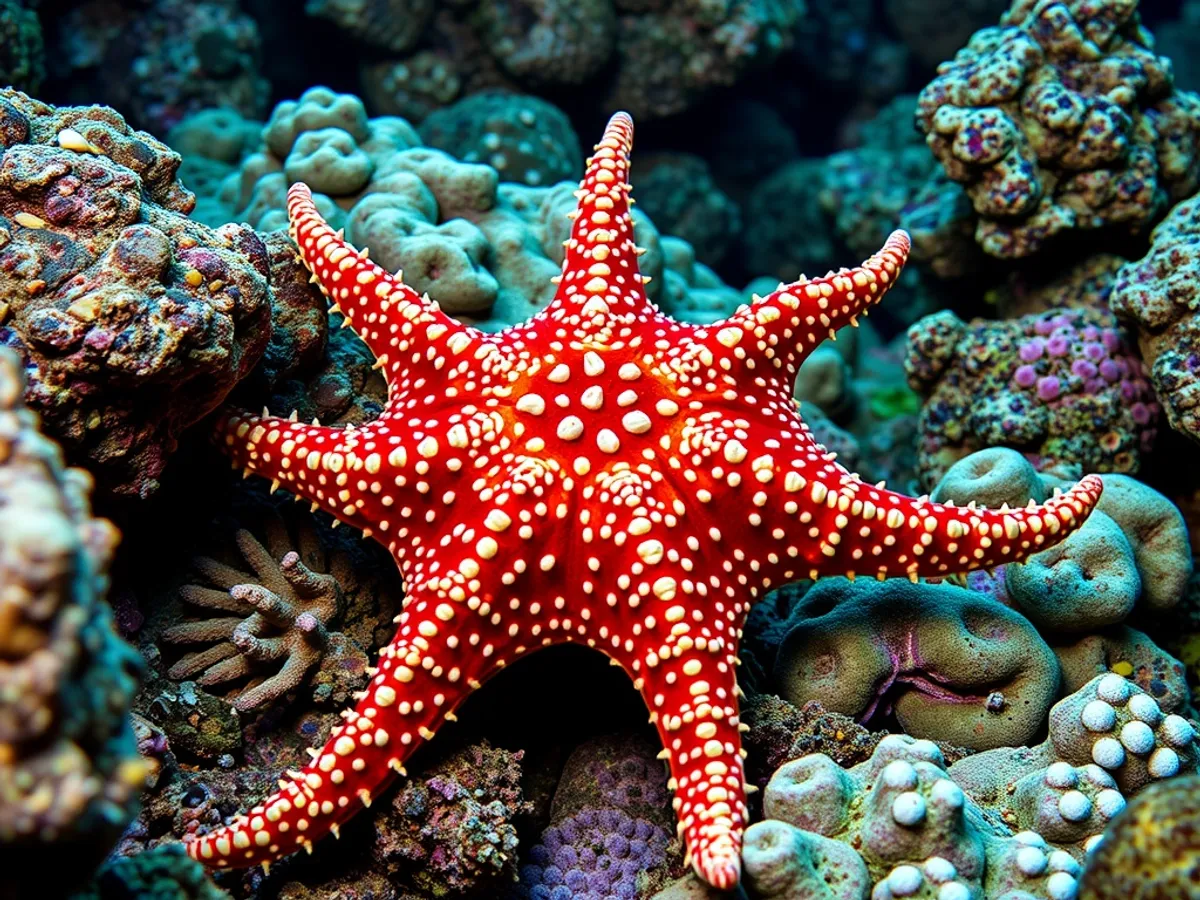
About the Crown-of-Thorns Starfish
Acanthaster planci eats reef-building coral by pushing its own stomach out through its mouth, spreading it over the coral like a sheet, and digesting the living tissue off the skeleton in place — leaving behind a clean white scar that algae quickly colonise. A single adult can strip several square metres of coral a year. On its own that would be tolerable; the problem is that the species undergoes explosive outbreaks, in which densities jump from a handful of animals per hectare to thousands. A large female can release upward of 50 million eggs in a season, and the leading explanation for outbreaks is that nutrient-rich runoff from agricultural land fuels the phytoplankton blooms that the larvae eat, so far more larvae survive to settle. On the Great Barrier Reef, crown-of-thorns outbreaks have been assessed as a cause of coral loss on the same order as bleaching and cyclones, and the two compound each other. It is protected by up to 20 cm of venomous spines carrying saponin toxins, which makes it painful to handle and unattractive to most predators. Control programmes now kill them one at a time by injecting ox bile or household vinegar, which is lethal to the starfish and harmless to the reef.
Fascinating facts
Many-Armed Predator
Unlike most starfish, the Crown-of-Thorns can have up to 21 arms, each covered in venomous spines.
Toxic Defense
Their spines contain saponin-based toxins that deter predators and can cause severe pain and swelling in humans.
Coral Reef Impact
Population booms of this starfish are a major threat to coral reefs, sometimes causing up to 40% of coral loss on affected reefs.
Detailed description
The Crown-of-Thorns Starfish (Acanthaster planci) is a conspicuously large echinoderm, typically measuring 25–35 cm in diameter but capable of reaching up to 60 cm. It is distinguished by its multiple (commonly 16–21) flexible arms radiating from a central disc, all densely covered with long, sharp, venomous spines that can reach up to 5 cm in length. The spines are coated with saponin-based toxins, serving as a potent defense against predators. Its upper surface is a mosaic of vivid colors, often ranging from grayish-purple to reddish or greenish hues, aiding in camouflage among coral. The starfish moves using thousands of tube feet located on its underside, which also facilitate adhesion to complex reef surfaces. A. planci is a specialized corallivore, feeding almost exclusively on scleractinian (hard) corals by everting its stomach over the coral tissue and secreting digestive enzymes. It is primarily nocturnal, hiding in crevices or under coral ledges during the day and emerging at night to feed. The species is solitary for most of its life but can aggregate in large numbers during population outbreaks, causing significant coral mortality. Its remarkable regenerative abilities allow it to regrow lost arms, and in some cases, entire individuals can regenerate from a single arm if part of the central disc is attached. The Crown-of-Thorns Starfish plays a complex ecological role, both as a natural regulator of coral diversity and, during outbreaks, as a major driver of reef decline.
Did you know?
A single adult Crown-of-Thorns Starfish can consume up to 6 square meters of living coral per year.
Research & sources
Wikipedia summary
The crown-of-thorns starfish, Acanthaster planci, is a large starfish that preys upon hard, or stony, coral polyps (Scleractinia). The crown-of-thorns starfish receives its name from venomous thornlike spines that cover its upper surface, resembling the biblical crown of thorns. It is one of the largest starfish in the world.
Behaviour & social structure
Acanthaster planci is predominantly nocturnal, remaining hidden in reef crevices or beneath coral heads during daylight hours to avoid predators. At night, it emerges to feed, using chemosensory cues to locate preferred coral species, with a notable preference for fast-growing, branching corals such as Acropora. Its feeding involves everting its stomach onto the coral surface, secreting digestive enzymes, and absorbing the liquefied tissue, leaving behind white coral skeletons. While generally solitary, COTS may form dense aggregations (up to several hundred individuals per hectare) during outbreaks, which are believed to be triggered by increased larval survival linked to nutrient enrichment or reduced predation. Social interactions are minimal outside of spawning events, though aggregations can facilitate synchronized feeding and reproduction. The starfish exhibits slow movement, averaging 20–35 cm per minute, but can travel several meters per night in search of food. When threatened, it can shed arms as a defensive mechanism, which may later regenerate.
Reproduction & life cycle
Crown-of-Thorns Starfish are broadcast spawners, releasing eggs and sperm into the water column during synchronized mass spawning events, typically occurring once a year between November and February, often correlated with rising sea temperatures and lunar cycles. A single large female can release up to 60 million eggs in a single spawning season. Fertilization is external, and the resulting planktonic larvae (bipinnaria and later brachiolaria stages) drift with ocean currents for 2–4 weeks before settling onto the reef and metamorphosing into juveniles. There is no parental care; survival rates are extremely low, with high mortality due to predation and environmental factors. Juveniles initially feed on coralline algae before shifting to corallivory after several months. Sexual maturity is typically reached at 2–3 years, and individuals may live up to 8–10 years in the wild.
Adaptations & survival
Acanthaster planci exhibits several key adaptations for survival in coral reef environments. Its long, venomous spines deter most predators, although some specialized species (e.g., the giant triton snail, Charonia tritonis) can prey on it. The starfish’s ability to evert its stomach enables it to digest prey externally, allowing it to consume large coral polyps and maximize nutrient uptake. Its regenerative capacity is exceptional, permitting rapid recovery from predation or injury. The starfish’s coloration provides camouflage among coral and rubble, while its chemosensory abilities enable it to detect both food and conspecifics over considerable distances. Larval stages are highly dispersive, allowing for wide geographic distribution and colonization of new reefs. The ability to rapidly increase reproductive output under favorable conditions (e.g., nutrient enrichment) contributes to its potential for population outbreaks.
Cultural significance
The Crown-of-Thorns Starfish has a complex reputation in human culture. Its biblical name references the crown of thorns worn by Jesus, alluding to its formidable appearance. In some Pacific Island traditions, it is regarded as a symbol of destruction or a harbinger of reef decline. The species has become a focal point in marine conservation discourse, often cited in media and environmental campaigns as an emblem of the fragility of coral reefs. There are no significant traditional uses of the species due to its venomous spines, but it occasionally appears in local art or folklore as a cautionary figure.
Recent research
Recent research has focused on the genetic diversity and cryptic speciation within the Acanthaster genus, revealing that what was once considered a single species may represent a complex of closely related species across the Indo-Pacific. Studies have also elucidated the molecular composition of its toxins and the ecological triggers for population outbreaks, including the role of terrestrial runoff and predator depletion. Ongoing research aims to develop more effective, targeted control measures, such as biological controls (e.g., promoting natural predators) and automated removal technologies (e.g., underwater robots). Additionally, the impact of COTS outbreaks on reef recovery and resilience in the context of climate change remains a key area of investigation.
Videos
Habitat
Coral reefs

Conservation
The Crown-of-Thorns Starfish is currently classified as Least Concern on the IUCN Red List.
Threats & challenges
While the global population of A. planci is not currently threatened (IUCN: Least Concern), localized outbreaks pose significant challenges to coral reef health, particularly on the Great Barrier Reef and in parts of the western Pacific. Outbreaks are often linked to anthropogenic factors such as increased nutrient runoff (which enhances phytoplankton and larval survival), overfishing of natural predators, and climate change. These outbreaks can devastate coral cover, reducing biodiversity and reef resilience. Conversely, A. planci faces natural threats from specialized predators (e.g., giant triton snails, some fish, and the harlequin shrimp), disease, and environmental changes. Management strategies include manual removal, targeted injection of bile salts or vinegar, and restoration of predator populations, but effective large-scale control remains challenging.
Taxonomy
Scientific name
Acanthaster planci
- Kingdom
- Animalia
- Phylum
- Echinodermata
- Class
- Asteroidea
- Order
- Valvatida
- Family
- Acanthasteridae
- Genus
- Acanthaster
- Species
- planci
Community notes
Share your observations about the Crown-of-Thorns Starfish.
No community notes yet. Be the first!
Discover more wildlife
More fascinating animals from the encyclopedia.