
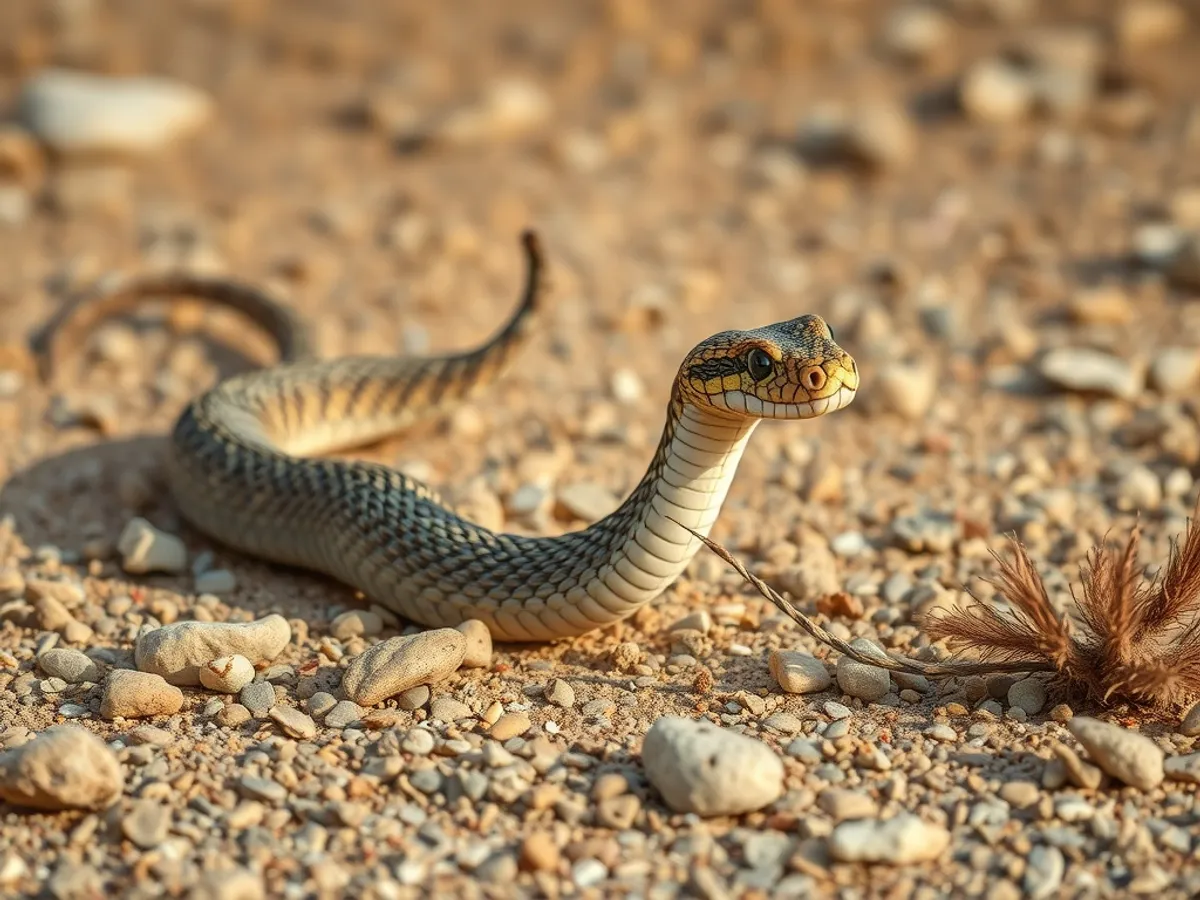
About the Desert Horned Viper
Cerastes cerastes is the small Saharan viper with a single spine-like scale sticking up above each eye, and although the horns are its trademark, hornless individuals occur in the same populations, so their exact function remains debated — the best supported idea is that they shade the eye or break up its outline while the snake lies buried. Burial is the core of its life. Rather than digging, it shuffles laterally with a rocking motion that displaces sand out sideways and sinks the body straight down, until only the eyes and the top of the head are exposed, and it will lie like that for hours waiting for a lizard or a rodent to pass. It travels across loose sand by sidewinding, throwing loops of the body sideways so that only two short sections touch the ground at any moment, which gives grip on a surface that would otherwise slip out from under a normal serpentine crawl and keeps most of the body off scorching sand. Its warning display is unusual and water-thrifty: instead of hissing, which costs moisture from the respiratory tract, it rubs its coils against one another so that the strongly keeled, saw-edged flank scales rasp, producing a dry sizzling sound. The venom is primarily cytotoxic and haemotoxic, painful and destructive but rarely fatal to adults.
Fascinating facts
Sidewinding Locomotion
The Desert Horned Viper uses sidewinding, a specialized movement that allows it to move quickly and efficiently across shifting desert sands without overheating.
Distinctive Horns
It possesses raised, horn-like scales above its eyes, a feature that is thought to help protect its eyes from blowing sand.
Nocturnal Hunter
This viper is predominantly nocturnal, hunting at night when temperatures are cooler and prey is more active.
Detailed description
The Desert Horned Viper (Cerastes cerastes) is a medium-sized venomous snake, typically measuring 30–60 cm in length, though some individuals may reach up to 85 cm. Its most distinctive anatomical feature is the pair of supraocular 'horns'—scalelike protrusions above each eye, which may serve as camouflage or protection from sand. The body is stout, with keeled dorsal scales that contribute to its rough texture and cryptic coloration, ranging from pale yellow to reddish-brown, closely matching the desert substrate. The head is broad and triangular, with large eyes adapted for nocturnal vision. This species exhibits a unique sidewinding locomotion, minimizing contact with hot sand and enabling efficient movement across loose surfaces. Its fangs are relatively long, allowing for effective envenomation of prey. The viper is primarily nocturnal and crepuscular, spending daylight hours buried beneath the sand with only its eyes and horns exposed. It is an ambush predator, relying on its camouflage and patience to capture small mammals, lizards, and occasionally birds. The Desert Horned Viper is solitary outside of the breeding season and exhibits little social interaction. Reproduction is oviparous, with females laying clutches of 8–23 eggs in concealed locations. Adapted to extreme aridity, it can survive long periods without direct water intake, deriving moisture from its prey.
Did you know?
Despite their intimidating appearance and venomous bite, Desert Horned Vipers are relatively docile and will often attempt to flee rather than confront threats.
Research & sources
Behaviour & social structure
Cerastes cerastes is predominantly nocturnal, becoming active at dusk and during the night to avoid the intense daytime heat. It spends much of the day buried in sand, using lateral undulations to submerge itself, leaving only its eyes and horns visible. This behavior aids in thermoregulation and predator avoidance. The viper is an ambush predator, remaining motionless and waiting for prey to approach before striking rapidly. Its diet consists mainly of small rodents, lizards, and occasionally birds, which it subdues with a quick venomous bite. Feeding frequency is low, often dictated by prey availability. Social interactions are minimal, with individuals generally avoiding each other except during the breeding season. When threatened, the viper may exhibit a defensive display, producing a rasping sound by rubbing its coils together—a behavior known as stridulation. It may also flatten its body and hiss as a warning before striking.
Reproduction & life cycle
The breeding season for the Desert Horned Viper typically occurs in spring and early summer (March to June), coinciding with increased prey availability. Males locate females through pheromonal cues and may engage in combat with rivals, intertwining their bodies in ritualized wrestling matches. After successful mating, females lay clutches of 8–23 eggs in sheltered locations such as under rocks or within burrows. Incubation lasts approximately 50–80 days, depending on ambient temperatures. Hatchlings emerge fully independent, measuring around 12–15 cm in length, and receive no parental care. Sexual maturity is generally reached at 2–3 years of age. Reproductive output may vary with environmental conditions, and in particularly harsh years, some females may skip breeding altogether.
Adaptations & survival
The Desert Horned Viper possesses several remarkable adaptations for desert survival. Its cryptic coloration and rough, keeled scales provide effective camouflage against sandy and rocky substrates, aiding both predation and predator avoidance. The supraocular horns may help break up the outline of the head, further enhancing concealment, and potentially protect the eyes from blowing sand. Sidewinding locomotion is a key behavioral adaptation, allowing the snake to move efficiently across loose, hot sand while minimizing body contact and heat absorption. The viper's ability to submerge itself in sand helps regulate body temperature and avoid desiccation. Physiologically, it can tolerate significant dehydration and derives most of its water needs from prey. Its venom is adapted for rapid immobilization of small, agile prey, and contains hemotoxins that disrupt blood clotting and tissue integrity.
Cultural significance
The Desert Horned Viper features in the folklore and mythology of several North African and Middle Eastern cultures, often symbolizing danger, stealth, or the harshness of the desert. Its distinctive horns have contributed to its reputation as a mystical or supernatural creature in local stories. In some regions, it is erroneously believed to possess magical or medicinal properties, leading to occasional use in traditional remedies, though such practices are rare. The species has also attracted interest from herpetologists and nature enthusiasts due to its unique appearance and adaptations.
Recent research
Recent research on Cerastes cerastes has focused on its venom composition, which contains a complex mixture of hemotoxins, neurotoxins, and cytotoxins with potential biomedical applications, including anticoagulant and anticancer properties. Studies have also examined the biomechanics of sidewinding locomotion, providing insights into robotic design and desert locomotion strategies. Genetic analyses have clarified the species' phylogenetic relationships within the Viperidae family and highlighted significant genetic diversity across its range. Ongoing ecological studies are investigating the impacts of habitat fragmentation and climate change on population dynamics and distribution. Conservation research is limited but increasing, with a focus on monitoring population trends and mitigating localized threats.
Sources
Cerastes cerastes (Desert Horned Viper): Taxonomy, Natural History, and Conservation
Schleich, H.H., Kästle, W., & Kabisch, K. (1996)
scientificIUCN Red List of Threatened Species: Cerastes cerastes
IUCN SSC Amphibian and Reptile Specialist Group
conservationCerastes cerastes (Desert Horned Viper): Natural History and Ecology
Schleich, H.H., Kästle, W., & Kabisch, K. (1996)
scientificCerastes cerastes: The IUCN Red List of Threatened Species 2021
IUCN SSC Snake Specialist Group
conservationCerastes cerastes (Desert Horned Viper): Natural History and Venom Composition
J. Mallow, D. Ludwig, G. Nilson (2003)
scientificVideos
Habitat
Desert

Conservation
The Desert Horned Viper is currently classified as Least Concern on the IUCN Red List.
Threats & challenges
Currently classified as 'Least Concern' by the IUCN, the Desert Horned Viper faces relatively few widespread threats due to its broad distribution and adaptability. However, localized populations may be impacted by habitat degradation from expanding agriculture, urbanization, and off-road vehicle activity, which can disrupt sand dune habitats. The species is sometimes collected for the pet trade or killed due to fear of venomous snakes. Climate change poses a potential long-term threat by altering desert ecosystems and prey availability. Despite these challenges, population trends remain stable in most areas, and the species is not considered at immediate risk.
Taxonomy
Scientific name
Cerastes cerastes
- Kingdom
- Animalia
- Phylum
- Chordata
- Class
- Reptilia
- Order
- Squamata
- Family
- Viperidae
- Genus
- Cerastes
- Species
- cerastes
Community notes
Share your observations about the Desert Horned Viper.
No community notes yet. Be the first!
Discover more wildlife
More fascinating animals from the encyclopedia.