
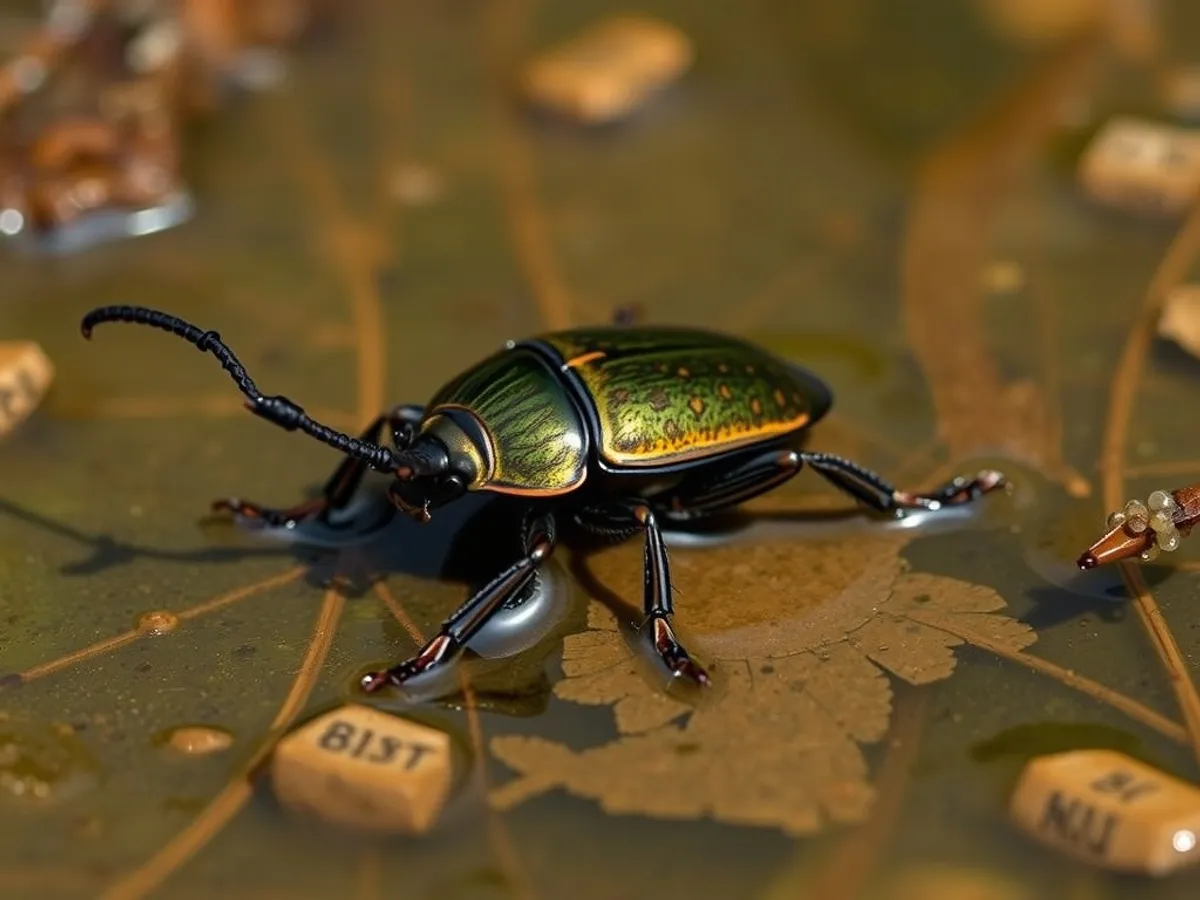
About the Diving Beetle
The Diving Beetle is an aquatic insect known for its streamlined, oval-shaped body and strong swimming abilities. It typically has a dark, glossy back and lighter underbelly, with long, fringed hind legs adapted for propulsion through water. Diving beetles are agile predators, feeding on other insects, tadpoles, and even small fish. They surface regularly to trap air beneath their wing cases, allowing them to breathe while submerged. Found in freshwater habitats across Europe and parts of Asia, they play a vital role in aquatic ecosystems.
Fascinating facts
Aquatic Adaptations
Diving beetles have hydrodynamic bodies and fringed hind legs that make them excellent swimmers in freshwater environments.
Voracious Predators
Both adult and larval diving beetles are carnivorous, preying on other insects, tadpoles, and even small fish.
Air Reservoir
They trap air under their elytra (wing covers) to allow them to breathe while submerged for extended periods.
Detailed description
Dytiscus marginalis, commonly known as the Great Diving Beetle, is a large aquatic beetle reaching lengths of 27–35 mm, with females often slightly larger than males. Its body is robust, streamlined, and oval-shaped, adapted for efficient swimming. The dorsal surface is typically dark brown to black, while the ventral side is yellowish or olive. Males can be distinguished by their smooth elytra and specialized suction cups on their forelegs, which aid in gripping females during mating, whereas females have finely grooved elytra. The hind legs are long, flattened, and fringed with stiff hairs, functioning as powerful paddles for propulsion. Dytiscus marginalis is an adept predator, both as larva and adult, with strong mandibles capable of subduing prey larger than itself. It possesses a unique respiratory adaptation: adults trap an air bubble beneath their elytra, allowing them to remain submerged for extended periods. The species is primarily nocturnal, often hunting at night and hiding among aquatic vegetation during the day. Dytiscus marginalis is found in a wide range of still or slow-moving freshwater habitats across Europe and northern Asia, where it plays a key role as a top invertebrate predator. Both larvae and adults are voracious, feeding on insects, tadpoles, and small fish, and their presence is an indicator of healthy aquatic ecosystems.
Did you know?
Diving beetles can emit a foul-tasting chemical to deter predators when threatened.
Research & sources
Wikipedia summary
The Dytiscidae, from the Ancient Greek word δυτικός (dystikos), meaning "able to dive", are the predaceous diving beetles, a family of water beetles. They occur in virtually any freshwater habitat around the world, but a few species live in terrestrial habitats such as among leaf litter. The “diving” in their common name comes from their cycling between underwater and the surface to replenish oxygen like a diver. The adults of most are between 1 and 2.5 cm (0.4–1.0 in) long, though much variation is seen between species. The European Dytiscus latissimus and Brazilian Bifurcitus ducalis are the largest, reaching up to 4.5 and 4.75 cm respectively, although the latter is listed as extinct by the IUCN. In contrast, the smallest is likely the Australian Limbodessus atypicali of subterranean waters, which only is about 0.9 mm (0.035 in) long. Most are dark brown, blackish, or dark olive in color with golden highlights in some subfamilies. The larvae are commonly known as water tigers due to their voracious appetite. They have short, but sharp mandibles, and immediately upon biting, they deliver digestive enzymes into prey to suck their liquefied remains. The family includes more than 4,000 described species in numerous genera. The oldest of the species is †Palaeodytes gutta, from the Late Jurassic according to Karabastau Formation fossils.
Behaviour & social structure
Dytiscus marginalis exhibits solitary and highly predatory behavior. Adults are agile swimmers, using their hind legs in a synchronous, rowing motion to pursue prey or evade predators. They rely on ambush and active pursuit, capturing prey with their sharp mandibles. Larvae, known as 'water tigers,' are especially aggressive, employing rapid strikes to seize and inject digestive enzymes into their victims, liquefying tissues for ingestion. Both life stages surface periodically to replenish their air supply, using the tip of the abdomen to trap air under the elytra. Adults are capable of flight and may disperse to new water bodies, especially at night or after rain. While generally solitary, multiple individuals may be found in suitable habitats, especially during breeding season. Cannibalism can occur, particularly among larvae in crowded conditions. Daily activity peaks at dusk and night, with daytime spent concealed among submerged plants or debris.
Reproduction & life cycle
Breeding occurs primarily in spring and early summer. Males use their modified forelegs to grasp females during copulation, which often takes place underwater. Females lay eggs singly, inserting them into the tissues of aquatic plants using a sharp ovipositor. Each female can lay several hundred eggs over the breeding season. The incubation period lasts 2–3 weeks, after which larvae emerge and begin predatory feeding immediately. Larval development comprises three instars over 4–8 weeks, depending on temperature and food availability. Mature larvae leave the water to pupate in moist soil near the water’s edge, forming an earthen cell. The pupal stage lasts 2–3 weeks, after which adults emerge and return to the water. There is typically one generation per year, though some adults may overwinter in mud or detritus at the bottom of ponds.
Adaptations & survival
Dytiscus marginalis is highly adapted to aquatic life. Its streamlined body reduces drag, while the hind legs are flattened and fringed for powerful swimming. The beetle’s ability to trap air under its elytra enables prolonged dives and underwater respiration. The larvae’s sickle-shaped mandibles deliver digestive enzymes, allowing external digestion of prey. Adults have well-developed compound eyes for detecting movement in dim underwater environments. The capacity for flight allows colonization of new habitats and escape from deteriorating conditions. Suction cups on male forelegs are a specialized adaptation for successful mating. Both larvae and adults exhibit cuticular waterproofing, preventing waterlogging and aiding buoyancy control.
Cultural significance
Diving beetles have featured in European folklore as symbols of transformation and adaptability, owing to their aquatic and aerial abilities. In some cultures, their predatory larvae have inspired cautionary tales for children. They have also been used as model organisms in studies of aquatic insect physiology and biomechanics. There are no known traditional uses for Dytiscus marginalis specifically, but their presence in ponds is often welcomed by naturalists as an indicator of water quality.
Recent research
Recent research has focused on the biomechanics of diving beetle swimming, revealing efficient propulsion mechanisms that inspire biomimetic robotics. Studies on their respiratory adaptations have contributed to understanding gas exchange in aquatic insects. Molecular phylogenetic analyses are refining the evolutionary relationships within Dytiscidae. Ongoing monitoring of populations in Europe is assessing the impacts of climate change and habitat fragmentation. Additionally, the antimicrobial properties of beetle cuticle and secretions are being explored for potential biomedical applications.
Videos
Habitat
Freshwater ponds, lakes, and slow-moving streams

Conservation
The Diving Beetle is currently classified as Least Concern on the IUCN Red List.
Threats & challenges
While Dytiscus marginalis is currently listed as Least Concern, it faces localized threats from habitat loss, water pollution, and the drainage of wetlands. Agricultural runoff and pesticide use can degrade water quality and reduce prey availability. Introduction of fish to previously fishless ponds can lead to increased predation on larvae and competition for resources. Climate change may alter the distribution and phenology of the species. Despite these pressures, the species remains widespread and adaptable, though populations may decline in intensively managed landscapes.
Taxonomy
Scientific name
Dytiscus marginalis
- Kingdom
- Animalia
- Phylum
- Arthropoda
- Class
- Insecta
- Order
- Coleoptera
- Family
- Dytiscidae
- Genus
- Dytiscus
- Species
- marginalis
Community notes
Share your observations about the Diving Beetle.
No community notes yet. Be the first!
Discover more wildlife
More fascinating animals from the encyclopedia.