
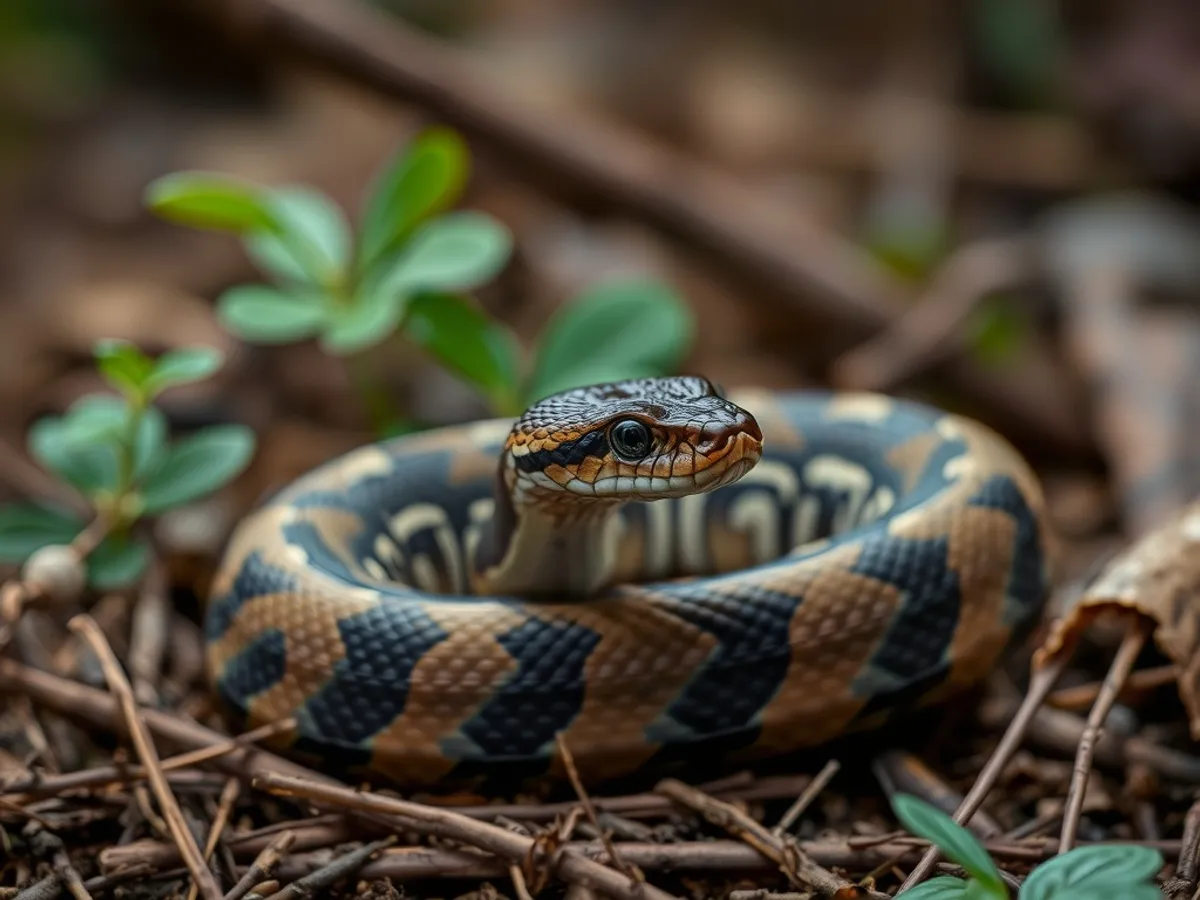
About the Dumeril's Boa
Dumeril's Boa is a non-venomous, heavy-bodied snake native to the island of Madagascar. It is known for its distinctive brown and gray coloration, which provides excellent camouflage among leaf litter on the forest floor. Growing up to 2 meters (6.5 feet) in length, this boa is mostly terrestrial and relies on ambush hunting to capture prey such as birds, mammals, and occasionally reptiles. Unlike many other boas, Dumeril's Boa gives birth to live young rather than laying eggs, and it plays an important role in controlling rodent populations within its habitat.
Fascinating facts
Excellent Camouflage
The intricate brown and gray patterning on Dumeril's Boa helps it blend seamlessly into the leaf litter of Madagascar's forests.
Gentle Giant
Despite its size, Dumeril's Boa is known for its calm demeanor and rarely shows aggression, even in the wild.
Live Birth
Female Dumeril's Boas give birth to live young, with litters ranging from 6 to 28 babies at a time.
Detailed description
Dumeril's Boa (Acrantophis dumerili) is a robust, medium-to-large constrictor endemic to the southwestern dry forests and scrublands of Madagascar. Adults typically range from 1.5 to 2 meters in length, though exceptional individuals may reach up to 2.5 meters. The species exhibits a distinctive cryptic coloration, with a base of grayish-brown to reddish-brown overlaid with irregular dark blotches and lighter patches, providing effective camouflage against the leaf litter and forest floor. The head is broad and triangular, with heat-sensitive labial pits along the upper and lower jaws, aiding in the detection of warm-blooded prey. Dumeril's Boa is primarily terrestrial but may occasionally climb low vegetation. Its muscular body is well-adapted for constriction, and the tail is relatively short and blunt. The eyes are medium-sized with vertical pupils, reflecting its crepuscular and nocturnal habits. Unlike many other boids, this species is ovoviviparous, giving birth to live young, which are independent from birth. Dumeril's Boa plays a key ecological role as a mid-level predator, helping to regulate populations of small mammals, birds, and reptiles in its native habitat.
Did you know?
Unlike many boas, Dumeril's Boa is ovoviviparous, meaning it gives birth to live young instead of laying eggs.
Research & sources
Wikipedia summary
Acrantophis dumerili, commonly known as Dumeril's boa, is a species of non-venomous snake in the family Boidae. The species is endemic to Madagascar. No subspecies are currently recognized.
Behaviour & social structure
Dumeril's Boa is predominantly solitary and exhibits secretive, ambush-based predatory behavior. It spends much of the day concealed under leaf litter, fallen logs, or within burrows, becoming more active at dusk and during the night. The species relies on its camouflage and patience, remaining motionless for extended periods until suitable prey approaches. Upon detecting prey, it strikes rapidly, securing the animal with its jaws before coiling its body around the victim to suffocate it via constriction. Feeding occurs infrequently, with adults consuming prey items such as rodents, tenrecs, small lemurs, ground-dwelling birds, and occasionally reptiles. Juveniles focus on smaller prey, including lizards and nestling birds. Social interactions are limited outside of the breeding season, and individuals may display defensive behaviors such as hissing, body inflation, and mock strikes when threatened. Dumeril's Boa is not aggressive by nature and rarely bites unless provoked.
Reproduction & life cycle
Breeding in Dumeril's Boa typically occurs during the austral spring (September to November), coinciding with the onset of the rainy season. Males locate receptive females by following pheromone trails, and courtship involves tongue-flicking, body alignment, and gentle nudging. Copulation may last several hours. Females are ovoviviparous, retaining fertilized eggs internally until the young are fully developed. Gestation lasts approximately 6 to 8 months, after which the female gives birth to 6–28 live young, each measuring 30–40 cm in length. Neonates are fully independent at birth and receive no parental care. Sexual maturity is typically reached at 3–5 years of age, depending on growth rates and environmental conditions. Reproductive frequency may be biennial, as females often require significant time to recover energy reserves after giving birth.
Adaptations & survival
Dumeril's Boa possesses several adaptations for survival in Madagascar's dry forests. Its cryptic coloration and patterning provide exceptional camouflage, reducing predation risk and enhancing ambush hunting success. The heat-sensitive pits along the jaws allow detection of endothermic prey even in low-light conditions. Its muscular body and powerful constriction ability enable it to subdue relatively large prey. The species' ovoviviparous reproductive strategy is advantageous in unpredictable environments, as it eliminates the need to find secure nesting sites and protects developing young from desiccation and predation. Additionally, Dumeril's Boa can withstand periods of food scarcity by lowering its metabolic rate and surviving on infrequent, large meals.
Cultural significance
Dumeril's Boa holds a mixed reputation in Malagasy culture. While some local communities regard snakes with fear or suspicion, associating them with omens or taboos (fady), others recognize their ecological importance in controlling pest populations. There are no widespread traditions of using Dumeril's Boa in medicine or ritual, though occasional hunting for meat or perceived medicinal value has been reported. The species is sometimes featured in local folklore, often as a symbol of stealth or transformation.
Recent research
Recent research on Dumeril's Boa has focused on its population genetics, revealing moderate genetic diversity and some population structuring across its range, likely due to habitat fragmentation. Studies on thermal ecology indicate that the species selects microhabitats with stable temperatures and humidity, crucial for physiological regulation in Madagascar's variable climate. Ongoing research is investigating the impacts of habitat loss and fragmentation on movement patterns and reproductive success. Additionally, Dumeril's Boa is used as a model species in studies of boid evolution and reproductive strategies. Conservation genetics and ecological monitoring are priorities for ensuring the species' long-term viability.
Videos
Habitat
Dry forest and scrubland

Conservation
The Dumeril's Boa is currently classified as Least Concern on the IUCN Red List.
Threats & challenges
Although currently classified as Least Concern by the IUCN, Dumeril's Boa faces several threats. Habitat loss due to slash-and-burn agriculture (tavy), charcoal production, and deforestation is a significant concern, leading to fragmentation of its range. The species is also subject to collection for the international pet trade, though this is regulated. Local hunting for food and traditional medicine occurs but is not widespread. Introduced predators and competition with invasive species may pose additional risks. Despite these pressures, the species remains relatively widespread and adaptable, but ongoing habitat degradation could impact future population stability. Conservation efforts focus on habitat protection, enforcement of trade regulations, and community education.
Taxonomy
Scientific name
Acrantophis dumerili
- Kingdom
- Animalia
- Phylum
- Chordata
- Class
- Reptilia
- Order
- Squamata
- Family
- Boidae
- Genus
- Acrantophis
- Species
- dumerili
Where to see a dumeril's boa
2 zoos and aquariums in 2 countries are recorded as keeping this species.
Community notes
Share your observations about the Dumeril's Boa.
No community notes yet. Be the first!
Discover more wildlife
More fascinating animals from the encyclopedia.