
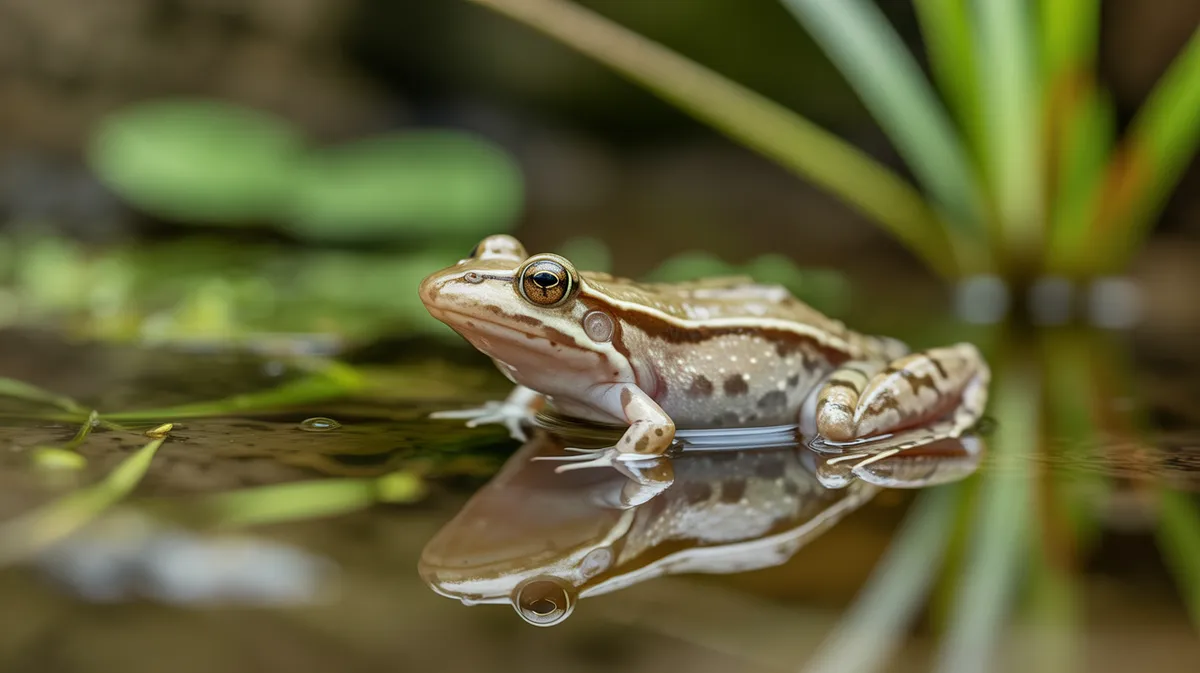
About the Dwarf African Clawed Frog
The Dwarf African Clawed Frog is a small, fully aquatic amphibian native to the slow-moving rivers, swamps, and ponds of Central and West Africa. It has a slender, flattened body with webbed feet and smooth, olive or brownish skin, often speckled with darker spots for camouflage. Unlike the larger African Clawed Frog, this species remains diminutive, rarely exceeding 4 centimeters in length. Its gentle nature and adaptability to aquarium life make it a popular pet, but in the wild it plays an important role as both predator and prey in freshwater ecosystems.
Fascinating facts
Fully Aquatic
Dwarf African Clawed Frogs spend their entire lives in the water and are unable to survive for long on land.
Clawed Toes
Their hind feet have sharp claws that help them stir up substrate and catch prey in their muddy, aquatic habitats.
No Tongue
These frogs do not have tongues; instead, they use their small hands to push food directly into their mouths.
Detailed description
The Dwarf African Clawed Frog (Hymenochirus boettgeri) is a diminutive, fully aquatic amphibian characterized by a slender, flattened body and a maximum snout-vent length of approximately 3.5–4.2 cm. Its skin is smooth and typically olive to brownish in color, often adorned with irregular dark spots that provide effective camouflage among submerged vegetation and leaf litter. The species is distinguished by its highly webbed hind feet, which aid in swimming, and unwebbed, slender forelimbs. Unlike its larger relative Xenopus laevis, H. boettgeri lacks claws on its hind feet, instead possessing small, keratinized tips. Its eyes are positioned dorsally and laterally, providing a wide field of vision for detecting predators and prey. The frog is entirely aquatic, rarely venturing onto land, and relies on cutaneous respiration in addition to rudimentary lungs. It is primarily nocturnal, remaining hidden during the day and becoming active at dusk. Socially, these frogs are generally gregarious, often found in small groups, but exhibit minimal territoriality. Their vocalizations, produced by males during the breeding season, are a series of rapid clicks or trills used to attract females. The species plays a vital ecological role as both predator of small aquatic invertebrates and prey for fish, birds, and larger amphibians.
Did you know?
Unlike most frogs, Dwarf African Clawed Frogs lack tongues and use their tiny, clawed forelimbs to help stuff food into their mouths.
Research & sources
Behaviour & social structure
Hymenochirus boettgeri exhibits predominantly nocturnal activity, emerging at dusk to forage and interact. It is an opportunistic carnivore, feeding on small aquatic invertebrates such as insect larvae, worms, crustaceans, and occasionally zooplankton. The frog employs a sit-and-wait hunting strategy, remaining motionless before lunging at prey with a rapid extension of its sticky tongue or by using its forelimbs to shovel food into its mouth. Social interactions are generally peaceful, with individuals tolerating close proximity to conspecifics, especially outside the breeding season. Males become more vocal during breeding, producing distinctive clicking calls underwater. The species is known for its 'piping' behavior, where males inflate their throats to amplify calls. Daily routines involve periods of rest among aquatic plants or substrate during daylight, with increased locomotion and foraging at night. The species is sensitive to water quality and prefers habitats with abundant cover and minimal current.
Reproduction & life cycle
Breeding in Hymenochirus boettgeri is closely linked to seasonal rainfall, typically occurring during the wet season when water levels rise. Males initiate courtship by producing a series of rapid, rhythmic clicking calls to attract females. Amplexus is axillary, with the male grasping the female just behind her forelimbs. Fertilization is external; the female releases eggs into the water, which are immediately fertilized by the male. Clutch sizes can range from 100 to 500 eggs, which are adhesive and attach to submerged vegetation or debris. Embryonic development is rapid, with hatching occurring within 2–3 days at optimal temperatures (22–26°C). Tadpoles are free-swimming and filter-feeding, undergoing metamorphosis into juvenile frogs within 6–8 weeks. There is no parental care post-oviposition, and survival rates are influenced by predation and environmental conditions. Sexual maturity is typically reached within 6–12 months, depending on food availability and temperature.
Adaptations & survival
Hymenochirus boettgeri is highly adapted to an aquatic lifestyle. Its streamlined body and fully webbed hind feet facilitate efficient swimming and maneuverability in dense aquatic vegetation. The species possesses a lateral line system, allowing it to detect vibrations and movements in the water, which is crucial for prey detection and predator avoidance. Cutaneous respiration is well developed, enabling the frog to absorb oxygen directly through its skin, an adaptation for low-oxygen environments. Its cryptic coloration provides camouflage against predators. The absence of claws, unlike Xenopus species, may reduce noise and disturbance when moving through fine substrates. Behavioral adaptations include nocturnality to avoid diurnal predators and the use of vocalizations for mate attraction in turbid or vegetated waters where visual cues are limited.
Cultural significance
The Dwarf African Clawed Frog has limited direct cultural significance in its native range but has become popular globally as an aquarium pet due to its small size, peaceful nature, and ease of care. In scientific research, it is occasionally used as a model organism for studies on amphibian physiology and development, although less so than Xenopus species. There are no known traditional uses or significant roles in local mythology or folklore. Its presence in the pet trade has contributed to public awareness of amphibian diversity and the importance of aquatic habitats.
Recent research
Recent research on Hymenochirus boettgeri has focused on its unique vocalization mechanisms, which differ from those of other pipid frogs, and its sensory adaptations for aquatic life. Studies have investigated the species' lateral line system and its role in prey detection. Genetic analyses have clarified its taxonomic relationships within the Pipidae family, revealing cryptic diversity among Hymenochirus populations. Ongoing research is examining the impacts of environmental contaminants on reproductive success and larval development, as well as the species' potential as a bioindicator for freshwater ecosystem health. Additionally, there is interest in the frog's resistance to chytridiomycosis, a fungal disease devastating to many amphibian populations.
Sources
Hymenochirus boettgeri: The IUCN Red List of Threatened Species 2016
IUCN SSC Amphibian Specialist Group
conservationSystematics and Natural History of African Dwarf Clawed Frogs (Hymenochirus: Pipidae)
Evans, B.J., Carter, T.F., Greenbaum, E., Gvoždík, V., Kelley, D.B., McLaughlin, P.J., Pauwels, O.S.G., Portik, D.M., Stanley, E.L., Tinsley, R.C., Tobias, M.L., Blackburn, D.C. (2015)
scientificHymenochirus boettgeri: The IUCN Red List of Threatened Species 2016
IUCN SSC Amphibian Specialist Group
conservationSystematics and Natural History of African Dwarf Clawed Frogs (Hymenochirus, Pipidae)
Evans, B.J., et al. (2015)
scientificVideos
Habitat
Freshwater ponds, swamps, and slow-moving streams

Conservation
The Dwarf African Clawed Frog is currently classified as Least Concern on the IUCN Red List.
Threats & challenges
Currently assessed as Least Concern by the IUCN, Hymenochirus boettgeri faces localized threats from habitat degradation, pollution, and the introduction of predatory fish species. Agricultural runoff and pesticide contamination can negatively impact water quality, affecting both adults and developing larvae. Collection for the pet trade, while regulated, has not yet resulted in significant population declines but requires ongoing monitoring. Climate change poses a potential long-term threat through alterations in rainfall patterns and water availability. Despite these challenges, the species remains widespread and adaptable, with stable populations across much of its range. Continued habitat loss and water pollution, however, could pose future risks.
Taxonomy
Scientific name
Hymenochirus boettgeri
- Kingdom
- Animalia
- Phylum
- Chordata
- Class
- Amphibia
- Order
- Anura
- Family
- Pipidae
- Genus
- Hymenochirus
- Species
- boettgeri
Where to see a dwarf african clawed frog
1 zoo and aquarium in 1 country are recorded as keeping this species.
Community notes
Share your observations about the Dwarf African Clawed Frog.
No community notes yet. Be the first!
Discover more wildlife
More fascinating animals from the encyclopedia.