
About the Eastern Bluebird
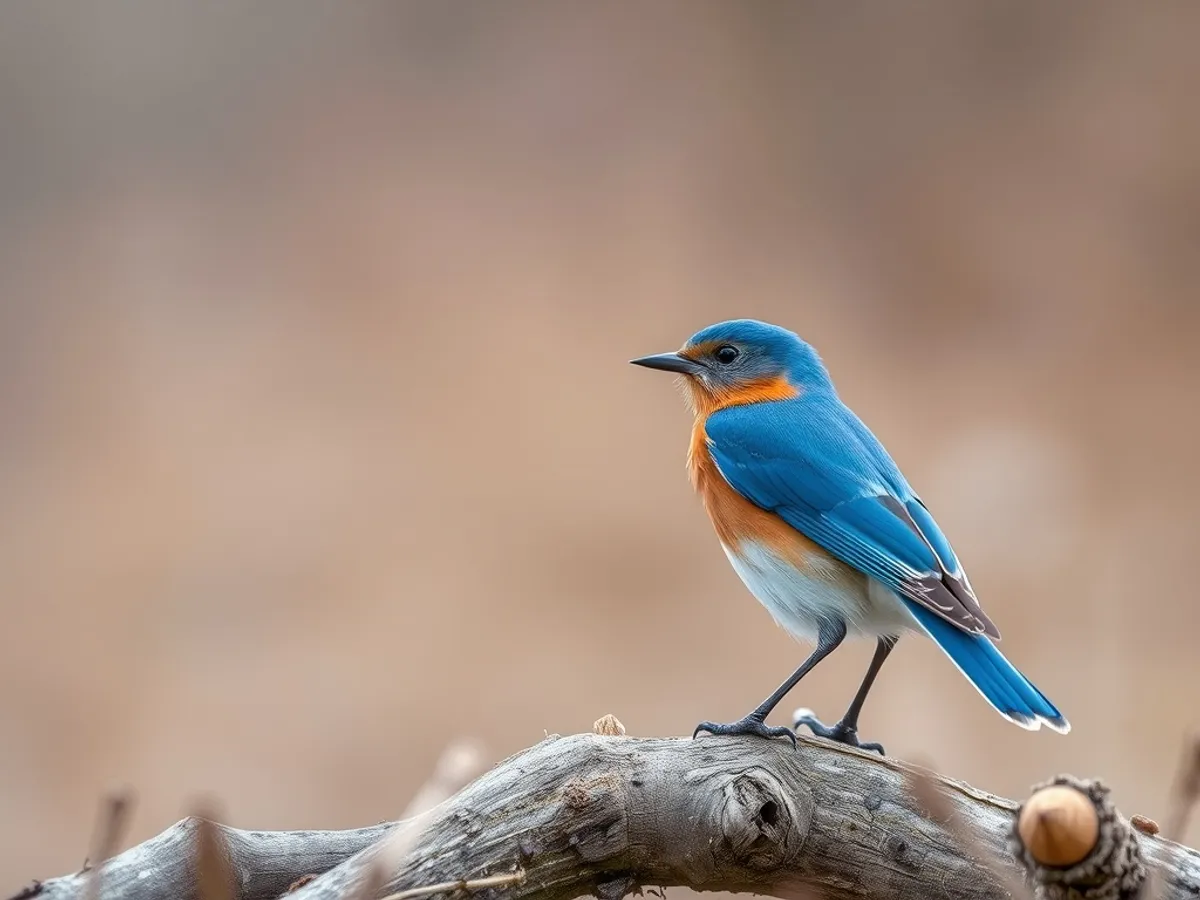
The Eastern Bluebird is a small, brightly colored thrush native to North America. Males are easily recognized by their vibrant blue upperparts and rusty red throats and breasts, while females display more subdued hues. These birds are beloved for their gentle nature and melodic songs, often found perched on fences or nesting in open woodlands, fields, and orchards. Eastern Bluebirds are cavity nesters, frequently relying on natural holes or nest boxes for breeding. Their populations have rebounded after conservation efforts, making them a common sight in suitable habitats.
Fascinating facts
Nest Box Success
Eastern Bluebirds readily use nest boxes, which helped their populations recover after a decline caused by habitat loss and competition with invasive species.
Melodic Singers
Both male and female Eastern Bluebirds sing, though males are especially vocal during the breeding season to attract mates and defend territory.
Insect Controllers
Their diet includes a large number of insects such as beetles, caterpillars, and grasshoppers, making them valuable for natural pest control.
Detailed description
The Eastern Bluebird (Sialia sialis) is a small thrush, measuring 16–21 cm (6.3–8.3 in) in length, with a wingspan of 25–32 cm (9.8–12.6 in) and weighing 27–34 g (0.95–1.20 oz). Males are strikingly colored, with deep blue upperparts and a rusty or brick-red throat and breast, while females are paler, with grayish-blue wings and tail, and a lighter brownish-orange breast. Their bills are short and straight, adapted for catching insects and picking fruit. Eastern Bluebirds have large eyes relative to their head size, enhancing their ability to spot prey from perches. Their legs and feet are strong, suited for perching and hopping on the ground. These birds are primarily diurnal, active from dawn to dusk, and exhibit a gentle, inquisitive demeanor. They are vocal, producing a variety of soft warbles, whistles, and chattering calls, especially during the breeding season. Socially, Eastern Bluebirds are often seen in small family groups or loose flocks outside the breeding season, and they display territorial behavior during nesting. Their life expectancy in the wild averages 6–10 years, though many succumb to predation or environmental hazards earlier.
Did you know?
The Eastern Bluebird was once in severe decline but recovered significantly due to nest box campaigns by bird enthusiasts.
Research & sources
Wikipedia summary
The eastern bluebird is a small North American migratory thrush found in open woodlands, farmlands, and orchards.
Behaviour & social structure
Eastern Bluebirds are primarily insectivorous during the breeding season, feeding on beetles, caterpillars, grasshoppers, and spiders, which they spot from low perches before swooping down to capture. In colder months, their diet shifts to include a higher proportion of fruits and berries, such as dogwood, sumac, and wild grapes. They exhibit 'sit-and-wait' foraging, perching quietly and scanning for movement. Bluebirds are territorial during nesting, with males singing and displaying to defend their area. Courtship involves males fluttering their wings and presenting nesting sites to females. Outside the breeding season, they may form loose flocks, sometimes joining with other thrushes or starlings. They are known for their gentle social interactions within family units, often with juveniles from previous broods helping to feed younger siblings. Daily routines include early morning and late afternoon foraging, midday resting, and frequent preening to maintain plumage.
Reproduction & life cycle
Eastern Bluebirds are seasonally monogamous, with pairs forming in late winter or early spring. The breeding season typically runs from March to August, varying by latitude. Females select and prepare the nest site, usually in natural tree cavities or nest boxes, lining it with grasses and pine needles. Clutch size ranges from 3 to 7 pale blue (occasionally white) eggs. Incubation, performed solely by the female, lasts 12–14 days. Both parents feed the altricial chicks, which fledge at about 16–21 days old. Pairs may raise two or three broods per season, with older fledglings sometimes assisting in feeding subsequent broods. High rates of nest predation and competition for cavities can impact reproductive success.
Adaptations & survival
Eastern Bluebirds possess several adaptations for their open-country lifestyle. Their keen eyesight allows them to detect small prey from a distance, while their agile flight and strong legs facilitate rapid ground foraging. Their cavity-nesting behavior reduces predation risk compared to open-nesting species. Seasonal dietary flexibility—shifting from insects to fruits—enables survival during periods of insect scarcity. Their plumage provides camouflage against sky and foliage, especially for females on the nest. Vocalizations serve both territory defense and mate attraction, with complex songs and calls adapted for long-distance communication in open habitats.
Cultural significance
The Eastern Bluebird holds a cherished place in North American culture, symbolizing happiness, hope, and renewal. It is the state bird of Missouri and New York, and features prominently in folklore, literature, and music. The phrase 'bluebird of happiness' is widely recognized, and bluebirds are often associated with the arrival of spring. Conservation efforts for bluebirds have fostered community engagement and environmental stewardship, with nest box trails becoming a popular citizen science activity.
Recent research
Recent research on Eastern Bluebirds has focused on the effects of climate change on breeding phenology, with some populations initiating nesting earlier in response to warmer springs. Studies have also examined the role of supplemental feeding and nest box design in reproductive success. Genetic analyses have revealed low levels of hybridization with Western and Mountain Bluebirds in areas of range overlap. Ongoing monitoring projects track population trends, migration patterns (using geolocators), and the impacts of urbanization. Behavioral studies continue to explore cooperative breeding, extra-pair paternity, and the influence of environmental contaminants on reproductive health.
Videos
Habitat
Open woodlands, fields, and farmlands with scattered trees


Conservation
The Eastern Bluebird is currently classified as Least Concern on the IUCN Red List.
Threats & challenges
Historically, Eastern Bluebird populations declined due to habitat loss, pesticide use, and competition with invasive cavity-nesters like European Starlings and House Sparrows. Modern threats include continued habitat fragmentation, window collisions, and predation by domestic cats and raccoons. However, widespread nest box programs and public awareness campaigns have led to significant population recovery since the 1970s. The species is currently listed as Least Concern by the IUCN, with stable or increasing populations across much of its range. Ongoing challenges include maintaining suitable nesting sites and mitigating the impacts of climate change on food availability and breeding phenology.
Taxonomy
Scientific name
Sialia sialis
- Kingdom
- Animalia
- Phylum
- Chordata
- Class
- Aves
- Order
- Passeriformes
- Family
- Turdidae
- Genus
- Sialia
- Species
- sialis
Community notes
Share your observations about the Eastern Bluebird.
No community notes yet. Be the first!
Discover more wildlife
More fascinating animals from the encyclopedia.